

Oxidation, Reduction, and Deoxygenation
2.2
207
⊡ Table 9
Reduction of 2-keto-α-D-glucoside
Reagent Solvent
E:A
NaBH 4
H 2 O/dioxane
96:4
(BH 3 ) 2
THF
94:6
H 2 , Pd/C
EtOH
32:68
H 2 , Rh/C
EtOH
20:80
⊡ Table 10
Reduction of 2-ketoximes
R
Reagent
Solvent
E:A
H
H 2 , Pd/C, HCl MeOH
1:1
H
LiAlH 4
THF
2:3
H
(BH 3 ) 2
THF
7:3
Ac
(BH 3 ) 2
THF
95:5
catalytic hydrogenation over various metals [154]. The oxime carbon is not as electrophilic as
a ketone carbon, and as a result sodium borohydride alone does not reduce an oxime. However, in the presence of an additive such as nickel(II) chloride, titanium(III) chloride, or titanium(IV) chloride, borohydrides will also perform oxime reductions [2]. Like other oximes,
carbohydrate oximes are also usually prepared from the corresponding ketone. Oximes at C2,
however, can also be prepared by nitrosochlorination of glycals followed by reaction with
alcohols [184]. The stereoselectivity in the oxime to amine reduction is often similar to the
one obtained in the reduction of the corresponding ketone, which has been described in the
previous section.
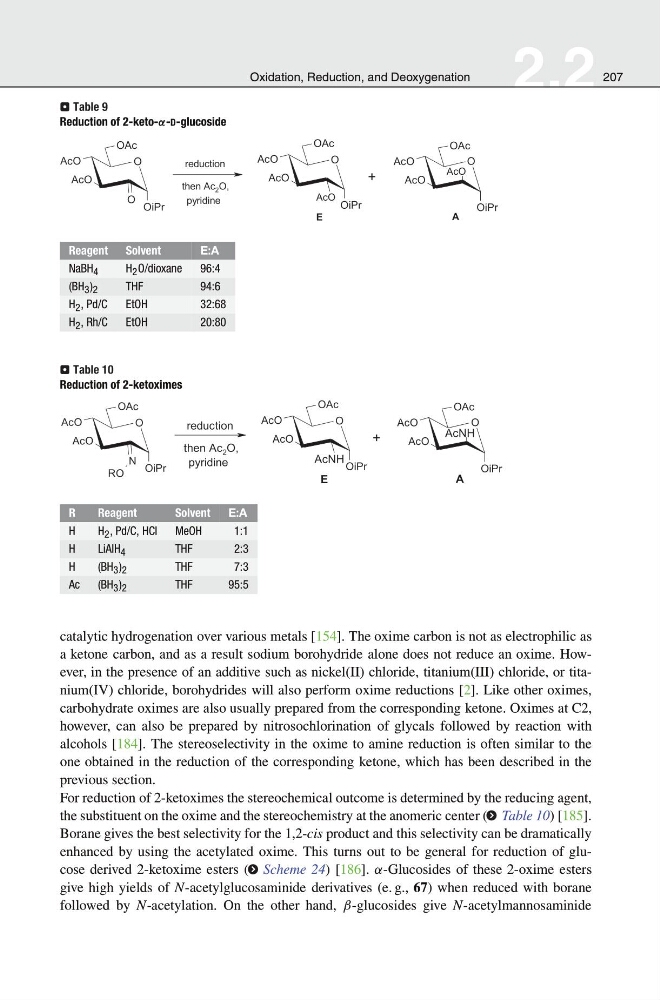
For reduction of 2-ketoximes the stereochemical outcome is determined by the reducing agent,
the substituent on the oxime and the stereochemistry at the anomeric center ( > Table 10) [185].
Borane gives the best selectivity for the 1,2-cis product and this selectivity can be dramatically
enhanced by using the acetylated oxime. This turns out to be general for reduction of glucose derived 2-ketoxime esters ( > Scheme 24) [186]. α-Glucosides of these 2-oxime esters
give high yields of N-acetylglucosaminide derivatives (e. g., 67) when reduced with borane
followed by N-acetylation. On the other hand, β-glucosides give N-acetylmannosaminide
2.2
207
⊡ Table 9
Reduction of 2-keto-α-D-glucoside
Reagent Solvent
E:A
NaBH 4
H 2 O/dioxane
96:4
(BH 3 ) 2
THF
94:6
H 2 , Pd/C
EtOH
32:68
H 2 , Rh/C
EtOH
20:80
⊡ Table 10
Reduction of 2-ketoximes
R
Reagent
Solvent
E:A
H
H 2 , Pd/C, HCl MeOH
1:1
H
LiAlH 4
THF
2:3
H
(BH 3 ) 2
THF
7:3
Ac
(BH 3 ) 2
THF
95:5
catalytic hydrogenation over various metals [154]. The oxime carbon is not as electrophilic as
a ketone carbon, and as a result sodium borohydride alone does not reduce an oxime. However, in the presence of an additive such as nickel(II) chloride, titanium(III) chloride, or titanium(IV) chloride, borohydrides will also perform oxime reductions [2]. Like other oximes,
carbohydrate oximes are also usually prepared from the corresponding ketone. Oximes at C2,
however, can also be prepared by nitrosochlorination of glycals followed by reaction with
alcohols [184]. The stereoselectivity in the oxime to amine reduction is often similar to the
one obtained in the reduction of the corresponding ketone, which has been described in the
previous section.
For reduction of 2-ketoximes the stereochemical outcome is determined by the reducing agent,
the substituent on the oxime and the stereochemistry at the anomeric center ( > Table 10) [185].
Borane gives the best selectivity for the 1,2-cis product and this selectivity can be dramatically
enhanced by using the acetylated oxime. This turns out to be general for reduction of glucose derived 2-ketoxime esters ( > Scheme 24) [186]. α-Glucosides of these 2-oxime esters
give high yields of N-acetylglucosaminide derivatives (e. g., 67) when reduced with borane
followed by N-acetylation. On the other hand, β-glucosides give N-acetylmannosaminide