

Oxidation, Reduction, and Deoxygenation
2.2
205
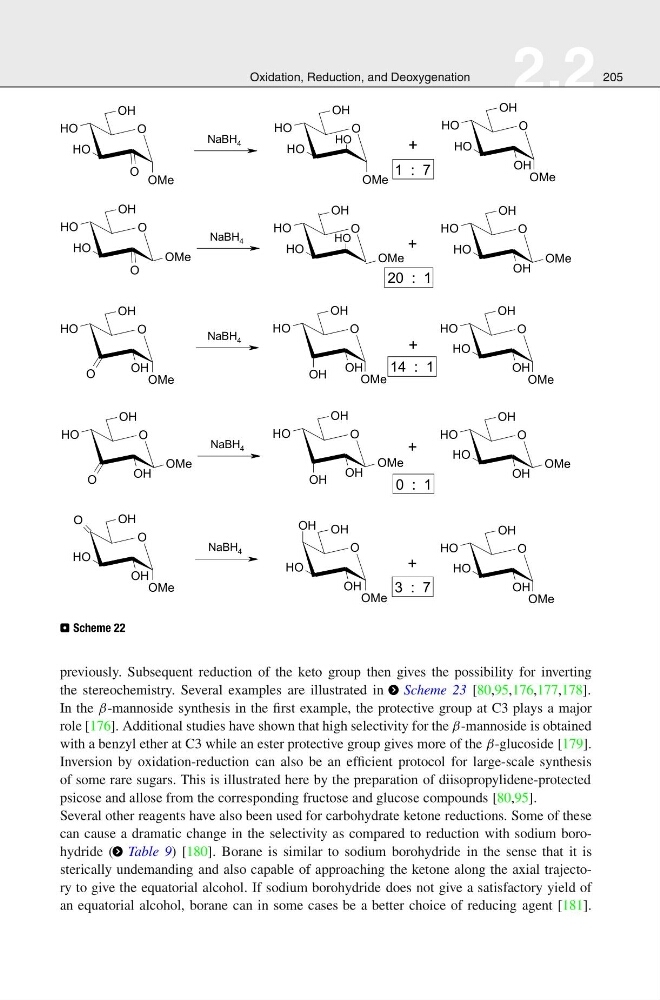
⊡ Scheme 22
previously. Subsequent reduction of the keto group then gives the possibility for inverting
the stereochemistry. Several examples are illustrated in > Scheme 23 [80,95,176,177,178].
In the β-mannoside synthesis in the first example, the protective group at C3 plays a major
role [176]. Additional studies have shown that high selectivity for the β-mannoside is obtained
with a benzyl ether at C3 while an ester protective group gives more of the β-glucoside [179].
Inversion by oxidation-reduction can also be an efficient protocol for large-scale synthesis
of some rare sugars. This is illustrated here by the preparation of diisopropylidene-protected
psicose and allose from the corresponding fructose and glucose compounds [80,95].
Several other reagents have also been used for carbohydrate ketone reductions. Some of these
can cause a dramatic change in the selectivity as compared to reduction with sodium borohydride ( > Table 9) [180]. Borane is similar to sodium borohydride in the sense that it is
sterically undemanding and also capable of approaching the ketone along the axial trajectory to give the equatorial alcohol. If sodium borohydride does not give a satisfactory yield of
an equatorial alcohol, borane can in some cases be a better choice of reducing agent [181].
2.2
205
⊡ Scheme 22
previously. Subsequent reduction of the keto group then gives the possibility for inverting
the stereochemistry. Several examples are illustrated in > Scheme 23 [80,95,176,177,178].
In the β-mannoside synthesis in the first example, the protective group at C3 plays a major
role [176]. Additional studies have shown that high selectivity for the β-mannoside is obtained
with a benzyl ether at C3 while an ester protective group gives more of the β-glucoside [179].
Inversion by oxidation-reduction can also be an efficient protocol for large-scale synthesis
of some rare sugars. This is illustrated here by the preparation of diisopropylidene-protected
psicose and allose from the corresponding fructose and glucose compounds [80,95].
Several other reagents have also been used for carbohydrate ketone reductions. Some of these
can cause a dramatic change in the selectivity as compared to reduction with sodium borohydride ( > Table 9) [180]. Borane is similar to sodium borohydride in the sense that it is
sterically undemanding and also capable of approaching the ketone along the axial trajectory to give the equatorial alcohol. If sodium borohydride does not give a satisfactory yield of
an equatorial alcohol, borane can in some cases be a better choice of reducing agent [181].