

204
2
General Synthetic Methods
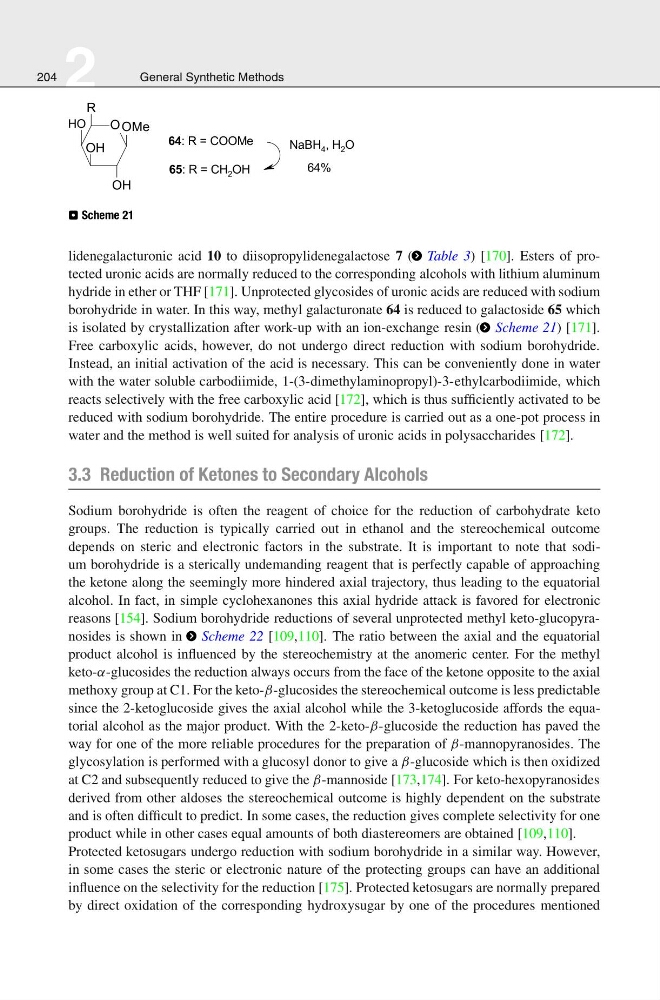
⊡ Scheme 21
lidenegalacturonic acid 10 to diisopropylidenegalactose 7 ( > Table 3) [170]. Esters of protected uronic acids are normally reduced to the corresponding alcohols with lithium aluminum
hydride in ether or THF [171]. Unprotected glycosides of uronic acids are reduced with sodium
borohydride in water. In this way, methyl galacturonate 64 is reduced to galactoside 65 which
is isolated by crystallization after work-up with an ion-exchange resin ( > Scheme 21) [171].
Free carboxylic acids, however, do not undergo direct reduction with sodium borohydride.
Instead, an initial activation of the acid is necessary. This can be conveniently done in water
with the water soluble carbodiimide, 1-(3-dimethylaminopropyl)-3-ethylcarbodiimide, which
reacts selectively with the free carboxylic acid [172], which is thus sufficiently activated to be
reduced with sodium borohydride. The entire procedure is carried out as a one-pot process in
water and the method is well suited for analysis of uronic acids in polysaccharides [172].
3.3 Reduction of Ketones to Secondary Alcohols
Sodium borohydride is often the reagent of choice for the reduction of carbohydrate keto
groups. The reduction is typically carried out in ethanol and the stereochemical outcome
depends on steric and electronic factors in the substrate. It is important to note that sodium borohydride is a sterically undemanding reagent that is perfectly capable of approaching
the ketone along the seemingly more hindered axial trajectory, thus leading to the equatorial
alcohol. In fact, in simple cyclohexanones this axial hydride attack is favored for electronic
reasons [154]. Sodium borohydride reductions of several unprotected methyl keto-glucopyranosides is shown in > Scheme 22 [109,110]. The ratio between the axial and the equatorial
product alcohol is influenced by the stereochemistry at the anomeric center. For the methyl
keto-α-glucosides the reduction always occurs from the face of the ketone opposite to the axial
methoxy group at C1. For the keto-β-glucosides the stereochemical outcome is less predictable
since the 2-ketoglucoside gives the axial alcohol while the 3-ketoglucoside affords the equatorial alcohol as the major product. With the 2-keto-β-glucoside the reduction has paved the
way for one of the more reliable procedures for the preparation of β-mannopyranosides. The
glycosylation is performed with a glucosyl donor to give a β-glucoside which is then oxidized
at C2 and subsequently reduced to give the β-mannoside [173,174]. For keto-hexopyranosides
derived from other aldoses the stereochemical outcome is highly dependent on the substrate
and is often difficult to predict. In some cases, the reduction gives complete selectivity for one
product while in other cases equal amounts of both diastereomers are obtained [109,110].
Protected ketosugars undergo reduction with sodium borohydride in a similar way. However,
in some cases the steric or electronic nature of the protecting groups can have an additional
influence on the selectivity for the reduction [175]. Protected ketosugars are normally prepared
by direct oxidation of the corresponding hydroxysugar by one of the procedures mentioned
2
General Synthetic Methods
⊡ Scheme 21
lidenegalacturonic acid 10 to diisopropylidenegalactose 7 ( > Table 3) [170]. Esters of protected uronic acids are normally reduced to the corresponding alcohols with lithium aluminum
hydride in ether or THF [171]. Unprotected glycosides of uronic acids are reduced with sodium
borohydride in water. In this way, methyl galacturonate 64 is reduced to galactoside 65 which
is isolated by crystallization after work-up with an ion-exchange resin ( > Scheme 21) [171].
Free carboxylic acids, however, do not undergo direct reduction with sodium borohydride.
Instead, an initial activation of the acid is necessary. This can be conveniently done in water
with the water soluble carbodiimide, 1-(3-dimethylaminopropyl)-3-ethylcarbodiimide, which
reacts selectively with the free carboxylic acid [172], which is thus sufficiently activated to be
reduced with sodium borohydride. The entire procedure is carried out as a one-pot process in
water and the method is well suited for analysis of uronic acids in polysaccharides [172].
3.3 Reduction of Ketones to Secondary Alcohols
Sodium borohydride is often the reagent of choice for the reduction of carbohydrate keto
groups. The reduction is typically carried out in ethanol and the stereochemical outcome
depends on steric and electronic factors in the substrate. It is important to note that sodium borohydride is a sterically undemanding reagent that is perfectly capable of approaching
the ketone along the seemingly more hindered axial trajectory, thus leading to the equatorial
alcohol. In fact, in simple cyclohexanones this axial hydride attack is favored for electronic
reasons [154]. Sodium borohydride reductions of several unprotected methyl keto-glucopyranosides is shown in > Scheme 22 [109,110]. The ratio between the axial and the equatorial
product alcohol is influenced by the stereochemistry at the anomeric center. For the methyl
keto-α-glucosides the reduction always occurs from the face of the ketone opposite to the axial
methoxy group at C1. For the keto-β-glucosides the stereochemical outcome is less predictable
since the 2-ketoglucoside gives the axial alcohol while the 3-ketoglucoside affords the equatorial alcohol as the major product. With the 2-keto-β-glucoside the reduction has paved the
way for one of the more reliable procedures for the preparation of β-mannopyranosides. The
glycosylation is performed with a glucosyl donor to give a β-glucoside which is then oxidized
at C2 and subsequently reduced to give the β-mannoside [173,174]. For keto-hexopyranosides
derived from other aldoses the stereochemical outcome is highly dependent on the substrate
and is often difficult to predict. In some cases, the reduction gives complete selectivity for one
product while in other cases equal amounts of both diastereomers are obtained [109,110].
Protected ketosugars undergo reduction with sodium borohydride in a similar way. However,
in some cases the steric or electronic nature of the protecting groups can have an additional
influence on the selectivity for the reduction [175]. Protected ketosugars are normally prepared
by direct oxidation of the corresponding hydroxysugar by one of the procedures mentioned