

Oxidation, Reduction, and Deoxygenation
2.2
203
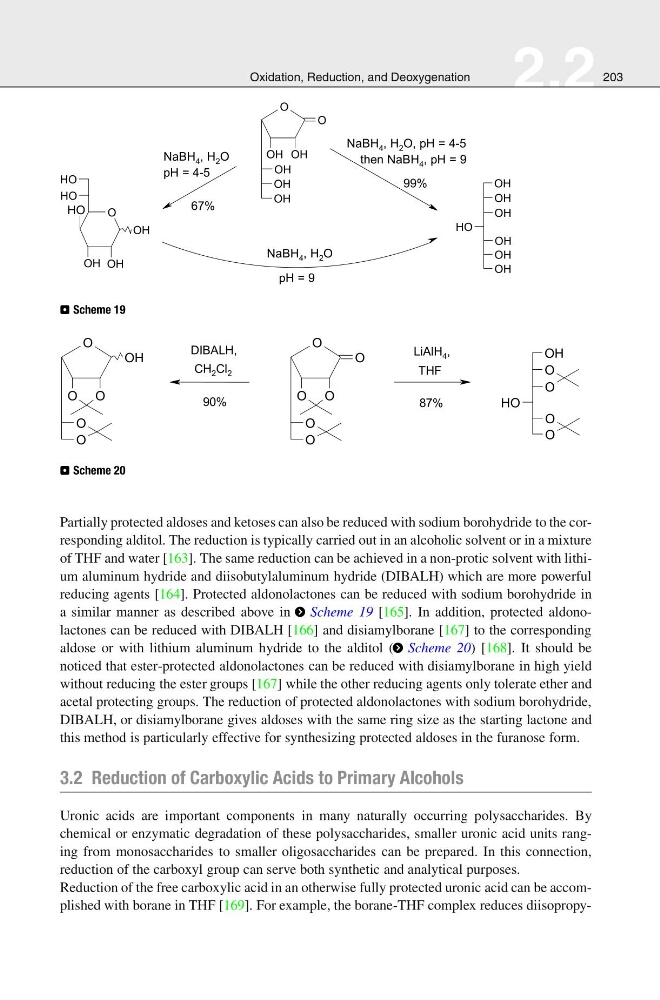
⊡ Scheme 19
⊡ Scheme 20
Partially protected aldoses and ketoses can also be reduced with sodium borohydride to the corresponding alditol. The reduction is typically carried out in an alcoholic solvent or in a mixture
of THF and water [163]. The same reduction can be achieved in a non-protic solvent with lithium aluminum hydride and diisobutylaluminum hydride (DIBALH) which are more powerful
reducing agents [164]. Protected aldonolactones can be reduced with sodium borohydride in
a similar manner as described above in > Scheme 19 [165]. In addition, protected aldonolactones can be reduced with DIBALH [166] and disiamylborane [167] to the corresponding
aldose or with lithium aluminum hydride to the alditol ( > Scheme 20) [168]. It should be
noticed that ester-protected aldonolactones can be reduced with disiamylborane in high yield
without reducing the ester groups [167] while the other reducing agents only tolerate ether and
acetal protecting groups. The reduction of protected aldonolactones with sodium borohydride,
DIBALH, or disiamylborane gives aldoses with the same ring size as the starting lactone and
this method is particularly effective for synthesizing protected aldoses in the furanose form.
3.2 Reduction of Carboxylic Acids to Primary Alcohols
Uronic acids are important components in many naturally occurring polysaccharides. By
chemical or enzymatic degradation of these polysaccharides, smaller uronic acid units ranging from monosaccharides to smaller oligosaccharides can be prepared. In this connection,
reduction of the carboxyl group can serve both synthetic and analytical purposes.
Reduction of the free carboxylic acid in an otherwise fully protected uronic acid can be accomplished with borane in THF [169]. For example, the borane-THF complex reduces diisopropy-
2.2
203
⊡ Scheme 19
⊡ Scheme 20
Partially protected aldoses and ketoses can also be reduced with sodium borohydride to the corresponding alditol. The reduction is typically carried out in an alcoholic solvent or in a mixture
of THF and water [163]. The same reduction can be achieved in a non-protic solvent with lithium aluminum hydride and diisobutylaluminum hydride (DIBALH) which are more powerful
reducing agents [164]. Protected aldonolactones can be reduced with sodium borohydride in
a similar manner as described above in > Scheme 19 [165]. In addition, protected aldonolactones can be reduced with DIBALH [166] and disiamylborane [167] to the corresponding
aldose or with lithium aluminum hydride to the alditol ( > Scheme 20) [168]. It should be
noticed that ester-protected aldonolactones can be reduced with disiamylborane in high yield
without reducing the ester groups [167] while the other reducing agents only tolerate ether and
acetal protecting groups. The reduction of protected aldonolactones with sodium borohydride,
DIBALH, or disiamylborane gives aldoses with the same ring size as the starting lactone and
this method is particularly effective for synthesizing protected aldoses in the furanose form.
3.2 Reduction of Carboxylic Acids to Primary Alcohols
Uronic acids are important components in many naturally occurring polysaccharides. By
chemical or enzymatic degradation of these polysaccharides, smaller uronic acid units ranging from monosaccharides to smaller oligosaccharides can be prepared. In this connection,
reduction of the carboxyl group can serve both synthetic and analytical purposes.
Reduction of the free carboxylic acid in an otherwise fully protected uronic acid can be accomplished with borane in THF [169]. For example, the borane-THF complex reduces diisopropy-