

Oxidation, Reduction, and Deoxygenation
2.2
193
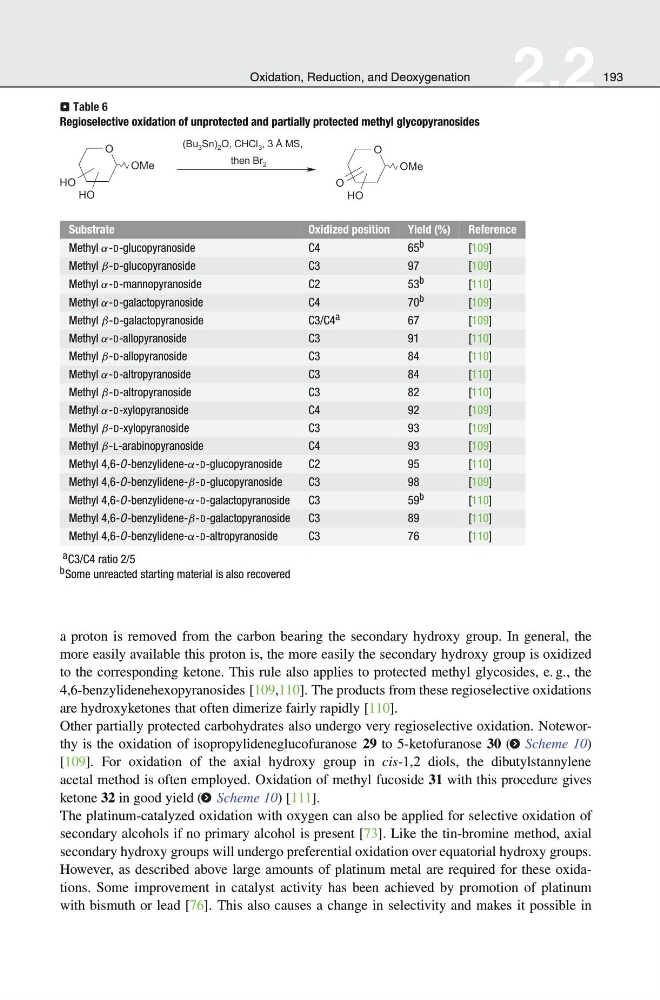
⊡ Table 6
Regioselective oxidation of unprotected and partially protected methyl glycopyranosides
Substrate
Oxidized position
Yield (%) Reference
Methyl α-D-glucopyranoside
C4
65 b
[109]
Methyl β-D-glucopyranoside
C3
97
[109]
Methyl α-D-mannopyranoside
C2
53 b
[110]
Methyl α-D-galactopyranoside
C4
70 b
[109]
Methyl β-D-galactopyranoside
C3/C4 a
67
[109]
Methyl α-D-allopyranoside
C3
91
[110]
Methyl β-D-allopyranoside
C3
84
[110]
Methyl α-D-altropyranoside
C3
84
[110]
Methyl β-D-altropyranoside
C3
82
[110]
Methyl α-D-xylopyranoside
C4
92
[109]
Methyl β-D-xylopyranoside
C3
93
[109]
Methyl β-L-arabinopyranoside
C4
93
[109]
Methyl 4,6-O-benzylidene-α-D-glucopyranoside
C2
95
[110]
Methyl 4,6-O-benzylidene-β-D-glucopyranoside
C3
98
[109]
Methyl 4,6-O-benzylidene-α-D-galactopyranoside
C3
59 b
[110]
Methyl 4,6-O-benzylidene-β-D-galactopyranoside
C3
89
[110]
Methyl 4,6-O-benzylidene-α-D-altropyranoside
C3
76
[110]
a C3/C4 ratio 2/5
b Some unreacted starting material is also recovered
a proton is removed from the carbon bearing the secondary hydroxy group. In general, the
more easily available this proton is, the more easily the secondary hydroxy group is oxidized
to the corresponding ketone. This rule also applies to protected methyl glycosides, e. g., the
4,6-benzylidenehexopyranosides [109,110]. The products from these regioselective oxidations
are hydroxyketones that often dimerize fairly rapidly [110].
Other partially protected carbohydrates also undergo very regioselective oxidation. Noteworthy is the oxidation of isopropylideneglucofuranose 29 to 5-ketofuranose 30 ( > Scheme 10)
[109]. For oxidation of the axial hydroxy group in cis-1,2 diols, the dibutylstannylene
acetal method is often employed. Oxidation of methyl fucoside 31 with this procedure gives
ketone 32 in good yield ( > Scheme 10) [111].
The platinum-catalyzed oxidation with oxygen can also be applied for selective oxidation of
secondary alcohols if no primary alcohol is present [73]. Like the tin-bromine method, axial
secondary hydroxy groups will undergo preferential oxidation over equatorial hydroxy groups.
However, as described above large amounts of platinum metal are required for these oxidations. Some improvement in catalyst activity has been achieved by promotion of platinum
with bismuth or lead [76]. This also causes a change in selectivity and makes it possible in
2.2
193
⊡ Table 6
Regioselective oxidation of unprotected and partially protected methyl glycopyranosides
Substrate
Oxidized position
Yield (%) Reference
Methyl α-D-glucopyranoside
C4
65 b
[109]
Methyl β-D-glucopyranoside
C3
97
[109]
Methyl α-D-mannopyranoside
C2
53 b
[110]
Methyl α-D-galactopyranoside
C4
70 b
[109]
Methyl β-D-galactopyranoside
C3/C4 a
67
[109]
Methyl α-D-allopyranoside
C3
91
[110]
Methyl β-D-allopyranoside
C3
84
[110]
Methyl α-D-altropyranoside
C3
84
[110]
Methyl β-D-altropyranoside
C3
82
[110]
Methyl α-D-xylopyranoside
C4
92
[109]
Methyl β-D-xylopyranoside
C3
93
[109]
Methyl β-L-arabinopyranoside
C4
93
[109]
Methyl 4,6-O-benzylidene-α-D-glucopyranoside
C2
95
[110]
Methyl 4,6-O-benzylidene-β-D-glucopyranoside
C3
98
[109]
Methyl 4,6-O-benzylidene-α-D-galactopyranoside
C3
59 b
[110]
Methyl 4,6-O-benzylidene-β-D-galactopyranoside
C3
89
[110]
Methyl 4,6-O-benzylidene-α-D-altropyranoside
C3
76
[110]
a C3/C4 ratio 2/5
b Some unreacted starting material is also recovered
a proton is removed from the carbon bearing the secondary hydroxy group. In general, the
more easily available this proton is, the more easily the secondary hydroxy group is oxidized
to the corresponding ketone. This rule also applies to protected methyl glycosides, e. g., the
4,6-benzylidenehexopyranosides [109,110]. The products from these regioselective oxidations
are hydroxyketones that often dimerize fairly rapidly [110].
Other partially protected carbohydrates also undergo very regioselective oxidation. Noteworthy is the oxidation of isopropylideneglucofuranose 29 to 5-ketofuranose 30 ( > Scheme 10)
[109]. For oxidation of the axial hydroxy group in cis-1,2 diols, the dibutylstannylene
acetal method is often employed. Oxidation of methyl fucoside 31 with this procedure gives
ketone 32 in good yield ( > Scheme 10) [111].
The platinum-catalyzed oxidation with oxygen can also be applied for selective oxidation of
secondary alcohols if no primary alcohol is present [73]. Like the tin-bromine method, axial
secondary hydroxy groups will undergo preferential oxidation over equatorial hydroxy groups.
However, as described above large amounts of platinum metal are required for these oxidations. Some improvement in catalyst activity has been achieved by promotion of platinum
with bismuth or lead [76]. This also causes a change in selectivity and makes it possible in