

192
2
General Synthetic Methods
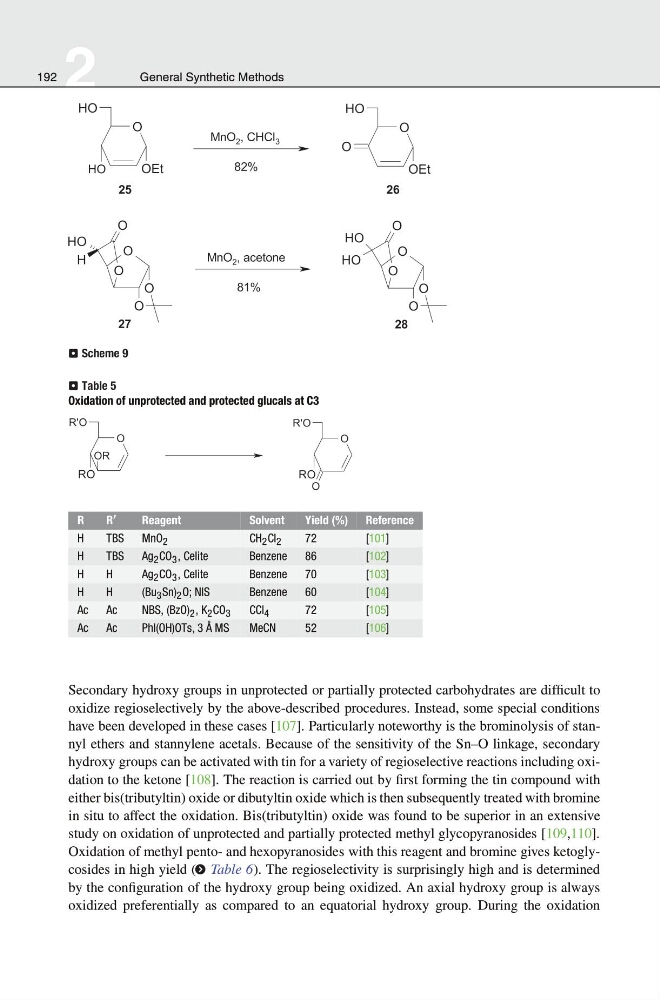
⊡ Scheme 9
⊡ Table 5
Oxidation of unprotected and protected glucals at C3
R
R
Reagent
Solvent
Yield (%) Reference
H
TBS
MnO 2
CH 2 Cl 2
72
[101]
H
TBS
Ag 2 CO 3 , Celite
Benzene 86
[102]
H
H
Ag 2 CO 3 , Celite
Benzene 70
[103]
H
H
(Bu 3 Sn) 2 O; NIS
Benzene 60
[104]
Ac
Ac
NBS, (BzO) 2 , K 2 CO 3
CCl 4
72
[105]
Ac
Ac
PhI(OH)OTs, 3 Å MS
MeCN
52
[106]
Secondary hydroxy groups in unprotected or partially protected carbohydrates are difficult to
oxidize regioselectively by the above-described procedures. Instead, some special conditions
have been developed in these cases [107]. Particularly noteworthy is the brominolysis of stannyl ethers and stannylene acetals. Because of the sensitivity of the Sn–O linkage, secondary
hydroxy groups can be activated with tin for a variety of regioselective reactions including oxidation to the ketone [108]. The reaction is carried out by first forming the tin compound with
either bis(tributyltin) oxide or dibutyltin oxide which is then subsequently treated with bromine
in situ to affect the oxidation. Bis(tributyltin) oxide was found to be superior in an extensive
study on oxidation of unprotected and partially protected methyl glycopyranosides [109,110].
Oxidation of methyl pento- and hexopyranosides with this reagent and bromine gives ketoglycosides in high yield ( > Table 6). The regioselectivity is surprisingly high and is determined
by the configuration of the hydroxy group being oxidized. An axial hydroxy group is always
oxidized preferentially as compared to an equatorial hydroxy group. During the oxidation
2
General Synthetic Methods
⊡ Scheme 9
⊡ Table 5
Oxidation of unprotected and protected glucals at C3
R
R
Reagent
Solvent
Yield (%) Reference
H
TBS
MnO 2
CH 2 Cl 2
72
[101]
H
TBS
Ag 2 CO 3 , Celite
Benzene 86
[102]
H
H
Ag 2 CO 3 , Celite
Benzene 70
[103]
H
H
(Bu 3 Sn) 2 O; NIS
Benzene 60
[104]
Ac
Ac
NBS, (BzO) 2 , K 2 CO 3
CCl 4
72
[105]
Ac
Ac
PhI(OH)OTs, 3 Å MS
MeCN
52
[106]
Secondary hydroxy groups in unprotected or partially protected carbohydrates are difficult to
oxidize regioselectively by the above-described procedures. Instead, some special conditions
have been developed in these cases [107]. Particularly noteworthy is the brominolysis of stannyl ethers and stannylene acetals. Because of the sensitivity of the Sn–O linkage, secondary
hydroxy groups can be activated with tin for a variety of regioselective reactions including oxidation to the ketone [108]. The reaction is carried out by first forming the tin compound with
either bis(tributyltin) oxide or dibutyltin oxide which is then subsequently treated with bromine
in situ to affect the oxidation. Bis(tributyltin) oxide was found to be superior in an extensive
study on oxidation of unprotected and partially protected methyl glycopyranosides [109,110].
Oxidation of methyl pento- and hexopyranosides with this reagent and bromine gives ketoglycosides in high yield ( > Table 6). The regioselectivity is surprisingly high and is determined
by the configuration of the hydroxy group being oxidized. An axial hydroxy group is always
oxidized preferentially as compared to an equatorial hydroxy group. During the oxidation