

194
2
General Synthetic Methods
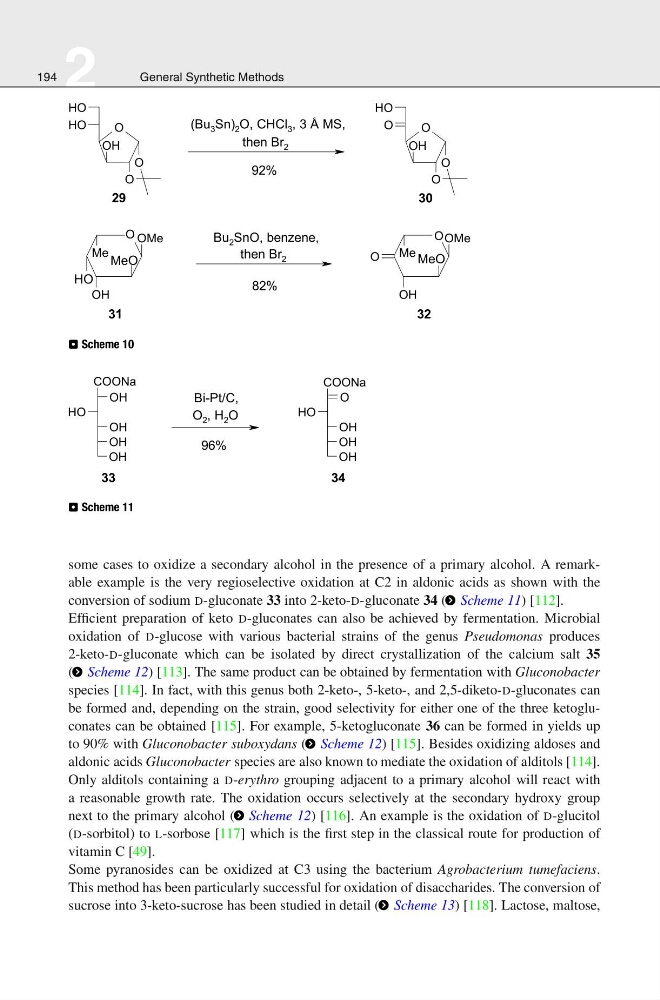
⊡ Scheme 10
⊡ Scheme 11
some cases to oxidize a secondary alcohol in the presence of a primary alcohol. A remarkable example is the very regioselective oxidation at C2 in aldonic acids as shown with the
conversion of sodium D-gluconate 33 into 2-keto-D-gluconate 34 ( > Scheme 11) [112].
Efficient preparation of keto D-gluconates can also be achieved by fermentation. Microbial
oxidation of D-glucose with various bacterial strains of the genus Pseudomonas produces
2-keto-D-gluconate which can be isolated by direct crystallization of the calcium salt 35
( > Scheme 12) [113]. The same product can be obtained by fermentation with Gluconobacter
species [114]. In fact, with this genus both 2-keto-, 5-keto-, and 2,5-diketo-D-gluconates can
be formed and, depending on the strain, good selectivity for either one of the three ketogluconates can be obtained [115]. For example, 5-ketogluconate 36 can be formed in yields up
to 90% with Gluconobacter suboxydans ( > Scheme 12) [115]. Besides oxidizing aldoses and
aldonic acids Gluconobacter species are also known to mediate the oxidation of alditols [114].
Only alditols containing a D-erythro grouping adjacent to a primary alcohol will react with
a reasonable growth rate. The oxidation occurs selectively at the secondary hydroxy group
next to the primary alcohol ( > Scheme 12) [116]. An example is the oxidation of D-glucitol
(D-sorbitol) to L-sorbose [117] which is the first step in the classical route for production of
vitamin C [49].
Some pyranosides can be oxidized at C3 using the bacterium Agrobacterium tumefaciens.
This method has been particularly successful for oxidation of disaccharides. The conversion of
sucrose into 3-keto-sucrose has been studied in detail ( > Scheme 13) [118]. Lactose, maltose,
2
General Synthetic Methods
⊡ Scheme 10
⊡ Scheme 11
some cases to oxidize a secondary alcohol in the presence of a primary alcohol. A remarkable example is the very regioselective oxidation at C2 in aldonic acids as shown with the
conversion of sodium D-gluconate 33 into 2-keto-D-gluconate 34 ( > Scheme 11) [112].
Efficient preparation of keto D-gluconates can also be achieved by fermentation. Microbial
oxidation of D-glucose with various bacterial strains of the genus Pseudomonas produces
2-keto-D-gluconate which can be isolated by direct crystallization of the calcium salt 35
( > Scheme 12) [113]. The same product can be obtained by fermentation with Gluconobacter
species [114]. In fact, with this genus both 2-keto-, 5-keto-, and 2,5-diketo-D-gluconates can
be formed and, depending on the strain, good selectivity for either one of the three ketogluconates can be obtained [115]. For example, 5-ketogluconate 36 can be formed in yields up
to 90% with Gluconobacter suboxydans ( > Scheme 12) [115]. Besides oxidizing aldoses and
aldonic acids Gluconobacter species are also known to mediate the oxidation of alditols [114].
Only alditols containing a D-erythro grouping adjacent to a primary alcohol will react with
a reasonable growth rate. The oxidation occurs selectively at the secondary hydroxy group
next to the primary alcohol ( > Scheme 12) [116]. An example is the oxidation of D-glucitol
(D-sorbitol) to L-sorbose [117] which is the first step in the classical route for production of
vitamin C [49].
Some pyranosides can be oxidized at C3 using the bacterium Agrobacterium tumefaciens.
This method has been particularly successful for oxidation of disaccharides. The conversion of
sucrose into 3-keto-sucrose has been studied in detail ( > Scheme 13) [118]. Lactose, maltose,