

Oxidation, Reduction, and Deoxygenation
2.2
189
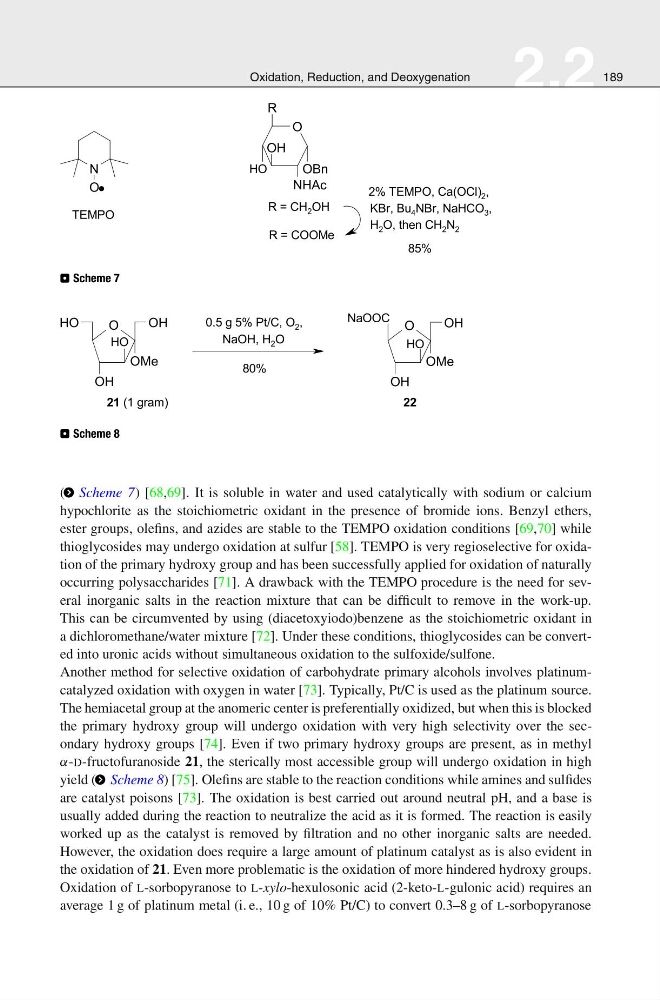
⊡ Scheme 7
⊡ Scheme 8
( > Scheme 7) [68,69]. It is soluble in water and used catalytically with sodium or calcium
hypochlorite as the stoichiometric oxidant in the presence of bromide ions. Benzyl ethers,
ester groups, olefins, and azides are stable to the TEMPO oxidation conditions [69,70] while
thioglycosides may undergo oxidation at sulfur [58]. TEMPO is very regioselective for oxidation of the primary hydroxy group and has been successfully applied for oxidation of naturally
occurring polysaccharides [71]. A drawback with the TEMPO procedure is the need for several inorganic salts in the reaction mixture that can be difficult to remove in the work-up.
This can be circumvented by using (diacetoxyiodo)benzene as the stoichiometric oxidant in
a dichloromethane/water mixture [72]. Under these conditions, thioglycosides can be converted into uronic acids without simultaneous oxidation to the sulfoxide/sulfone.
Another method for selective oxidation of carbohydrate primary alcohols involves platinumcatalyzed oxidation with oxygen in water [73]. Typically, Pt/C is used as the platinum source.
The hemiacetal group at the anomeric center is preferentially oxidized, but when this is blocked
the primary hydroxy group will undergo oxidation with very high selectivity over the secondary hydroxy groups [74]. Even if two primary hydroxy groups are present, as in methyl
α-D-fructofuranoside 21, the sterically most accessible group will undergo oxidation in high
yield ( > Scheme 8) [75]. Olefins are stable to the reaction conditions while amines and sulfides
are catalyst poisons [73]. The oxidation is best carried out around neutral pH, and a base is
usually added during the reaction to neutralize the acid as it is formed. The reaction is easily
worked up as the catalyst is removed by filtration and no other inorganic salts are needed.
However, the oxidation does require a large amount of platinum catalyst as is also evident in
the oxidation of 21. Even more problematic is the oxidation of more hindered hydroxy groups.
Oxidation of L-sorbopyranose to L-xylo-hexulosonic acid (2-keto-L-gulonic acid) requires an
average 1 g of platinum metal (i. e., 10 g of 10% Pt/C) to convert 0.3–8 g of L-sorbopyranose
2.2
189
⊡ Scheme 7
⊡ Scheme 8
( > Scheme 7) [68,69]. It is soluble in water and used catalytically with sodium or calcium
hypochlorite as the stoichiometric oxidant in the presence of bromide ions. Benzyl ethers,
ester groups, olefins, and azides are stable to the TEMPO oxidation conditions [69,70] while
thioglycosides may undergo oxidation at sulfur [58]. TEMPO is very regioselective for oxidation of the primary hydroxy group and has been successfully applied for oxidation of naturally
occurring polysaccharides [71]. A drawback with the TEMPO procedure is the need for several inorganic salts in the reaction mixture that can be difficult to remove in the work-up.
This can be circumvented by using (diacetoxyiodo)benzene as the stoichiometric oxidant in
a dichloromethane/water mixture [72]. Under these conditions, thioglycosides can be converted into uronic acids without simultaneous oxidation to the sulfoxide/sulfone.
Another method for selective oxidation of carbohydrate primary alcohols involves platinumcatalyzed oxidation with oxygen in water [73]. Typically, Pt/C is used as the platinum source.
The hemiacetal group at the anomeric center is preferentially oxidized, but when this is blocked
the primary hydroxy group will undergo oxidation with very high selectivity over the secondary hydroxy groups [74]. Even if two primary hydroxy groups are present, as in methyl
α-D-fructofuranoside 21, the sterically most accessible group will undergo oxidation in high
yield ( > Scheme 8) [75]. Olefins are stable to the reaction conditions while amines and sulfides
are catalyst poisons [73]. The oxidation is best carried out around neutral pH, and a base is
usually added during the reaction to neutralize the acid as it is formed. The reaction is easily
worked up as the catalyst is removed by filtration and no other inorganic salts are needed.
However, the oxidation does require a large amount of platinum catalyst as is also evident in
the oxidation of 21. Even more problematic is the oxidation of more hindered hydroxy groups.
Oxidation of L-sorbopyranose to L-xylo-hexulosonic acid (2-keto-L-gulonic acid) requires an
average 1 g of platinum metal (i. e., 10 g of 10% Pt/C) to convert 0.3–8 g of L-sorbopyranose