

188
2
General Synthetic Methods
⊡ Scheme 5
⊡ Scheme 6
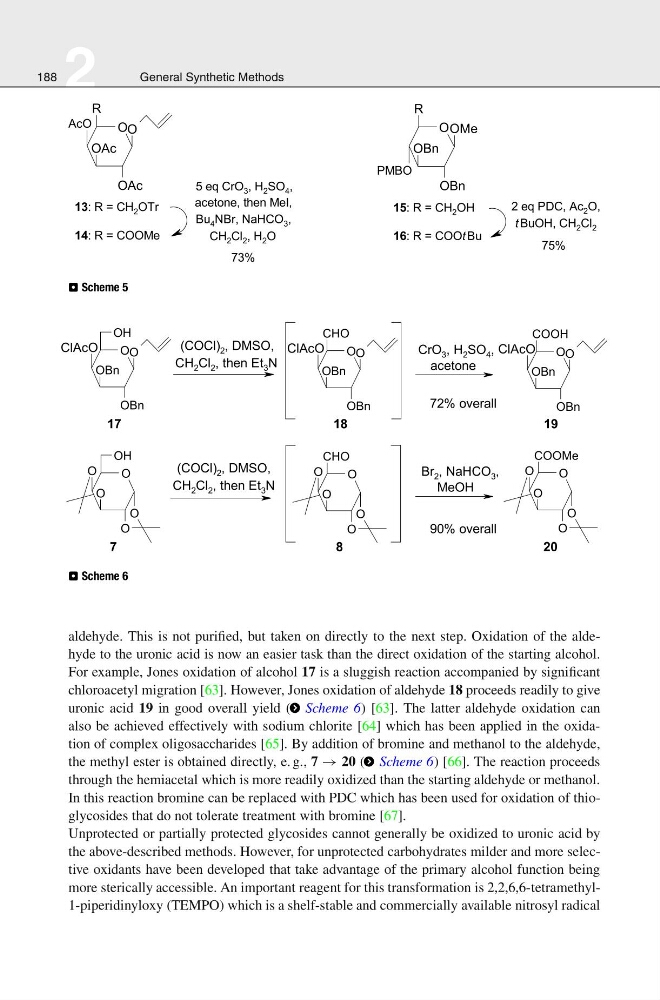
aldehyde. This is not purified, but taken on directly to the next step. Oxidation of the aldehyde to the uronic acid is now an easier task than the direct oxidation of the starting alcohol.
For example, Jones oxidation of alcohol 17 is a sluggish reaction accompanied by significant
chloroacetyl migration [63]. However, Jones oxidation of aldehyde 18 proceeds readily to give
uronic acid 19 in good overall yield ( > Scheme 6) [63]. The latter aldehyde oxidation can
also be achieved effectively with sodium chlorite [64] which has been applied in the oxidation of complex oligosaccharides [65]. By addition of bromine and methanol to the aldehyde,
the methyl ester is obtained directly, e. g., 7 → 20 ( > Scheme 6) [66]. The reaction proceeds
through the hemiacetal which is more readily oxidized than the starting aldehyde or methanol.
In this reaction bromine can be replaced with PDC which has been used for oxidation of thioglycosides that do not tolerate treatment with bromine [67].
Unprotected or partially protected glycosides cannot generally be oxidized to uronic acid by
the above-described methods. However, for unprotected carbohydrates milder and more selective oxidants have been developed that take advantage of the primary alcohol function being
more sterically accessible. An important reagent for this transformation is 2,2,6,6-tetramethyl1-piperidinyloxy (TEMPO) which is a shelf-stable and commercially available nitrosyl radical
2
General Synthetic Methods
⊡ Scheme 5
⊡ Scheme 6
aldehyde. This is not purified, but taken on directly to the next step. Oxidation of the aldehyde to the uronic acid is now an easier task than the direct oxidation of the starting alcohol.
For example, Jones oxidation of alcohol 17 is a sluggish reaction accompanied by significant
chloroacetyl migration [63]. However, Jones oxidation of aldehyde 18 proceeds readily to give
uronic acid 19 in good overall yield ( > Scheme 6) [63]. The latter aldehyde oxidation can
also be achieved effectively with sodium chlorite [64] which has been applied in the oxidation of complex oligosaccharides [65]. By addition of bromine and methanol to the aldehyde,
the methyl ester is obtained directly, e. g., 7 → 20 ( > Scheme 6) [66]. The reaction proceeds
through the hemiacetal which is more readily oxidized than the starting aldehyde or methanol.
In this reaction bromine can be replaced with PDC which has been used for oxidation of thioglycosides that do not tolerate treatment with bromine [67].
Unprotected or partially protected glycosides cannot generally be oxidized to uronic acid by
the above-described methods. However, for unprotected carbohydrates milder and more selective oxidants have been developed that take advantage of the primary alcohol function being
more sterically accessible. An important reagent for this transformation is 2,2,6,6-tetramethyl1-piperidinyloxy (TEMPO) which is a shelf-stable and commercially available nitrosyl radical