

Oxidation, Reduction, and Deoxygenation
2.2
187
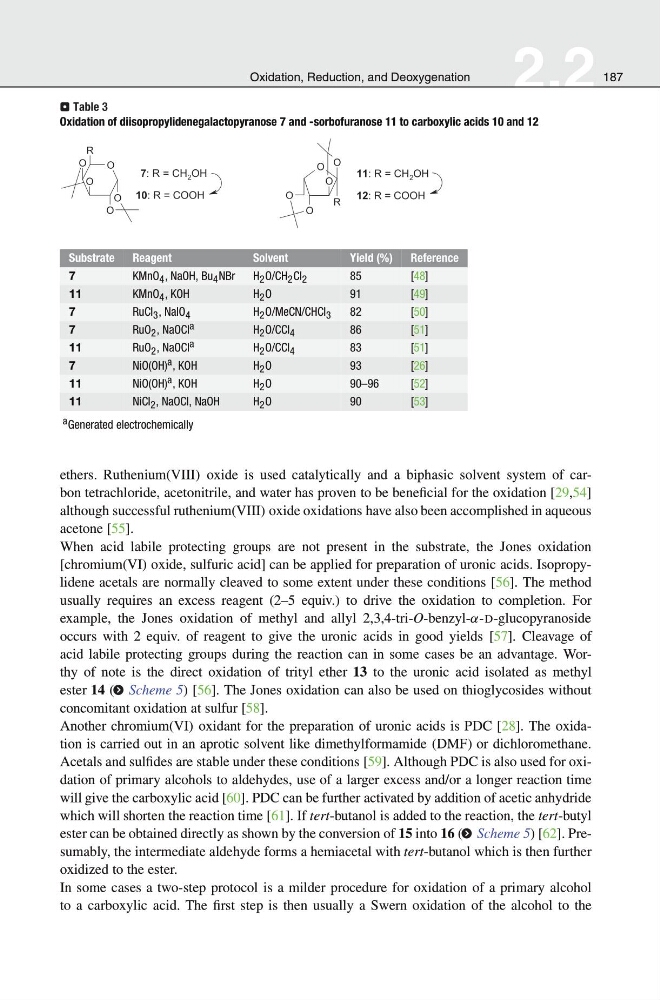
⊡ Table 3
Oxidation of diisopropylidenegalactopyranose 7 and -sorbofuranose 11 to carboxylic acids 10 and 12
Substrate
Reagent
Solvent
Yield (%) Reference
7
KMnO 4 , NaOH, Bu 4 NBr H 2 O/CH 2 Cl 2
85
[48]
11
KMnO 4 , KOH
H 2 O
91
[49]
7
RuCl 3 , NaIO 4
H 2 O/MeCN/CHCl 3
82
[50]
7
RuO 2 , NaOCl a
H 2 O/CCl 4
86
[51]
11
RuO 2 , NaOCl a
H 2 O/CCl 4
83
[51]
7
NiO(OH) a , KOH
H 2 O
93
[26]
11
NiO(OH) a , KOH
H 2 O
90–96
[52]
11
NiCl 2 , NaOCl, NaOH
H 2 O
90
[53]
a Generated electrochemically
ethers. Ruthenium(VIII) oxide is used catalytically and a biphasic solvent system of carbon tetrachloride, acetonitrile, and water has proven to be beneficial for the oxidation [29,54]
although successful ruthenium(VIII) oxide oxidations have also been accomplished in aqueous
acetone [55].
When acid labile protecting groups are not present in the substrate, the Jones oxidation
[chromium(VI) oxide, sulfuric acid] can be applied for preparation of uronic acids. Isopropylidene acetals are normally cleaved to some extent under these conditions [56]. The method
usually requires an excess reagent (2–5 equiv.) to drive the oxidation to completion. For
example, the Jones oxidation of methyl and allyl 2,3,4-tri-O-benzyl-α-D-glucopyranoside
occurs with 2 equiv. of reagent to give the uronic acids in good yields [57]. Cleavage of
acid labile protecting groups during the reaction can in some cases be an advantage. Worthy of note is the direct oxidation of trityl ether 13 to the uronic acid isolated as methyl
ester 14 ( > Scheme 5) [56]. The Jones oxidation can also be used on thioglycosides without
concomitant oxidation at sulfur [58].
Another chromium(VI) oxidant for the preparation of uronic acids is PDC [28]. The oxidation is carried out in an aprotic solvent like dimethylformamide (DMF) or dichloromethane.
Acetals and sulfides are stable under these conditions [59]. Although PDC is also used for oxidation of primary alcohols to aldehydes, use of a larger excess and/or a longer reaction time
will give the carboxylic acid [60]. PDC can be further activated by addition of acetic anhydride
which will shorten the reaction time [61]. If tert-butanol is added to the reaction, the tert-butyl
ester can be obtained directly as shown by the conversion of 15 into 16 ( > Scheme 5) [62]. Presumably, the intermediate aldehyde forms a hemiacetal with tert-butanol which is then further
oxidized to the ester.
In some cases a two-step protocol is a milder procedure for oxidation of a primary alcohol
to a carboxylic acid. The first step is then usually a Swern oxidation of the alcohol to the
2.2
187
⊡ Table 3
Oxidation of diisopropylidenegalactopyranose 7 and -sorbofuranose 11 to carboxylic acids 10 and 12
Substrate
Reagent
Solvent
Yield (%) Reference
7
KMnO 4 , NaOH, Bu 4 NBr H 2 O/CH 2 Cl 2
85
[48]
11
KMnO 4 , KOH
H 2 O
91
[49]
7
RuCl 3 , NaIO 4
H 2 O/MeCN/CHCl 3
82
[50]
7
RuO 2 , NaOCl a
H 2 O/CCl 4
86
[51]
11
RuO 2 , NaOCl a
H 2 O/CCl 4
83
[51]
7
NiO(OH) a , KOH
H 2 O
93
[26]
11
NiO(OH) a , KOH
H 2 O
90–96
[52]
11
NiCl 2 , NaOCl, NaOH
H 2 O
90
[53]
a Generated electrochemically
ethers. Ruthenium(VIII) oxide is used catalytically and a biphasic solvent system of carbon tetrachloride, acetonitrile, and water has proven to be beneficial for the oxidation [29,54]
although successful ruthenium(VIII) oxide oxidations have also been accomplished in aqueous
acetone [55].
When acid labile protecting groups are not present in the substrate, the Jones oxidation
[chromium(VI) oxide, sulfuric acid] can be applied for preparation of uronic acids. Isopropylidene acetals are normally cleaved to some extent under these conditions [56]. The method
usually requires an excess reagent (2–5 equiv.) to drive the oxidation to completion. For
example, the Jones oxidation of methyl and allyl 2,3,4-tri-O-benzyl-α-D-glucopyranoside
occurs with 2 equiv. of reagent to give the uronic acids in good yields [57]. Cleavage of
acid labile protecting groups during the reaction can in some cases be an advantage. Worthy of note is the direct oxidation of trityl ether 13 to the uronic acid isolated as methyl
ester 14 ( > Scheme 5) [56]. The Jones oxidation can also be used on thioglycosides without
concomitant oxidation at sulfur [58].
Another chromium(VI) oxidant for the preparation of uronic acids is PDC [28]. The oxidation is carried out in an aprotic solvent like dimethylformamide (DMF) or dichloromethane.
Acetals and sulfides are stable under these conditions [59]. Although PDC is also used for oxidation of primary alcohols to aldehydes, use of a larger excess and/or a longer reaction time
will give the carboxylic acid [60]. PDC can be further activated by addition of acetic anhydride
which will shorten the reaction time [61]. If tert-butanol is added to the reaction, the tert-butyl
ester can be obtained directly as shown by the conversion of 15 into 16 ( > Scheme 5) [62]. Presumably, the intermediate aldehyde forms a hemiacetal with tert-butanol which is then further
oxidized to the ester.
In some cases a two-step protocol is a milder procedure for oxidation of a primary alcohol
to a carboxylic acid. The first step is then usually a Swern oxidation of the alcohol to the