

186
2
General Synthetic Methods
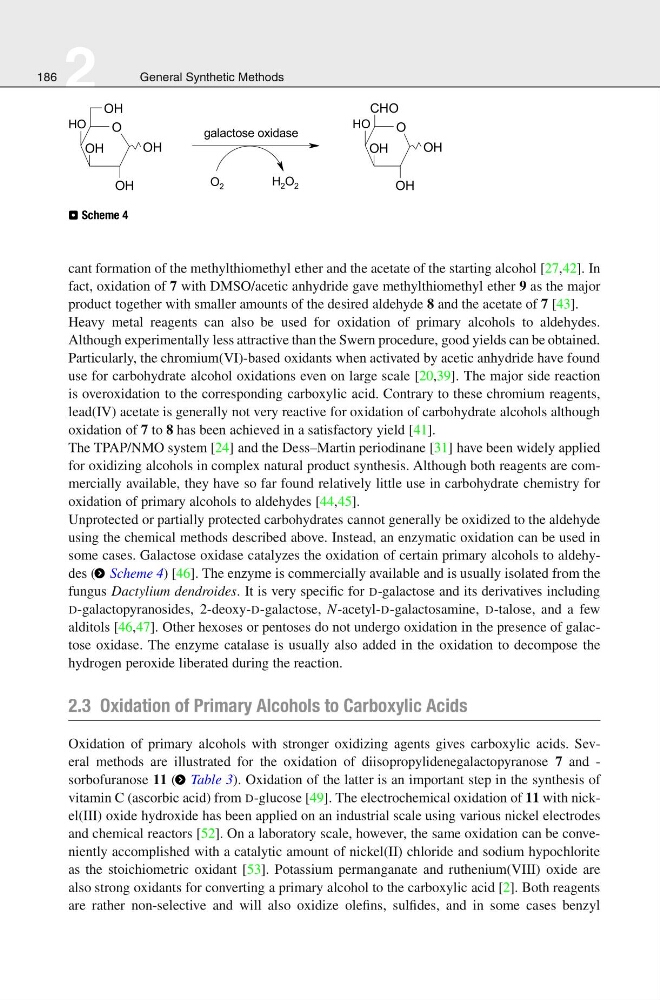
⊡ Scheme 4
cant formation of the methylthiomethyl ether and the acetate of the starting alcohol [27,42]. In
fact, oxidation of 7 with DMSO/acetic anhydride gave methylthiomethyl ether 9 as the major
product together with smaller amounts of the desired aldehyde 8 and the acetate of 7 [43].
Heavy metal reagents can also be used for oxidation of primary alcohols to aldehydes.
Although experimentally less attractive than the Swern procedure, good yields can be obtained.
Particularly, the chromium(VI)-based oxidants when activated by acetic anhydride have found
use for carbohydrate alcohol oxidations even on large scale [20,39]. The major side reaction
is overoxidation to the corresponding carboxylic acid. Contrary to these chromium reagents,
lead(IV) acetate is generally not very reactive for oxidation of carbohydrate alcohols although
oxidation of 7 to 8 has been achieved in a satisfactory yield [41].
The TPAP/NMO system [24] and the Dess–Martin periodinane [31] have been widely applied
for oxidizing alcohols in complex natural product synthesis. Although both reagents are commercially available, they have so far found relatively little use in carbohydrate chemistry for
oxidation of primary alcohols to aldehydes [44,45].
Unprotected or partially protected carbohydrates cannot generally be oxidized to the aldehyde
using the chemical methods described above. Instead, an enzymatic oxidation can be used in
some cases. Galactose oxidase catalyzes the oxidation of certain primary alcohols to aldehydes ( > Scheme 4) [46]. The enzyme is commercially available and is usually isolated from the
fungus Dactylium dendroides. It is very specific for D-galactose and its derivatives including
D-galactopyranosides, 2-deoxy-D-galactose, N-acetyl-D-galactosamine, D-talose, and a few
alditols [46,47]. Other hexoses or pentoses do not undergo oxidation in the presence of galactose oxidase. The enzyme catalase is usually also added in the oxidation to decompose the
hydrogen peroxide liberated during the reaction.
2.3 Oxidation of Primary Alcohols to Carboxylic Acids
Oxidation of primary alcohols with stronger oxidizing agents gives carboxylic acids. Several methods are illustrated for the oxidation of diisopropylidenegalactopyranose 7 and -
sorbofuranose 11 ( > Table 3). Oxidation of the latter is an important step in the synthesis of
vitamin C (ascorbic acid) from D-glucose [49]. The electrochemical oxidation of 11 with nickel(III) oxide hydroxide has been applied on an industrial scale using various nickel electrodes
and chemical reactors [52]. On a laboratory scale, however, the same oxidation can be conveniently accomplished with a catalytic amount of nickel(II) chloride and sodium hypochlorite
as the stoichiometric oxidant [53]. Potassium permanganate and ruthenium(VIII) oxide are
also strong oxidants for converting a primary alcohol to the carboxylic acid [2]. Both reagents
are rather non-selective and will also oxidize olefins, sulfides, and in some cases benzyl
2
General Synthetic Methods
⊡ Scheme 4
cant formation of the methylthiomethyl ether and the acetate of the starting alcohol [27,42]. In
fact, oxidation of 7 with DMSO/acetic anhydride gave methylthiomethyl ether 9 as the major
product together with smaller amounts of the desired aldehyde 8 and the acetate of 7 [43].
Heavy metal reagents can also be used for oxidation of primary alcohols to aldehydes.
Although experimentally less attractive than the Swern procedure, good yields can be obtained.
Particularly, the chromium(VI)-based oxidants when activated by acetic anhydride have found
use for carbohydrate alcohol oxidations even on large scale [20,39]. The major side reaction
is overoxidation to the corresponding carboxylic acid. Contrary to these chromium reagents,
lead(IV) acetate is generally not very reactive for oxidation of carbohydrate alcohols although
oxidation of 7 to 8 has been achieved in a satisfactory yield [41].
The TPAP/NMO system [24] and the Dess–Martin periodinane [31] have been widely applied
for oxidizing alcohols in complex natural product synthesis. Although both reagents are commercially available, they have so far found relatively little use in carbohydrate chemistry for
oxidation of primary alcohols to aldehydes [44,45].
Unprotected or partially protected carbohydrates cannot generally be oxidized to the aldehyde
using the chemical methods described above. Instead, an enzymatic oxidation can be used in
some cases. Galactose oxidase catalyzes the oxidation of certain primary alcohols to aldehydes ( > Scheme 4) [46]. The enzyme is commercially available and is usually isolated from the
fungus Dactylium dendroides. It is very specific for D-galactose and its derivatives including
D-galactopyranosides, 2-deoxy-D-galactose, N-acetyl-D-galactosamine, D-talose, and a few
alditols [46,47]. Other hexoses or pentoses do not undergo oxidation in the presence of galactose oxidase. The enzyme catalase is usually also added in the oxidation to decompose the
hydrogen peroxide liberated during the reaction.
2.3 Oxidation of Primary Alcohols to Carboxylic Acids
Oxidation of primary alcohols with stronger oxidizing agents gives carboxylic acids. Several methods are illustrated for the oxidation of diisopropylidenegalactopyranose 7 and -
sorbofuranose 11 ( > Table 3). Oxidation of the latter is an important step in the synthesis of
vitamin C (ascorbic acid) from D-glucose [49]. The electrochemical oxidation of 11 with nickel(III) oxide hydroxide has been applied on an industrial scale using various nickel electrodes
and chemical reactors [52]. On a laboratory scale, however, the same oxidation can be conveniently accomplished with a catalytic amount of nickel(II) chloride and sodium hypochlorite
as the stoichiometric oxidant [53]. Potassium permanganate and ruthenium(VIII) oxide are
also strong oxidants for converting a primary alcohol to the carboxylic acid [2]. Both reagents
are rather non-selective and will also oxidize olefins, sulfides, and in some cases benzyl