

Oxidation, Reduction, and Deoxygenation
2.2
185
oxidation at the anomeric center by the peracid. The same transformation can be achieved
with indium(III) chloride and 2-iodoxybenzoic acid [35].
2.2 Oxidation of Primary Alcohols to Aldehydes
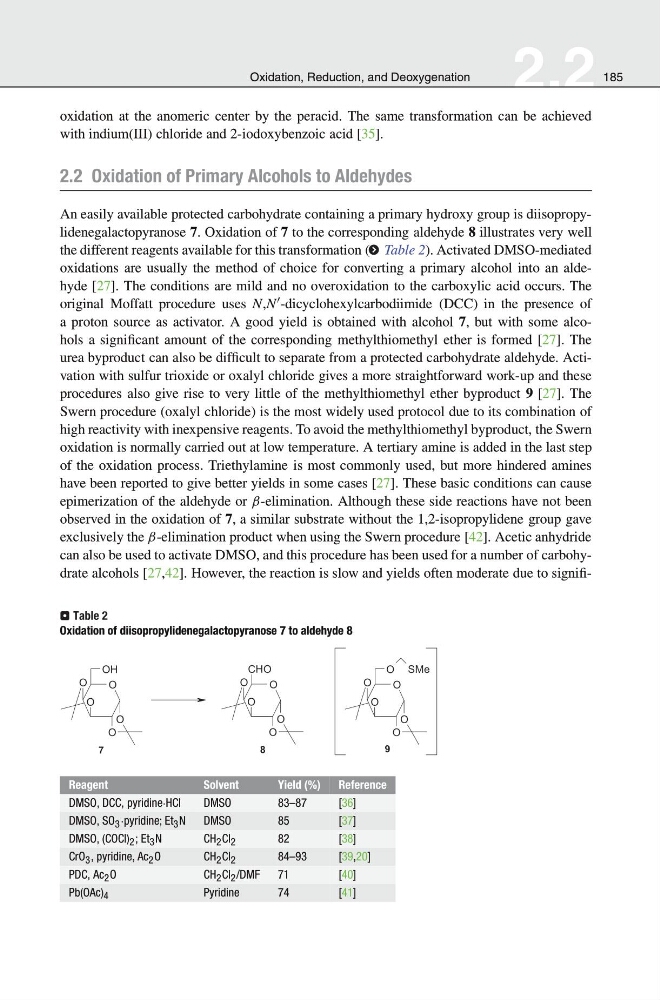
An easily available protected carbohydrate containing a primary hydroxy group is diisopropylidenegalactopyranose 7. Oxidation of 7 to the corresponding aldehyde 8 illustrates very well
the different reagents available for this transformation ( > Table 2). Activated DMSO-mediated
oxidations are usually the method of choice for converting a primary alcohol into an aldehyde [27]. The conditions are mild and no overoxidation to the carboxylic acid occurs. The
original Moffatt procedure uses N,N -dicyclohexylcarbodiimide (DCC) in the presence of
a proton source as activator. A good yield is obtained with alcohol 7, but with some alcohols a significant amount of the corresponding methylthiomethyl ether is formed [27]. The
urea byproduct can also be difficult to separate from a protected carbohydrate aldehyde. Activation with sulfur trioxide or oxalyl chloride gives a more straightforward work-up and these
procedures also give rise to very little of the methylthiomethyl ether byproduct 9 [27]. The
Swern procedure (oxalyl chloride) is the most widely used protocol due to its combination of
high reactivity with inexpensive reagents. To avoid the methylthiomethyl byproduct, the Swern
oxidation is normally carried out at low temperature. A tertiary amine is added in the last step
of the oxidation process. Triethylamine is most commonly used, but more hindered amines
have been reported to give better yields in some cases [27]. These basic conditions can cause
epimerization of the aldehyde or β-elimination. Although these side reactions have not been
observed in the oxidation of 7, a similar substrate without the 1,2-isopropylidene group gave
exclusively the β-elimination product when using the Swern procedure [42]. Acetic anhydride
can also be used to activate DMSO, and this procedure has been used for a number of carbohydrate alcohols [27,42]. However, the reaction is slow and yields often moderate due to signifi⊡ Table 2
Oxidation of diisopropylidenegalactopyranose 7 to aldehyde 8
Reagent
Solvent
Yield (%) Reference
DMSO, DCC, pyridine·HCl
DMSO
83–87
[36]
DMSO, SO 3 ·pyridine; Et 3 N DMSO
85
[37]
DMSO, (COCl) 2 ; Et 3 N
CH 2 Cl 2
82
[38]
CrO 3 , pyridine, Ac 2 O
CH 2 Cl 2
84–93
[39,20]
PDC, Ac 2 O
CH 2 Cl 2 /DMF 71
[40]
Pb(OAc) 4
Pyridine
74
[41]
2.2
185
oxidation at the anomeric center by the peracid. The same transformation can be achieved
with indium(III) chloride and 2-iodoxybenzoic acid [35].
2.2 Oxidation of Primary Alcohols to Aldehydes
An easily available protected carbohydrate containing a primary hydroxy group is diisopropylidenegalactopyranose 7. Oxidation of 7 to the corresponding aldehyde 8 illustrates very well
the different reagents available for this transformation ( > Table 2). Activated DMSO-mediated
oxidations are usually the method of choice for converting a primary alcohol into an aldehyde [27]. The conditions are mild and no overoxidation to the carboxylic acid occurs. The
original Moffatt procedure uses N,N -dicyclohexylcarbodiimide (DCC) in the presence of
a proton source as activator. A good yield is obtained with alcohol 7, but with some alcohols a significant amount of the corresponding methylthiomethyl ether is formed [27]. The
urea byproduct can also be difficult to separate from a protected carbohydrate aldehyde. Activation with sulfur trioxide or oxalyl chloride gives a more straightforward work-up and these
procedures also give rise to very little of the methylthiomethyl ether byproduct 9 [27]. The
Swern procedure (oxalyl chloride) is the most widely used protocol due to its combination of
high reactivity with inexpensive reagents. To avoid the methylthiomethyl byproduct, the Swern
oxidation is normally carried out at low temperature. A tertiary amine is added in the last step
of the oxidation process. Triethylamine is most commonly used, but more hindered amines
have been reported to give better yields in some cases [27]. These basic conditions can cause
epimerization of the aldehyde or β-elimination. Although these side reactions have not been
observed in the oxidation of 7, a similar substrate without the 1,2-isopropylidene group gave
exclusively the β-elimination product when using the Swern procedure [42]. Acetic anhydride
can also be used to activate DMSO, and this procedure has been used for a number of carbohydrate alcohols [27,42]. However, the reaction is slow and yields often moderate due to signifi⊡ Table 2
Oxidation of diisopropylidenegalactopyranose 7 to aldehyde 8
Reagent
Solvent
Yield (%) Reference
DMSO, DCC, pyridine·HCl
DMSO
83–87
[36]
DMSO, SO 3 ·pyridine; Et 3 N DMSO
85
[37]
DMSO, (COCl) 2 ; Et 3 N
CH 2 Cl 2
82
[38]
CrO 3 , pyridine, Ac 2 O
CH 2 Cl 2
84–93
[39,20]
PDC, Ac 2 O
CH 2 Cl 2 /DMF 71
[40]
Pb(OAc) 4
Pyridine
74
[41]