

184
2
General Synthetic Methods
Another ruthenium-catalyzed oxidation uses tetrapropylammonium perruthenate (TPAP) [24].
Being a ruthenium(VII) oxide, the perruthenate ion is a less powerful oxidant than ruthenium(VIII) oxide and more functional groups are stable to the oxidation conditions, including
alkenes, alkynes, amines, amides, benzyl, trityl and silyl ethers [24]. However, alcohols and
lactols still undergo oxidations in high yield with N-methyl-morpholine N-oxide (NMO) as the
stoichiometric oxidant. The reactions are usually carried out in dichloromethane, acetonitrile,
or mixtures of both in the presence of molecular sieves [24].
A number of special oxidation methods have also been applied to partially protected aldoses.
The Dess–Martin periodinane, 1,1,1-triacetoxy-1,1-dihydro-1,2-benziodoxol-3(1H)-one [31],
is a mild and efficient oxidant compatible with carbohydrate protecting groups [25]. However,
it is also quite expensive and should only be used if the other procedures fail. The hydrogen
transfer reactions catalyzed by 5% of RhH(PPh 3 ) 4 can also be applied to partially protected
aldoses [8].
In all the above methods for oxidizing carbohydrates a stoichiometric oxidant is added to
the reaction mixture. This can be avoided by using an electrochemical oxidation. A nickel
hydroxide electrode has been applied for oxidizing isopropylidene-protected carbohydrates in
aqueous base [26]. While secondary hydroxy groups fail to react under these conditions, the
hemiacetal at the anomeric center is oxidized to the lactone in good yield [26].
Besides aldoses methyl glycosides and glycals can also be oxidized at the anomeric center.
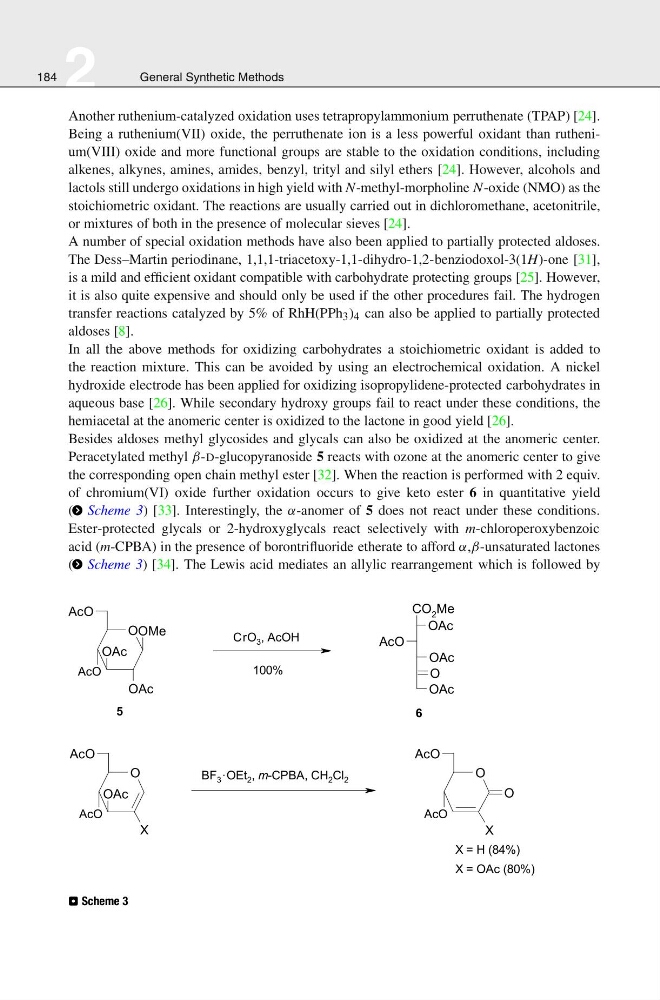
Peracetylated methyl β-D-glucopyranoside 5 reacts with ozone at the anomeric center to give
the corresponding open chain methyl ester [32]. When the reaction is performed with 2 equiv.
of chromium(VI) oxide further oxidation occurs to give keto ester 6 in quantitative yield
( > Scheme 3) [33]. Interestingly, the α-anomer of 5 does not react under these conditions.
Ester-protected glycals or 2-hydroxyglycals react selectively with m-chloroperoxybenzoic
acid (m-CPBA) in the presence of borontrifluoride etherate to afford α,β-unsaturated lactones
( > Scheme 3) [34]. The Lewis acid mediates an allylic rearrangement which is followed by
⊡ Scheme 3
2
General Synthetic Methods
Another ruthenium-catalyzed oxidation uses tetrapropylammonium perruthenate (TPAP) [24].
Being a ruthenium(VII) oxide, the perruthenate ion is a less powerful oxidant than ruthenium(VIII) oxide and more functional groups are stable to the oxidation conditions, including
alkenes, alkynes, amines, amides, benzyl, trityl and silyl ethers [24]. However, alcohols and
lactols still undergo oxidations in high yield with N-methyl-morpholine N-oxide (NMO) as the
stoichiometric oxidant. The reactions are usually carried out in dichloromethane, acetonitrile,
or mixtures of both in the presence of molecular sieves [24].
A number of special oxidation methods have also been applied to partially protected aldoses.
The Dess–Martin periodinane, 1,1,1-triacetoxy-1,1-dihydro-1,2-benziodoxol-3(1H)-one [31],
is a mild and efficient oxidant compatible with carbohydrate protecting groups [25]. However,
it is also quite expensive and should only be used if the other procedures fail. The hydrogen
transfer reactions catalyzed by 5% of RhH(PPh 3 ) 4 can also be applied to partially protected
aldoses [8].
In all the above methods for oxidizing carbohydrates a stoichiometric oxidant is added to
the reaction mixture. This can be avoided by using an electrochemical oxidation. A nickel
hydroxide electrode has been applied for oxidizing isopropylidene-protected carbohydrates in
aqueous base [26]. While secondary hydroxy groups fail to react under these conditions, the
hemiacetal at the anomeric center is oxidized to the lactone in good yield [26].
Besides aldoses methyl glycosides and glycals can also be oxidized at the anomeric center.
Peracetylated methyl β-D-glucopyranoside 5 reacts with ozone at the anomeric center to give
the corresponding open chain methyl ester [32]. When the reaction is performed with 2 equiv.
of chromium(VI) oxide further oxidation occurs to give keto ester 6 in quantitative yield
( > Scheme 3) [33]. Interestingly, the α-anomer of 5 does not react under these conditions.
Ester-protected glycals or 2-hydroxyglycals react selectively with m-chloroperoxybenzoic
acid (m-CPBA) in the presence of borontrifluoride etherate to afford α,β-unsaturated lactones
( > Scheme 3) [34]. The Lewis acid mediates an allylic rearrangement which is followed by
⊡ Scheme 3