

Oxidation, Reduction, and Deoxygenation
2.2
183
⊡ Table 1
Oxidation of diisopropylidenemannofuranose 1 and tetrabenzylglucopyranose 3 to lactones 2 and 4
Substrate
Reagent
Solvent
Yield (%) Reference
1
DMSO, Ac 2 O
DMSO
79–96
[15,16]
3
DMSO, Ac 2 O
DMSO
84
[17]
1
DMSO, (COCl) 2 ; Et 3 N
CH 2 Cl 2
82
[18]
3
DMSO, (COCl) 2 ; Et 3 N
CH 2 Cl 2
60
[19]
1
CrO 3 ·2C 5 H 5 N
CH 2 Cl 2
80
[16]
1
CrO 3 ·2C 5 H 5 N, Ac 2 O
CH 2 Cl 2
97
[20]
3
PDC, 3 Å MS
CH 2 Cl 2
86
[19]
1
PCC, 3 Å MS
CH 2 Cl 2
86
[21]
3
PCC, 3 Å MS
CH 2 Cl 2
95
[22]
1
RuO 2 , NaIO 4
H 2 O/CHCl 3 /CCl 4
79
[23]
1
TPAP, NMO
MeCN
88
[24]
3
TPAP, NMO
CH 2 Cl 2
94
[19]
1
Dess–Martin periodinane
CH 2 Cl 2
95
[25]
1
RhH(PPh 3 ) 4 , benzalacetone
DMF
93
[8]
1
NiO(OH) a , K 2 CO 3
H 2 O
80
[26]
a Generated electrochemically
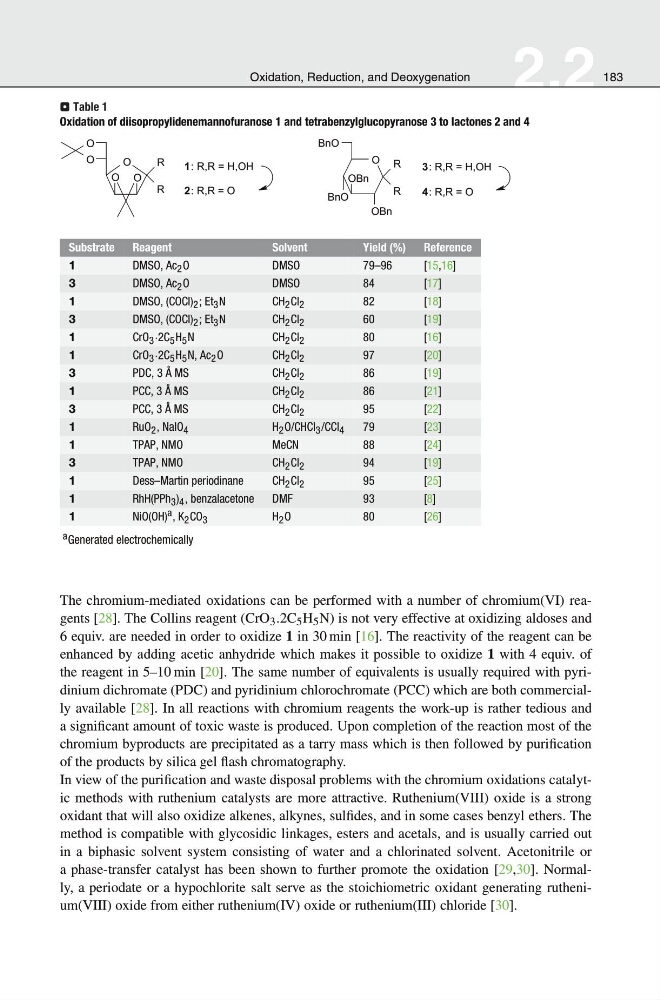
The chromium-mediated oxidations can be performed with a number of chromium(VI) reagents [28]. The Collins reagent (CrO 3 .2C 5 H 5 N) is not very effective at oxidizing aldoses and
6 equiv. are needed in order to oxidize 1 in 30 min [16]. The reactivity of the reagent can be
enhanced by adding acetic anhydride which makes it possible to oxidize 1 with 4 equiv. of
the reagent in 5–10 min [20]. The same number of equivalents is usually required with pyridinium dichromate (PDC) and pyridinium chlorochromate (PCC) which are both commercially available [28]. In all reactions with chromium reagents the work-up is rather tedious and
a significant amount of toxic waste is produced. Upon completion of the reaction most of the
chromium byproducts are precipitated as a tarry mass which is then followed by purification
of the products by silica gel flash chromatography.
In view of the purification and waste disposal problems with the chromium oxidations catalytic methods with ruthenium catalysts are more attractive. Ruthenium(VIII) oxide is a strong
oxidant that will also oxidize alkenes, alkynes, sulfides, and in some cases benzyl ethers. The
method is compatible with glycosidic linkages, esters and acetals, and is usually carried out
in a biphasic solvent system consisting of water and a chlorinated solvent. Acetonitrile or
a phase-transfer catalyst has been shown to further promote the oxidation [29,30]. Normally, a periodate or a hypochlorite salt serve as the stoichiometric oxidant generating ruthenium(VIII) oxide from either ruthenium(IV) oxide or ruthenium(III) chloride [30].
2.2
183
⊡ Table 1
Oxidation of diisopropylidenemannofuranose 1 and tetrabenzylglucopyranose 3 to lactones 2 and 4
Substrate
Reagent
Solvent
Yield (%) Reference
1
DMSO, Ac 2 O
DMSO
79–96
[15,16]
3
DMSO, Ac 2 O
DMSO
84
[17]
1
DMSO, (COCl) 2 ; Et 3 N
CH 2 Cl 2
82
[18]
3
DMSO, (COCl) 2 ; Et 3 N
CH 2 Cl 2
60
[19]
1
CrO 3 ·2C 5 H 5 N
CH 2 Cl 2
80
[16]
1
CrO 3 ·2C 5 H 5 N, Ac 2 O
CH 2 Cl 2
97
[20]
3
PDC, 3 Å MS
CH 2 Cl 2
86
[19]
1
PCC, 3 Å MS
CH 2 Cl 2
86
[21]
3
PCC, 3 Å MS
CH 2 Cl 2
95
[22]
1
RuO 2 , NaIO 4
H 2 O/CHCl 3 /CCl 4
79
[23]
1
TPAP, NMO
MeCN
88
[24]
3
TPAP, NMO
CH 2 Cl 2
94
[19]
1
Dess–Martin periodinane
CH 2 Cl 2
95
[25]
1
RhH(PPh 3 ) 4 , benzalacetone
DMF
93
[8]
1
NiO(OH) a , K 2 CO 3
H 2 O
80
[26]
a Generated electrochemically
The chromium-mediated oxidations can be performed with a number of chromium(VI) reagents [28]. The Collins reagent (CrO 3 .2C 5 H 5 N) is not very effective at oxidizing aldoses and
6 equiv. are needed in order to oxidize 1 in 30 min [16]. The reactivity of the reagent can be
enhanced by adding acetic anhydride which makes it possible to oxidize 1 with 4 equiv. of
the reagent in 5–10 min [20]. The same number of equivalents is usually required with pyridinium dichromate (PDC) and pyridinium chlorochromate (PCC) which are both commercially available [28]. In all reactions with chromium reagents the work-up is rather tedious and
a significant amount of toxic waste is produced. Upon completion of the reaction most of the
chromium byproducts are precipitated as a tarry mass which is then followed by purification
of the products by silica gel flash chromatography.
In view of the purification and waste disposal problems with the chromium oxidations catalytic methods with ruthenium catalysts are more attractive. Ruthenium(VIII) oxide is a strong
oxidant that will also oxidize alkenes, alkynes, sulfides, and in some cases benzyl ethers. The
method is compatible with glycosidic linkages, esters and acetals, and is usually carried out
in a biphasic solvent system consisting of water and a chlorinated solvent. Acetonitrile or
a phase-transfer catalyst has been shown to further promote the oxidation [29,30]. Normally, a periodate or a hypochlorite salt serve as the stoichiometric oxidant generating ruthenium(VIII) oxide from either ruthenium(IV) oxide or ruthenium(III) chloride [30].