

182
2
General Synthetic Methods
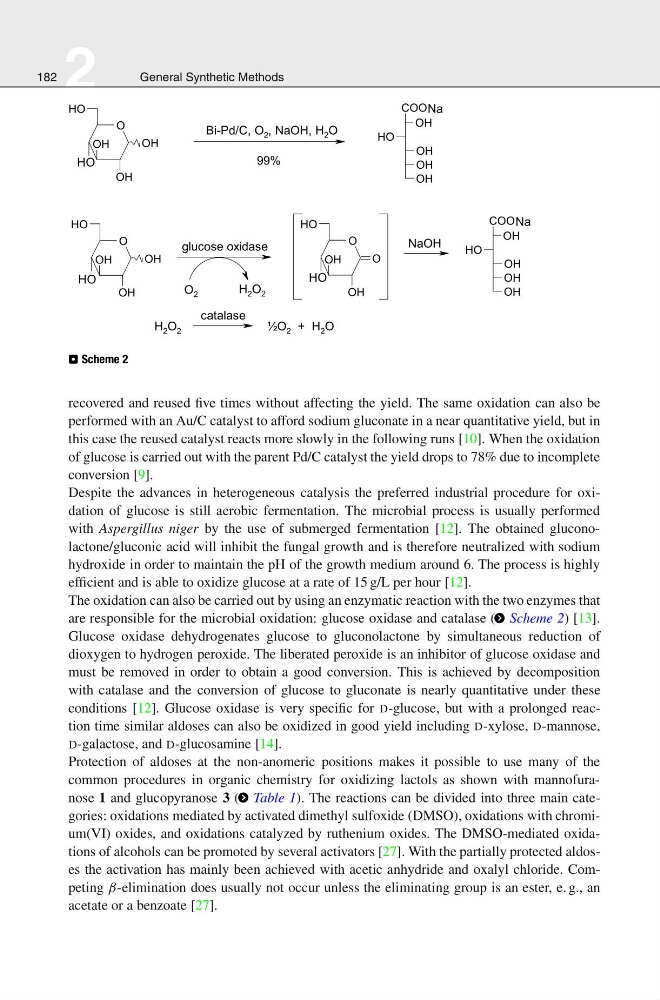
⊡ Scheme 2
recovered and reused five times without affecting the yield. The same oxidation can also be
performed with an Au/C catalyst to afford sodium gluconate in a near quantitative yield, but in
this case the reused catalyst reacts more slowly in the following runs [10]. When the oxidation
of glucose is carried out with the parent Pd/C catalyst the yield drops to 78% due to incomplete
conversion [9].
Despite the advances in heterogeneous catalysis the preferred industrial procedure for oxidation of glucose is still aerobic fermentation. The microbial process is usually performed
with Aspergillus niger by the use of submerged fermentation [12]. The obtained gluconolactone/gluconic acid will inhibit the fungal growth and is therefore neutralized with sodium
hydroxide in order to maintain the pH of the growth medium around 6. The process is highly
efficient and is able to oxidize glucose at a rate of 15 g/L per hour [12].
The oxidation can also be carried out by using an enzymatic reaction with the two enzymes that
are responsible for the microbial oxidation: glucose oxidase and catalase ( > Scheme 2) [13].
Glucose oxidase dehydrogenates glucose to gluconolactone by simultaneous reduction of
dioxygen to hydrogen peroxide. The liberated peroxide is an inhibitor of glucose oxidase and
must be removed in order to obtain a good conversion. This is achieved by decomposition
with catalase and the conversion of glucose to gluconate is nearly quantitative under these
conditions [12]. Glucose oxidase is very specific for D-glucose, but with a prolonged reaction time similar aldoses can also be oxidized in good yield including D-xylose, D-mannose,
D-galactose, and D-glucosamine [14].
Protection of aldoses at the non-anomeric positions makes it possible to use many of the
common procedures in organic chemistry for oxidizing lactols as shown with mannofuranose 1 and glucopyranose 3 ( > Table 1). The reactions can be divided into three main categories: oxidations mediated by activated dimethyl sulfoxide (DMSO), oxidations with chromium(VI) oxides, and oxidations catalyzed by ruthenium oxides. The DMSO-mediated oxidations of alcohols can be promoted by several activators [27]. With the partially protected aldoses the activation has mainly been achieved with acetic anhydride and oxalyl chloride. Competing β-elimination does usually not occur unless the eliminating group is an ester, e. g., an
acetate or a benzoate [27].
2
General Synthetic Methods
⊡ Scheme 2
recovered and reused five times without affecting the yield. The same oxidation can also be
performed with an Au/C catalyst to afford sodium gluconate in a near quantitative yield, but in
this case the reused catalyst reacts more slowly in the following runs [10]. When the oxidation
of glucose is carried out with the parent Pd/C catalyst the yield drops to 78% due to incomplete
conversion [9].
Despite the advances in heterogeneous catalysis the preferred industrial procedure for oxidation of glucose is still aerobic fermentation. The microbial process is usually performed
with Aspergillus niger by the use of submerged fermentation [12]. The obtained gluconolactone/gluconic acid will inhibit the fungal growth and is therefore neutralized with sodium
hydroxide in order to maintain the pH of the growth medium around 6. The process is highly
efficient and is able to oxidize glucose at a rate of 15 g/L per hour [12].
The oxidation can also be carried out by using an enzymatic reaction with the two enzymes that
are responsible for the microbial oxidation: glucose oxidase and catalase ( > Scheme 2) [13].
Glucose oxidase dehydrogenates glucose to gluconolactone by simultaneous reduction of
dioxygen to hydrogen peroxide. The liberated peroxide is an inhibitor of glucose oxidase and
must be removed in order to obtain a good conversion. This is achieved by decomposition
with catalase and the conversion of glucose to gluconate is nearly quantitative under these
conditions [12]. Glucose oxidase is very specific for D-glucose, but with a prolonged reaction time similar aldoses can also be oxidized in good yield including D-xylose, D-mannose,
D-galactose, and D-glucosamine [14].
Protection of aldoses at the non-anomeric positions makes it possible to use many of the
common procedures in organic chemistry for oxidizing lactols as shown with mannofuranose 1 and glucopyranose 3 ( > Table 1). The reactions can be divided into three main categories: oxidations mediated by activated dimethyl sulfoxide (DMSO), oxidations with chromium(VI) oxides, and oxidations catalyzed by ruthenium oxides. The DMSO-mediated oxidations of alcohols can be promoted by several activators [27]. With the partially protected aldoses the activation has mainly been achieved with acetic anhydride and oxalyl chloride. Competing β-elimination does usually not occur unless the eliminating group is an ester, e. g., an
acetate or a benzoate [27].