

Oxidation, Reduction, and Deoxygenation
2.2
181
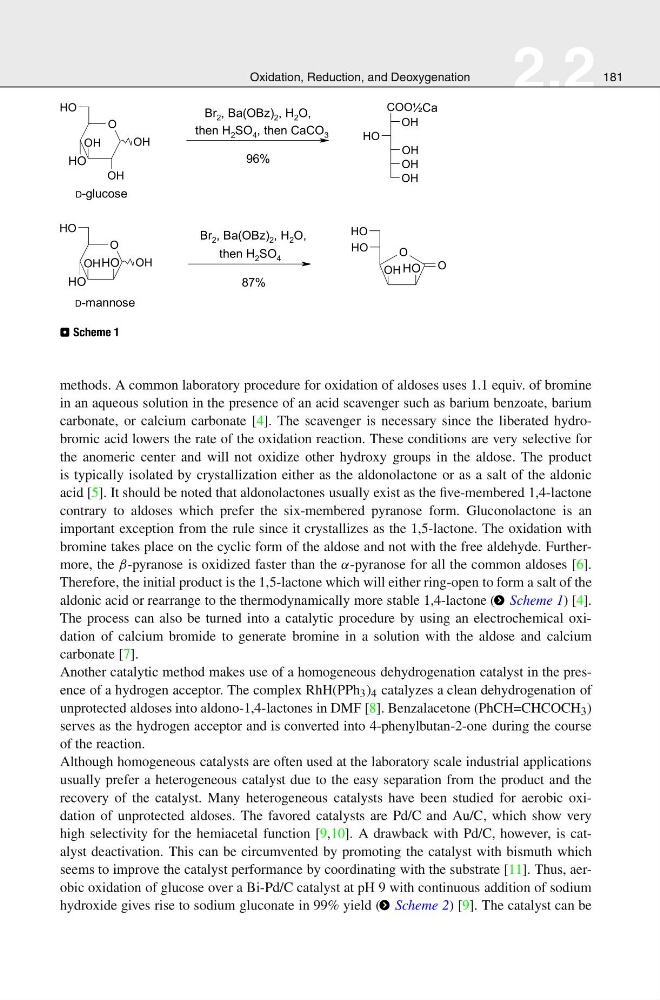
⊡ Scheme 1
methods. A common laboratory procedure for oxidation of aldoses uses 1.1 equiv. of bromine
in an aqueous solution in the presence of an acid scavenger such as barium benzoate, barium
carbonate, or calcium carbonate [4]. The scavenger is necessary since the liberated hydrobromic acid lowers the rate of the oxidation reaction. These conditions are very selective for
the anomeric center and will not oxidize other hydroxy groups in the aldose. The product
is typically isolated by crystallization either as the aldonolactone or as a salt of the aldonic
acid [5]. It should be noted that aldonolactones usually exist as the five-membered 1,4-lactone
contrary to aldoses which prefer the six-membered pyranose form. Gluconolactone is an
important exception from the rule since it crystallizes as the 1,5-lactone. The oxidation with
bromine takes place on the cyclic form of the aldose and not with the free aldehyde. Furthermore, the β-pyranose is oxidized faster than the α-pyranose for all the common aldoses [6].
Therefore, the initial product is the 1,5-lactone which will either ring-open to form a salt of the
aldonic acid or rearrange to the thermodynamically more stable 1,4-lactone ( > Scheme 1) [4].
The process can also be turned into a catalytic procedure by using an electrochemical oxidation of calcium bromide to generate bromine in a solution with the aldose and calcium
carbonate [7].
Another catalytic method makes use of a homogeneous dehydrogenation catalyst in the presence of a hydrogen acceptor. The complex RhH(PPh 3 ) 4 catalyzes a clean dehydrogenation of
unprotected aldoses into aldono-1,4-lactones in DMF [8]. Benzalacetone (PhCH=CHCOCH 3 )
serves as the hydrogen acceptor and is converted into 4-phenylbutan-2-one during the course
of the reaction.
Although homogeneous catalysts are often used at the laboratory scale industrial applications
usually prefer a heterogeneous catalyst due to the easy separation from the product and the
recovery of the catalyst. Many heterogeneous catalysts have been studied for aerobic oxidation of unprotected aldoses. The favored catalysts are Pd/C and Au/C, which show very
high selectivity for the hemiacetal function [9,10]. A drawback with Pd/C, however, is catalyst deactivation. This can be circumvented by promoting the catalyst with bismuth which
seems to improve the catalyst performance by coordinating with the substrate [11]. Thus, aerobic oxidation of glucose over a Bi-Pd/C catalyst at pH 9 with continuous addition of sodium
hydroxide gives rise to sodium gluconate in 99% yield ( > Scheme 2) [9]. The catalyst can be
2.2
181
⊡ Scheme 1
methods. A common laboratory procedure for oxidation of aldoses uses 1.1 equiv. of bromine
in an aqueous solution in the presence of an acid scavenger such as barium benzoate, barium
carbonate, or calcium carbonate [4]. The scavenger is necessary since the liberated hydrobromic acid lowers the rate of the oxidation reaction. These conditions are very selective for
the anomeric center and will not oxidize other hydroxy groups in the aldose. The product
is typically isolated by crystallization either as the aldonolactone or as a salt of the aldonic
acid [5]. It should be noted that aldonolactones usually exist as the five-membered 1,4-lactone
contrary to aldoses which prefer the six-membered pyranose form. Gluconolactone is an
important exception from the rule since it crystallizes as the 1,5-lactone. The oxidation with
bromine takes place on the cyclic form of the aldose and not with the free aldehyde. Furthermore, the β-pyranose is oxidized faster than the α-pyranose for all the common aldoses [6].
Therefore, the initial product is the 1,5-lactone which will either ring-open to form a salt of the
aldonic acid or rearrange to the thermodynamically more stable 1,4-lactone ( > Scheme 1) [4].
The process can also be turned into a catalytic procedure by using an electrochemical oxidation of calcium bromide to generate bromine in a solution with the aldose and calcium
carbonate [7].
Another catalytic method makes use of a homogeneous dehydrogenation catalyst in the presence of a hydrogen acceptor. The complex RhH(PPh 3 ) 4 catalyzes a clean dehydrogenation of
unprotected aldoses into aldono-1,4-lactones in DMF [8]. Benzalacetone (PhCH=CHCOCH 3 )
serves as the hydrogen acceptor and is converted into 4-phenylbutan-2-one during the course
of the reaction.
Although homogeneous catalysts are often used at the laboratory scale industrial applications
usually prefer a heterogeneous catalyst due to the easy separation from the product and the
recovery of the catalyst. Many heterogeneous catalysts have been studied for aerobic oxidation of unprotected aldoses. The favored catalysts are Pd/C and Au/C, which show very
high selectivity for the hemiacetal function [9,10]. A drawback with Pd/C, however, is catalyst deactivation. This can be circumvented by promoting the catalyst with bismuth which
seems to improve the catalyst performance by coordinating with the substrate [11]. Thus, aerobic oxidation of glucose over a Bi-Pd/C catalyst at pH 9 with continuous addition of sodium
hydroxide gives rise to sodium gluconate in 99% yield ( > Scheme 2) [9]. The catalyst can be