

190
2
General Synthetic Methods
in 1 h [76]. Increased activity can be obtained by using bismuth- or lead-promoted platinum
catalysts. The presence of the promoter seems to suppress poisoning of the catalyst caused
by accumulation of oxygen on the metal surface. However, the promoters also change the
selectivity profoundly [76], hence a general solution to the deactivation problem remains to be
found.
When an aldose is not protected at C1, oxidation can occur both at C1 and at the primary
position to give an aldaric acid. Strong nitric acid is the classical reagent for this oxidation.
For example, treatment of D-glucose with concentrated nitric acid at 60 °C for 1 h affords
D-glucaric acid isolated as the crystalline monopotassium salt in 41% yield [77]. Aldoses can
also be oxidized to aldaric acids by the platinum-catalyzed oxidation with oxygen, but the need
for relatively large amounts of platinum generally makes this procedure less attractive [78].
More recently, a modification of TEMPO was introduced for oxidation of aldoses to aldaric
acids [79]. By this procedure glucose is converted into the monopotassium salt of glucaric acid
in 85% yield [79].
2.4 Oxidation of Secondary Alcohols to Ketones
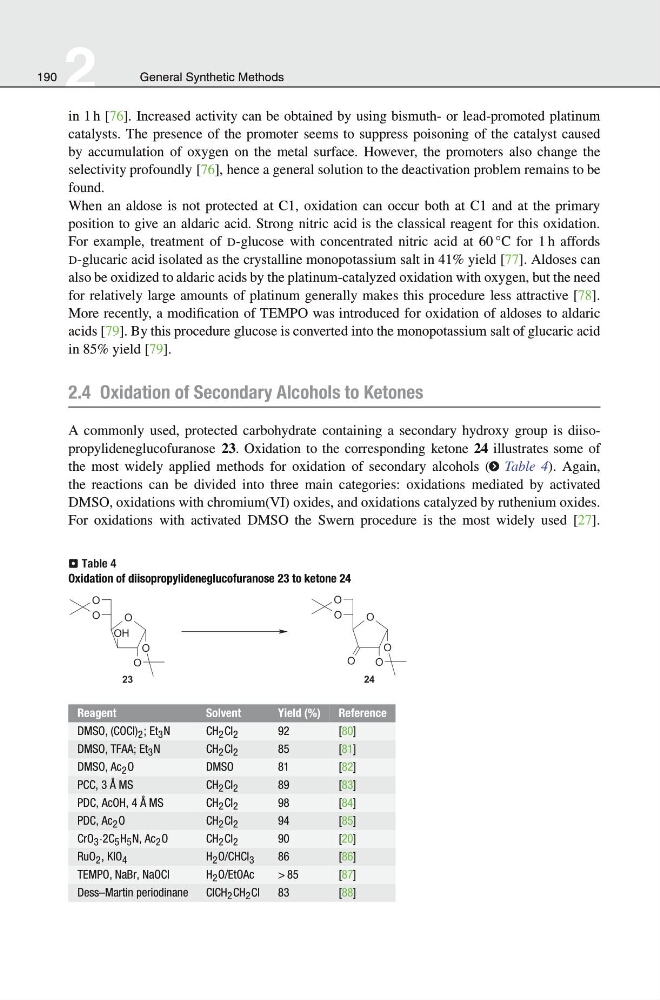
A commonly used, protected carbohydrate containing a secondary hydroxy group is diisopropylideneglucofuranose 23. Oxidation to the corresponding ketone 24 illustrates some of
the most widely applied methods for oxidation of secondary alcohols ( > Table 4). Again,
the reactions can be divided into three main categories: oxidations mediated by activated
DMSO, oxidations with chromium(VI) oxides, and oxidations catalyzed by ruthenium oxides.
For oxidations with activated DMSO the Swern procedure is the most widely used [27].
⊡ Table 4
Oxidation of diisopropylideneglucofuranose 23 to ketone 24
Reagent
Solvent
Yield (%) Reference
DMSO, (COCl) 2 ; Et 3 N
CH 2 Cl 2
92
[80]
DMSO, TFAA; Et 3 N
CH 2 Cl 2
85
[81]
DMSO, Ac 2 O
DMSO
81
[82]
PCC, 3 Å MS
CH 2 Cl 2
89
[83]
PDC, AcOH, 4 Å MS
CH 2 Cl 2
98
[84]
PDC, Ac 2 O
CH 2 Cl 2
94
[85]
CrO 3 ·2C 5 H 5 N, Ac 2 O
CH 2 Cl 2
90
[20]
RuO 2 , KIO 4
H 2 O/CHCl 3
86
[86]
TEMPO, NaBr, NaOCl
H 2 O/EtOAc
> 85
[87]
Dess–Martin periodinane ClCH 2 CH 2 Cl
83
[88]
2
General Synthetic Methods
in 1 h [76]. Increased activity can be obtained by using bismuth- or lead-promoted platinum
catalysts. The presence of the promoter seems to suppress poisoning of the catalyst caused
by accumulation of oxygen on the metal surface. However, the promoters also change the
selectivity profoundly [76], hence a general solution to the deactivation problem remains to be
found.
When an aldose is not protected at C1, oxidation can occur both at C1 and at the primary
position to give an aldaric acid. Strong nitric acid is the classical reagent for this oxidation.
For example, treatment of D-glucose with concentrated nitric acid at 60 °C for 1 h affords
D-glucaric acid isolated as the crystalline monopotassium salt in 41% yield [77]. Aldoses can
also be oxidized to aldaric acids by the platinum-catalyzed oxidation with oxygen, but the need
for relatively large amounts of platinum generally makes this procedure less attractive [78].
More recently, a modification of TEMPO was introduced for oxidation of aldoses to aldaric
acids [79]. By this procedure glucose is converted into the monopotassium salt of glucaric acid
in 85% yield [79].
2.4 Oxidation of Secondary Alcohols to Ketones
A commonly used, protected carbohydrate containing a secondary hydroxy group is diisopropylideneglucofuranose 23. Oxidation to the corresponding ketone 24 illustrates some of
the most widely applied methods for oxidation of secondary alcohols ( > Table 4). Again,
the reactions can be divided into three main categories: oxidations mediated by activated
DMSO, oxidations with chromium(VI) oxides, and oxidations catalyzed by ruthenium oxides.
For oxidations with activated DMSO the Swern procedure is the most widely used [27].
⊡ Table 4
Oxidation of diisopropylideneglucofuranose 23 to ketone 24
Reagent
Solvent
Yield (%) Reference
DMSO, (COCl) 2 ; Et 3 N
CH 2 Cl 2
92
[80]
DMSO, TFAA; Et 3 N
CH 2 Cl 2
85
[81]
DMSO, Ac 2 O
DMSO
81
[82]
PCC, 3 Å MS
CH 2 Cl 2
89
[83]
PDC, AcOH, 4 Å MS
CH 2 Cl 2
98
[84]
PDC, Ac 2 O
CH 2 Cl 2
94
[85]
CrO 3 ·2C 5 H 5 N, Ac 2 O
CH 2 Cl 2
90
[20]
RuO 2 , KIO 4
H 2 O/CHCl 3
86
[86]
TEMPO, NaBr, NaOCl
H 2 O/EtOAc
> 85
[87]
Dess–Martin periodinane ClCH 2 CH 2 Cl
83
[88]