

Reactions at Oxygen Atoms
2.1
161
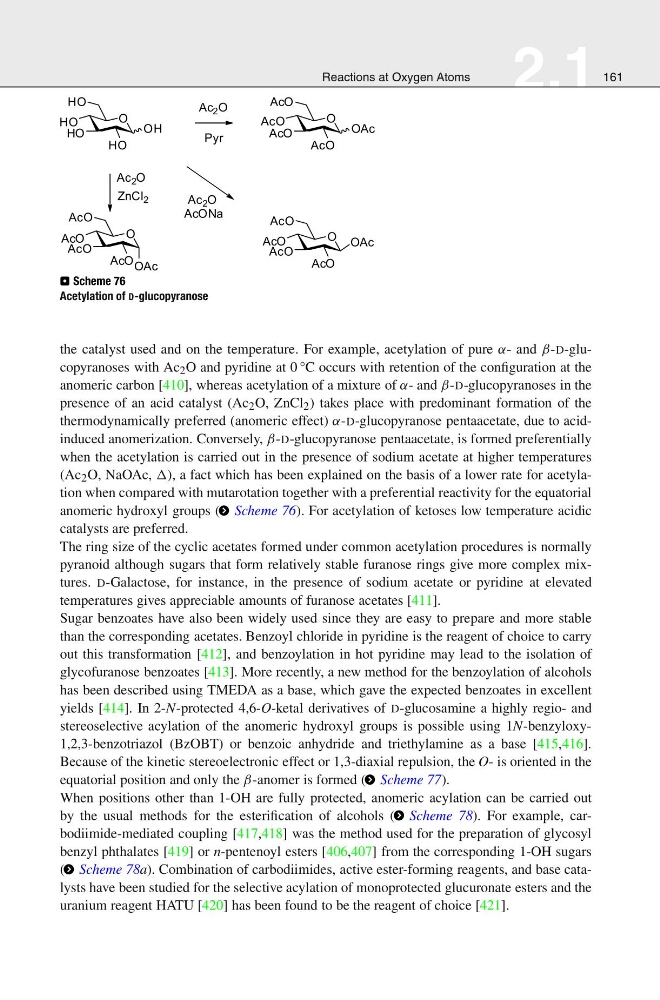
⊡ Scheme 76
Acetylation of D-glucopyranose
the catalyst used and on the temperature. For example, acetylation of pure α- and β-D-glucopyranoses with Ac 2 O and pyridine at 0 °C occurs with retention of the configuration at the
anomeric carbon [410], whereas acetylation of a mixture of α- and β-D-glucopyranoses in the
presence of an acid catalyst (Ac 2 O, ZnCl 2 ) takes place with predominant formation of the
thermodynamically preferred (anomeric effect) α-D-glucopyranose pentaacetate, due to acidinduced anomerization. Conversely, β-D-glucopyranose pentaacetate, is formed preferentially
when the acetylation is carried out in the presence of sodium acetate at higher temperatures
(Ac 2 O, NaOAc, ), a fact which has been explained on the basis of a lower rate for acetylation when compared with mutarotation together with a preferential reactivity for the equatorial
anomeric hydroxyl groups ( > Scheme 76). For acetylation of ketoses low temperature acidic
catalysts are preferred.
The ring size of the cyclic acetates formed under common acetylation procedures is normally
pyranoid although sugars that form relatively stable furanose rings give more complex mixtures. D-Galactose, for instance, in the presence of sodium acetate or pyridine at elevated
temperatures gives appreciable amounts of furanose acetates [411].
Sugar benzoates have also been widely used since they are easy to prepare and more stable
than the corresponding acetates. Benzoyl chloride in pyridine is the reagent of choice to carry
out this transformation [412], and benzoylation in hot pyridine may lead to the isolation of
glycofuranose benzoates [413]. More recently, a new method for the benzoylation of alcohols
has been described using TMEDA as a base, which gave the expected benzoates in excellent
yields [414]. In 2-N-protected 4,6-O-ketal derivatives of D-glucosamine a highly regio- and
stereoselective acylation of the anomeric hydroxyl groups is possible using 1N-benzyloxy1,2,3-benzotriazol (BzOBT) or benzoic anhydride and triethylamine as a base [415,416].
Because of the kinetic stereoelectronic effect or 1,3-diaxial repulsion, the O- is oriented in the
equatorial position and only the β-anomer is formed ( > Scheme 77).
When positions other than 1-OH are fully protected, anomeric acylation can be carried out
by the usual methods for the esterification of alcohols ( > Scheme 78). For example, carbodiimide-mediated coupling [417,418] was the method used for the preparation of glycosyl
benzyl phthalates [419] or n-pentenoyl esters [406,407] from the corresponding 1-OH sugars
( > Scheme 78a). Combination of carbodiimides, active ester-forming reagents, and base catalysts have been studied for the selective acylation of monoprotected glucuronate esters and the
uranium reagent HATU [420] has been found to be the reagent of choice [421].
2.1
161
⊡ Scheme 76
Acetylation of D-glucopyranose
the catalyst used and on the temperature. For example, acetylation of pure α- and β-D-glucopyranoses with Ac 2 O and pyridine at 0 °C occurs with retention of the configuration at the
anomeric carbon [410], whereas acetylation of a mixture of α- and β-D-glucopyranoses in the
presence of an acid catalyst (Ac 2 O, ZnCl 2 ) takes place with predominant formation of the
thermodynamically preferred (anomeric effect) α-D-glucopyranose pentaacetate, due to acidinduced anomerization. Conversely, β-D-glucopyranose pentaacetate, is formed preferentially
when the acetylation is carried out in the presence of sodium acetate at higher temperatures
(Ac 2 O, NaOAc, ), a fact which has been explained on the basis of a lower rate for acetylation when compared with mutarotation together with a preferential reactivity for the equatorial
anomeric hydroxyl groups ( > Scheme 76). For acetylation of ketoses low temperature acidic
catalysts are preferred.
The ring size of the cyclic acetates formed under common acetylation procedures is normally
pyranoid although sugars that form relatively stable furanose rings give more complex mixtures. D-Galactose, for instance, in the presence of sodium acetate or pyridine at elevated
temperatures gives appreciable amounts of furanose acetates [411].
Sugar benzoates have also been widely used since they are easy to prepare and more stable
than the corresponding acetates. Benzoyl chloride in pyridine is the reagent of choice to carry
out this transformation [412], and benzoylation in hot pyridine may lead to the isolation of
glycofuranose benzoates [413]. More recently, a new method for the benzoylation of alcohols
has been described using TMEDA as a base, which gave the expected benzoates in excellent
yields [414]. In 2-N-protected 4,6-O-ketal derivatives of D-glucosamine a highly regio- and
stereoselective acylation of the anomeric hydroxyl groups is possible using 1N-benzyloxy1,2,3-benzotriazol (BzOBT) or benzoic anhydride and triethylamine as a base [415,416].
Because of the kinetic stereoelectronic effect or 1,3-diaxial repulsion, the O- is oriented in the
equatorial position and only the β-anomer is formed ( > Scheme 77).
When positions other than 1-OH are fully protected, anomeric acylation can be carried out
by the usual methods for the esterification of alcohols ( > Scheme 78). For example, carbodiimide-mediated coupling [417,418] was the method used for the preparation of glycosyl
benzyl phthalates [419] or n-pentenoyl esters [406,407] from the corresponding 1-OH sugars
( > Scheme 78a). Combination of carbodiimides, active ester-forming reagents, and base catalysts have been studied for the selective acylation of monoprotected glucuronate esters and the
uranium reagent HATU [420] has been found to be the reagent of choice [421].