

160
2
General Synthetic Methods
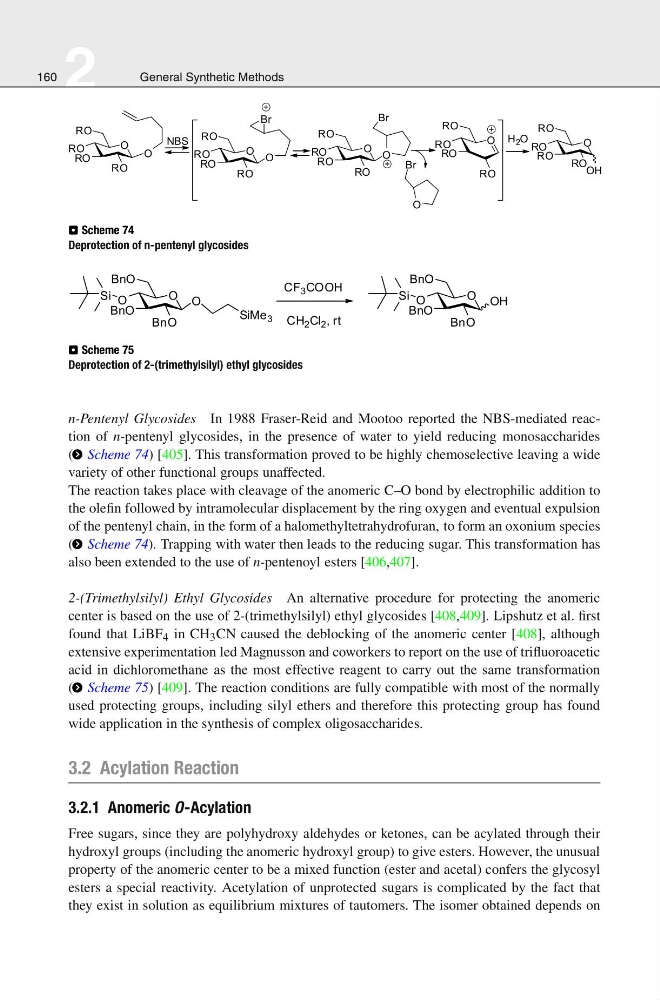
⊡ Scheme 74
Deprotection of n-pentenyl glycosides
⊡ Scheme 75
Deprotection of 2-(trimethylsilyl) ethyl glycosides
n-Pentenyl Glycosides In 1988 Fraser-Reid and Mootoo reported the NBS-mediated reaction of n-pentenyl glycosides, in the presence of water to yield reducing monosaccharides
( > Scheme 74) [405]. This transformation proved to be highly chemoselective leaving a wide
variety of other functional groups unaffected.
The reaction takes place with cleavage of the anomeric C–O bond by electrophilic addition to
the olefin followed by intramolecular displacement by the ring oxygen and eventual expulsion
of the pentenyl chain, in the form of a halomethyltetrahydrofuran, to form an oxonium species
( > Scheme 74). Trapping with water then leads to the reducing sugar. This transformation has
also been extended to the use of n-pentenoyl esters [406,407].
2-(Trimethylsilyl) Ethyl Glycosides An alternative procedure for protecting the anomeric
center is based on the use of 2-(trimethylsilyl) ethyl glycosides [408,409]. Lipshutz et al. first
found that LiBF 4 in CH 3 CN caused the deblocking of the anomeric center [408], although
extensive experimentation led Magnusson and coworkers to report on the use of trifluoroacetic
acid in dichloromethane as the most effective reagent to carry out the same transformation
( > Scheme 75) [409]. The reaction conditions are fully compatible with most of the normally
used protecting groups, including silyl ethers and therefore this protecting group has found
wide application in the synthesis of complex oligosaccharides.
3.2 Acylation Reaction
3.2.1 Anomeric O-Acylation
Free sugars, since they are polyhydroxy aldehydes or ketones, can be acylated through their
hydroxyl groups (including the anomeric hydroxyl group) to give esters. However, the unusual
property of the anomeric center to be a mixed function (ester and acetal) confers the glycosyl
esters a special reactivity. Acetylation of unprotected sugars is complicated by the fact that
they exist in solution as equilibrium mixtures of tautomers. The isomer obtained depends on
2
General Synthetic Methods
⊡ Scheme 74
Deprotection of n-pentenyl glycosides
⊡ Scheme 75
Deprotection of 2-(trimethylsilyl) ethyl glycosides
n-Pentenyl Glycosides In 1988 Fraser-Reid and Mootoo reported the NBS-mediated reaction of n-pentenyl glycosides, in the presence of water to yield reducing monosaccharides
( > Scheme 74) [405]. This transformation proved to be highly chemoselective leaving a wide
variety of other functional groups unaffected.
The reaction takes place with cleavage of the anomeric C–O bond by electrophilic addition to
the olefin followed by intramolecular displacement by the ring oxygen and eventual expulsion
of the pentenyl chain, in the form of a halomethyltetrahydrofuran, to form an oxonium species
( > Scheme 74). Trapping with water then leads to the reducing sugar. This transformation has
also been extended to the use of n-pentenoyl esters [406,407].
2-(Trimethylsilyl) Ethyl Glycosides An alternative procedure for protecting the anomeric
center is based on the use of 2-(trimethylsilyl) ethyl glycosides [408,409]. Lipshutz et al. first
found that LiBF 4 in CH 3 CN caused the deblocking of the anomeric center [408], although
extensive experimentation led Magnusson and coworkers to report on the use of trifluoroacetic
acid in dichloromethane as the most effective reagent to carry out the same transformation
( > Scheme 75) [409]. The reaction conditions are fully compatible with most of the normally
used protecting groups, including silyl ethers and therefore this protecting group has found
wide application in the synthesis of complex oligosaccharides.
3.2 Acylation Reaction
3.2.1 Anomeric O-Acylation
Free sugars, since they are polyhydroxy aldehydes or ketones, can be acylated through their
hydroxyl groups (including the anomeric hydroxyl group) to give esters. However, the unusual
property of the anomeric center to be a mixed function (ester and acetal) confers the glycosyl
esters a special reactivity. Acetylation of unprotected sugars is complicated by the fact that
they exist in solution as equilibrium mixtures of tautomers. The isomer obtained depends on