

Reactions at Oxygen Atoms
2.1
159
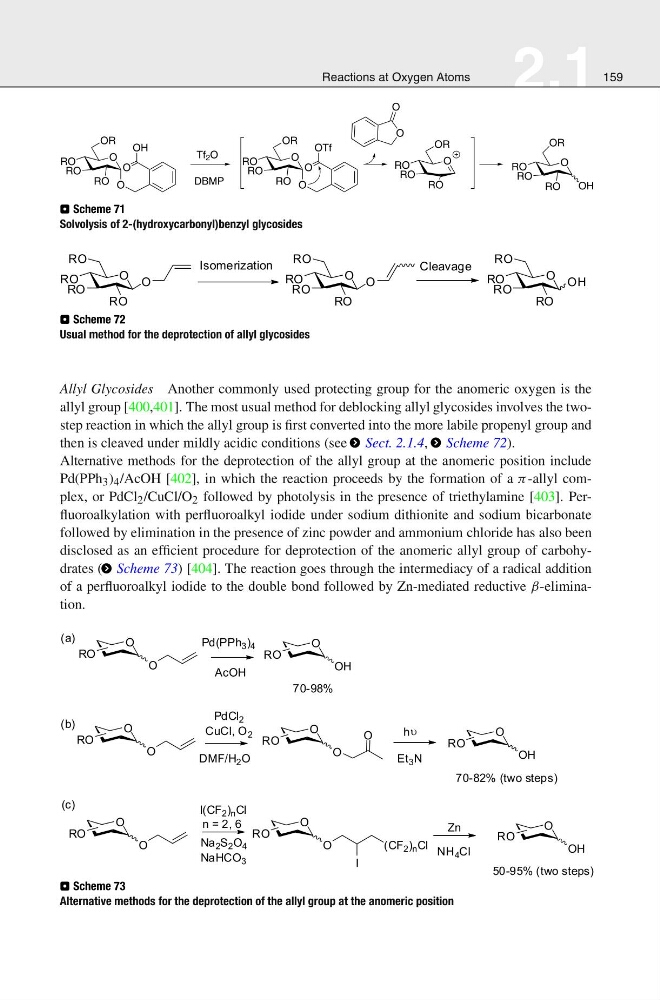
⊡ Scheme 71
Solvolysis of 2-(hydroxycarbonyl)benzyl glycosides
⊡ Scheme 72
Usual method for the deprotection of allyl glycosides
Allyl Glycosides Another commonly used protecting group for the anomeric oxygen is the
allyl group [400,401]. The most usual method for deblocking allyl glycosides involves the twostep reaction in which the allyl group is first converted into the more labile propenyl group and
then is cleaved under mildly acidic conditions (see > Sect. 2.1.4, > Scheme 72).
Alternative methods for the deprotection of the allyl group at the anomeric position include
Pd(PPh 3 ) 4 /AcOH [402], in which the reaction proceeds by the formation of a π-allyl complex, or PdCl 2 /CuCl/O 2 followed by photolysis in the presence of triethylamine [403]. Perfluoroalkylation with perfluoroalkyl iodide under sodium dithionite and sodium bicarbonate
followed by elimination in the presence of zinc powder and ammonium chloride has also been
disclosed as an efficient procedure for deprotection of the anomeric allyl group of carbohydrates ( > Scheme 73) [404]. The reaction goes through the intermediacy of a radical addition
of a perfluoroalkyl iodide to the double bond followed by Zn-mediated reductive β-elimination.
⊡ Scheme 73
Alternative methods for the deprotection of the allyl group at the anomeric position
2.1
159
⊡ Scheme 71
Solvolysis of 2-(hydroxycarbonyl)benzyl glycosides
⊡ Scheme 72
Usual method for the deprotection of allyl glycosides
Allyl Glycosides Another commonly used protecting group for the anomeric oxygen is the
allyl group [400,401]. The most usual method for deblocking allyl glycosides involves the twostep reaction in which the allyl group is first converted into the more labile propenyl group and
then is cleaved under mildly acidic conditions (see > Sect. 2.1.4, > Scheme 72).
Alternative methods for the deprotection of the allyl group at the anomeric position include
Pd(PPh 3 ) 4 /AcOH [402], in which the reaction proceeds by the formation of a π-allyl complex, or PdCl 2 /CuCl/O 2 followed by photolysis in the presence of triethylamine [403]. Perfluoroalkylation with perfluoroalkyl iodide under sodium dithionite and sodium bicarbonate
followed by elimination in the presence of zinc powder and ammonium chloride has also been
disclosed as an efficient procedure for deprotection of the anomeric allyl group of carbohydrates ( > Scheme 73) [404]. The reaction goes through the intermediacy of a radical addition
of a perfluoroalkyl iodide to the double bond followed by Zn-mediated reductive β-elimination.
⊡ Scheme 73
Alternative methods for the deprotection of the allyl group at the anomeric position