

162
2
General Synthetic Methods
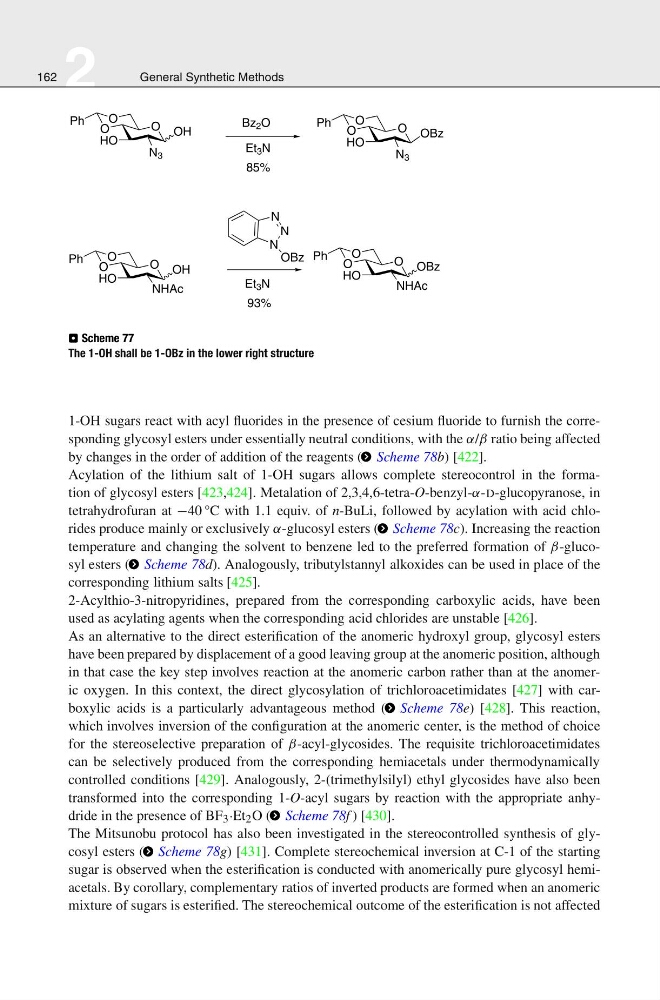
⊡ Scheme 77
The 1-OH shall be 1-OBz in the lower right structure
1-OH sugars react with acyl fluorides in the presence of cesium fluoride to furnish the corresponding glycosyl esters under essentially neutral conditions, with the α/β ratio being affected
by changes in the order of addition of the reagents ( > Scheme 78b) [422].
Acylation of the lithium salt of 1-OH sugars allows complete stereocontrol in the formation of glycosyl esters [423,424]. Metalation of 2,3,4,6-tetra-O-benzyl-α-D-glucopyranose, in
tetrahydrofuran at −40 °C with 1.1 equiv. of n-BuLi, followed by acylation with acid chlorides produce mainly or exclusively α-glucosyl esters ( > Scheme 78c). Increasing the reaction
temperature and changing the solvent to benzene led to the preferred formation of β-glucosyl esters ( > Scheme 78d). Analogously, tributylstannyl alkoxides can be used in place of the
corresponding lithium salts [425].
2-Acylthio-3-nitropyridines, prepared from the corresponding carboxylic acids, have been
used as acylating agents when the corresponding acid chlorides are unstable [426].
As an alternative to the direct esterification of the anomeric hydroxyl group, glycosyl esters
have been prepared by displacement of a good leaving group at the anomeric position, although
in that case the key step involves reaction at the anomeric carbon rather than at the anomeric oxygen. In this context, the direct glycosylation of trichloroacetimidates [427] with carboxylic acids is a particularly advantageous method ( > Scheme 78e) [428]. This reaction,
which involves inversion of the configuration at the anomeric center, is the method of choice
for the stereoselective preparation of β-acyl-glycosides. The requisite trichloroacetimidates
can be selectively produced from the corresponding hemiacetals under thermodynamically
controlled conditions [429]. Analogously, 2-(trimethylsilyl) ethyl glycosides have also been
transformed into the corresponding 1-O-acyl sugars by reaction with the appropriate anhydride in the presence of BF 3 ·Et 2 O ( > Scheme 78f ) [430].
The Mitsunobu protocol has also been investigated in the stereocontrolled synthesis of glycosyl esters ( > Scheme 78g) [431]. Complete stereochemical inversion at C-1 of the starting
sugar is observed when the esterification is conducted with anomerically pure glycosyl hemiacetals. By corollary, complementary ratios of inverted products are formed when an anomeric
mixture of sugars is esterified. The stereochemical outcome of the esterification is not affected
2
General Synthetic Methods
⊡ Scheme 77
The 1-OH shall be 1-OBz in the lower right structure
1-OH sugars react with acyl fluorides in the presence of cesium fluoride to furnish the corresponding glycosyl esters under essentially neutral conditions, with the α/β ratio being affected
by changes in the order of addition of the reagents ( > Scheme 78b) [422].
Acylation of the lithium salt of 1-OH sugars allows complete stereocontrol in the formation of glycosyl esters [423,424]. Metalation of 2,3,4,6-tetra-O-benzyl-α-D-glucopyranose, in
tetrahydrofuran at −40 °C with 1.1 equiv. of n-BuLi, followed by acylation with acid chlorides produce mainly or exclusively α-glucosyl esters ( > Scheme 78c). Increasing the reaction
temperature and changing the solvent to benzene led to the preferred formation of β-glucosyl esters ( > Scheme 78d). Analogously, tributylstannyl alkoxides can be used in place of the
corresponding lithium salts [425].
2-Acylthio-3-nitropyridines, prepared from the corresponding carboxylic acids, have been
used as acylating agents when the corresponding acid chlorides are unstable [426].
As an alternative to the direct esterification of the anomeric hydroxyl group, glycosyl esters
have been prepared by displacement of a good leaving group at the anomeric position, although
in that case the key step involves reaction at the anomeric carbon rather than at the anomeric oxygen. In this context, the direct glycosylation of trichloroacetimidates [427] with carboxylic acids is a particularly advantageous method ( > Scheme 78e) [428]. This reaction,
which involves inversion of the configuration at the anomeric center, is the method of choice
for the stereoselective preparation of β-acyl-glycosides. The requisite trichloroacetimidates
can be selectively produced from the corresponding hemiacetals under thermodynamically
controlled conditions [429]. Analogously, 2-(trimethylsilyl) ethyl glycosides have also been
transformed into the corresponding 1-O-acyl sugars by reaction with the appropriate anhydride in the presence of BF 3 ·Et 2 O ( > Scheme 78f ) [430].
The Mitsunobu protocol has also been investigated in the stereocontrolled synthesis of glycosyl esters ( > Scheme 78g) [431]. Complete stereochemical inversion at C-1 of the starting
sugar is observed when the esterification is conducted with anomerically pure glycosyl hemiacetals. By corollary, complementary ratios of inverted products are formed when an anomeric
mixture of sugars is esterified. The stereochemical outcome of the esterification is not affected