

Reactions at Oxygen Atoms
2.1
145
cally demanding tert-butyldimethylsilyl group requires reaction of the alcohol with tert-butyldimethylchlorosilane in the presence of imidazole as a catalyst and the formation of the
tert-butyldimethylsilyl ether of tertiary alcohols is very difficult. Alternatively, a more reactive
form such as trialkylsilyl trifluoromethanesulfonates (R 3 SiOTf) can be used.
As a rule, the bulkier the substituents, the greater the stability of the resulting silyl derivatives.
However, stability is not only a function of steric bulk since electronic effects play a role as
well, which can be exploited to differentiate stability under acidic or basic conditions. For
example, phenyl-substituted silyl ethers are equal or more reactive than their trimethylsilyl
counterparts under alkaline conditions, but less reactive under acidic conditions. In general terms, however, the relative stabilities of the silyl-protected functional groups will follow
the order of: i Pr 3 Si > ThMe 2 Si > t BuPh 2 Si > t BuMe 2 Si > i PrMe 2 Si > Et 3 Si > Ph 2 MeSi
> Me 3 Si [288].
On the other hand, silyl groups can migrate between different nucleophilic sites in a molecule
under basic conditions. These migrations have to be considered as possible side reactions,
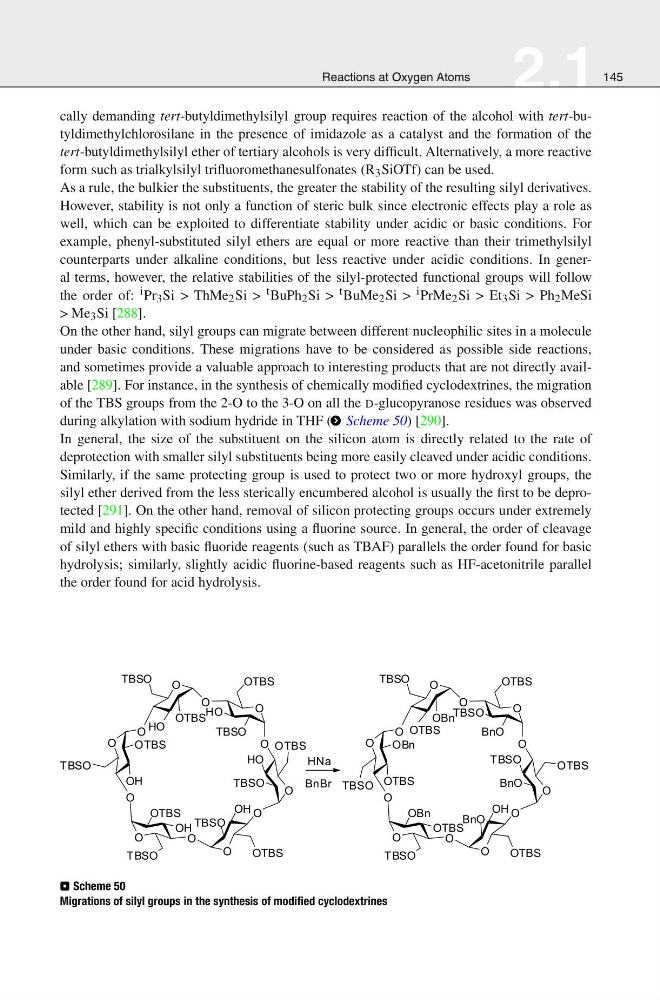
and sometimes provide a valuable approach to interesting products that are not directly available [289]. For instance, in the synthesis of chemically modified cyclodextrines, the migration
of the TBS groups from the 2-O to the 3-O on all the D-glucopyranose residues was observed
during alkylation with sodium hydride in THF ( > Scheme 50) [290].
In general, the size of the substituent on the silicon atom is directly related to the rate of
deprotection with smaller silyl substituents being more easily cleaved under acidic conditions.
Similarly, if the same protecting group is used to protect two or more hydroxyl groups, the
silyl ether derived from the less sterically encumbered alcohol is usually the first to be deprotected [291]. On the other hand, removal of silicon protecting groups occurs under extremely
mild and highly specific conditions using a fluorine source. In general, the order of cleavage
of silyl ethers with basic fluoride reagents (such as TBAF) parallels the order found for basic
hydrolysis; similarly, slightly acidic fluorine-based reagents such as HF-acetonitrile parallel
the order found for acid hydrolysis.
⊡ Scheme 50
Migrations of silyl groups in the synthesis of modified cyclodextrines
2.1
145
cally demanding tert-butyldimethylsilyl group requires reaction of the alcohol with tert-butyldimethylchlorosilane in the presence of imidazole as a catalyst and the formation of the
tert-butyldimethylsilyl ether of tertiary alcohols is very difficult. Alternatively, a more reactive
form such as trialkylsilyl trifluoromethanesulfonates (R 3 SiOTf) can be used.
As a rule, the bulkier the substituents, the greater the stability of the resulting silyl derivatives.
However, stability is not only a function of steric bulk since electronic effects play a role as
well, which can be exploited to differentiate stability under acidic or basic conditions. For
example, phenyl-substituted silyl ethers are equal or more reactive than their trimethylsilyl
counterparts under alkaline conditions, but less reactive under acidic conditions. In general terms, however, the relative stabilities of the silyl-protected functional groups will follow
the order of: i Pr 3 Si > ThMe 2 Si > t BuPh 2 Si > t BuMe 2 Si > i PrMe 2 Si > Et 3 Si > Ph 2 MeSi
> Me 3 Si [288].
On the other hand, silyl groups can migrate between different nucleophilic sites in a molecule
under basic conditions. These migrations have to be considered as possible side reactions,
and sometimes provide a valuable approach to interesting products that are not directly available [289]. For instance, in the synthesis of chemically modified cyclodextrines, the migration
of the TBS groups from the 2-O to the 3-O on all the D-glucopyranose residues was observed
during alkylation with sodium hydride in THF ( > Scheme 50) [290].
In general, the size of the substituent on the silicon atom is directly related to the rate of
deprotection with smaller silyl substituents being more easily cleaved under acidic conditions.
Similarly, if the same protecting group is used to protect two or more hydroxyl groups, the
silyl ether derived from the less sterically encumbered alcohol is usually the first to be deprotected [291]. On the other hand, removal of silicon protecting groups occurs under extremely
mild and highly specific conditions using a fluorine source. In general, the order of cleavage
of silyl ethers with basic fluoride reagents (such as TBAF) parallels the order found for basic
hydrolysis; similarly, slightly acidic fluorine-based reagents such as HF-acetonitrile parallel
the order found for acid hydrolysis.
⊡ Scheme 50
Migrations of silyl groups in the synthesis of modified cyclodextrines