

146
2
General Synthetic Methods
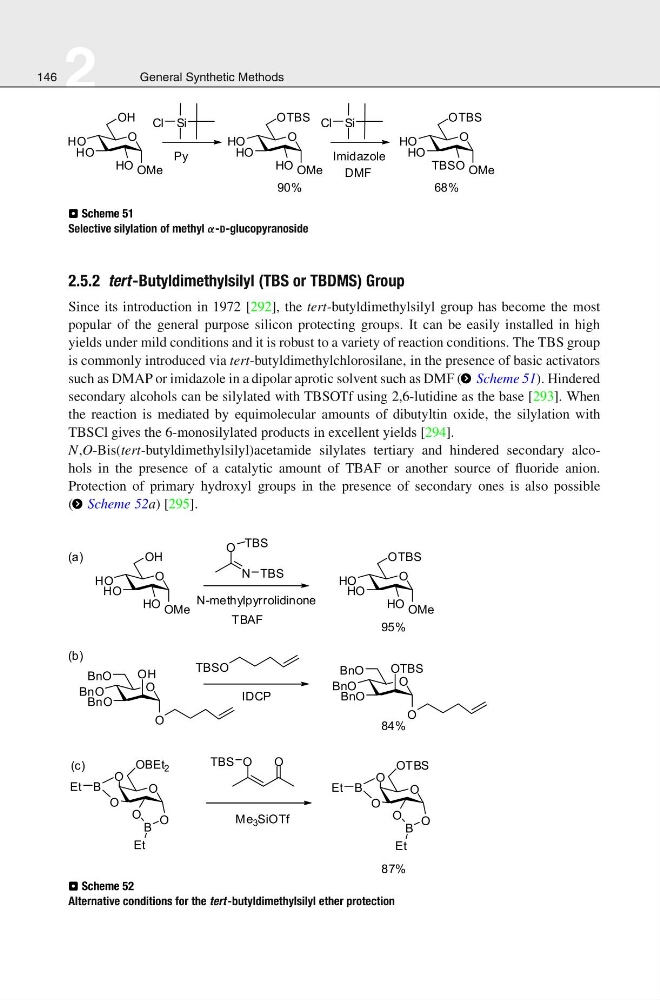
⊡ Scheme 51
Selective silylation of methyl α-D-glucopyranoside
2.5.2 tert -Butyldimethylsilyl (TBS or TBDMS) Group
Since its introduction in 1972 [292], the tert-butyldimethylsilyl group has become the most
popular of the general purpose silicon protecting groups. It can be easily installed in high
yields under mild conditions and it is robust to a variety of reaction conditions. The TBS group
is commonly introduced via tert-butyldimethylchlorosilane, in the presence of basic activators
such as DMAP or imidazole in a dipolar aprotic solvent such as DMF ( > Scheme 51). Hindered
secondary alcohols can be silylated with TBSOTf using 2,6-lutidine as the base [293]. When
the reaction is mediated by equimolecular amounts of dibutyltin oxide, the silylation with
TBSCl gives the 6-monosilylated products in excellent yields [294].
N,O-Bis(tert-butyldimethylsilyl)acetamide silylates tertiary and hindered secondary alcohols in the presence of a catalytic amount of TBAF or another source of fluoride anion.
Protection of primary hydroxyl groups in the presence of secondary ones is also possible
( > Scheme 52a) [295].
⊡ Scheme 52
Alternative conditions for the tert -butyldimethylsilyl ether protection
2
General Synthetic Methods
⊡ Scheme 51
Selective silylation of methyl α-D-glucopyranoside
2.5.2 tert -Butyldimethylsilyl (TBS or TBDMS) Group
Since its introduction in 1972 [292], the tert-butyldimethylsilyl group has become the most
popular of the general purpose silicon protecting groups. It can be easily installed in high
yields under mild conditions and it is robust to a variety of reaction conditions. The TBS group
is commonly introduced via tert-butyldimethylchlorosilane, in the presence of basic activators
such as DMAP or imidazole in a dipolar aprotic solvent such as DMF ( > Scheme 51). Hindered
secondary alcohols can be silylated with TBSOTf using 2,6-lutidine as the base [293]. When
the reaction is mediated by equimolecular amounts of dibutyltin oxide, the silylation with
TBSCl gives the 6-monosilylated products in excellent yields [294].
N,O-Bis(tert-butyldimethylsilyl)acetamide silylates tertiary and hindered secondary alcohols in the presence of a catalytic amount of TBAF or another source of fluoride anion.
Protection of primary hydroxyl groups in the presence of secondary ones is also possible
( > Scheme 52a) [295].
⊡ Scheme 52
Alternative conditions for the tert -butyldimethylsilyl ether protection