

144
2
General Synthetic Methods
The removal of NSEC carbonates is carried out by reaction with TBAF in the presence of
esters including acetyl, levulinoyl, benzoyl and pivaloyl, but also allyl and PMB ethers are not
affected. However, the NSEC group cannot be selectively removed in the presence of Fmoc
protecting groups.
2.5 Silylation Reactions: Silyl-Type Protecting Groups
2.5.1 Silyl Ethers. General Aspects
Silyl ethers have become very important alcohol protecting groups, which are used, among
other ways, routinely in carbohydrate chemistry [286]. Silyl derivatives are generally stable
over a wide variety of reaction conditions and at the same time are selectively removable in
the presence of other functional groups including other protecting groups.
Additionally, the ability to vary the organic groups on silicon introduces the potential to alter
the R 3 Si group in terms of both its steric and electronic characteristics and thereby influence the stability of the silylated species to a wide variety of reaction and deprotection conditions [287].
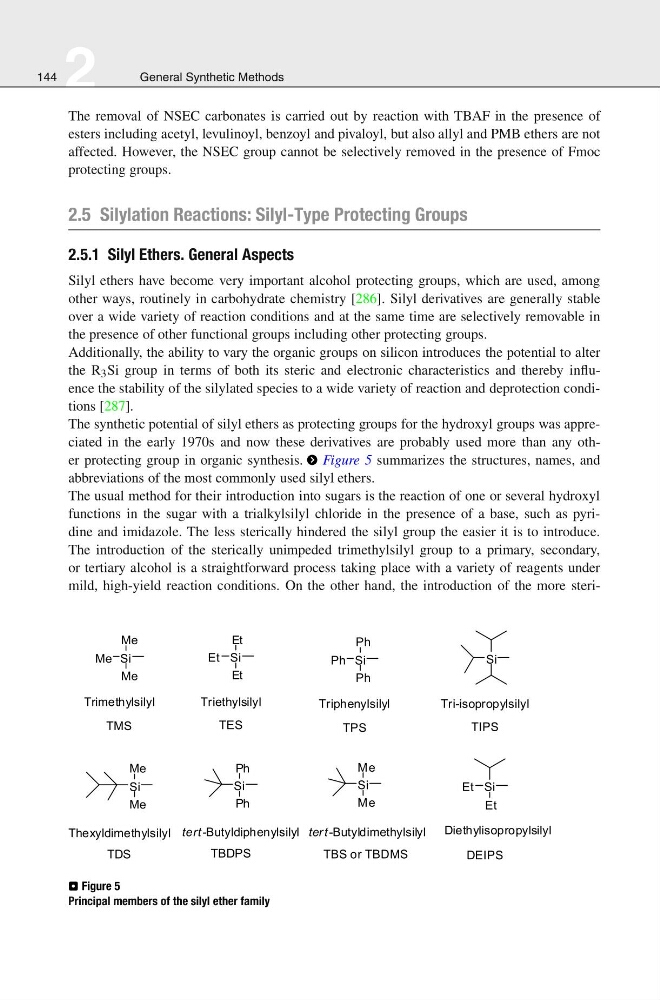
The synthetic potential of silyl ethers as protecting groups for the hydroxyl groups was appreciated in the early 1970s and now these derivatives are probably used more than any other protecting group in organic synthesis. > Figure 5 summarizes the structures, names, and
abbreviations of the most commonly used silyl ethers.
The usual method for their introduction into sugars is the reaction of one or several hydroxyl
functions in the sugar with a trialkylsilyl chloride in the presence of a base, such as pyridine and imidazole. The less sterically hindered the silyl group the easier it is to introduce.
The introduction of the sterically unimpeded trimethylsilyl group to a primary, secondary,
or tertiary alcohol is a straightforward process taking place with a variety of reagents under
mild, high-yield reaction conditions. On the other hand, the introduction of the more steri⊡ Figure 5
Principal members of the silyl ether family
2
General Synthetic Methods
The removal of NSEC carbonates is carried out by reaction with TBAF in the presence of
esters including acetyl, levulinoyl, benzoyl and pivaloyl, but also allyl and PMB ethers are not
affected. However, the NSEC group cannot be selectively removed in the presence of Fmoc
protecting groups.
2.5 Silylation Reactions: Silyl-Type Protecting Groups
2.5.1 Silyl Ethers. General Aspects
Silyl ethers have become very important alcohol protecting groups, which are used, among
other ways, routinely in carbohydrate chemistry [286]. Silyl derivatives are generally stable
over a wide variety of reaction conditions and at the same time are selectively removable in
the presence of other functional groups including other protecting groups.
Additionally, the ability to vary the organic groups on silicon introduces the potential to alter
the R 3 Si group in terms of both its steric and electronic characteristics and thereby influence the stability of the silylated species to a wide variety of reaction and deprotection conditions [287].
The synthetic potential of silyl ethers as protecting groups for the hydroxyl groups was appreciated in the early 1970s and now these derivatives are probably used more than any other protecting group in organic synthesis. > Figure 5 summarizes the structures, names, and
abbreviations of the most commonly used silyl ethers.
The usual method for their introduction into sugars is the reaction of one or several hydroxyl
functions in the sugar with a trialkylsilyl chloride in the presence of a base, such as pyridine and imidazole. The less sterically hindered the silyl group the easier it is to introduce.
The introduction of the sterically unimpeded trimethylsilyl group to a primary, secondary,
or tertiary alcohol is a straightforward process taking place with a variety of reagents under
mild, high-yield reaction conditions. On the other hand, the introduction of the more steri⊡ Figure 5
Principal members of the silyl ether family