

138
2
General Synthetic Methods
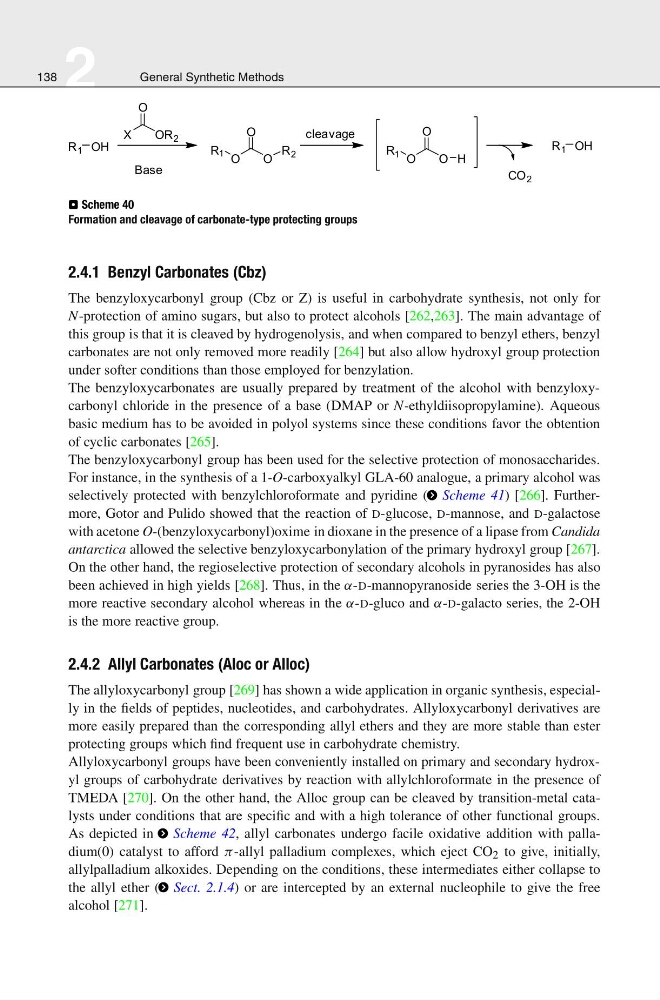
⊡ Scheme 40
Formation and cleavage of carbonate-type protecting groups
2.4.1 Benzyl Carbonates (Cbz)
The benzyloxycarbonyl group (Cbz or Z) is useful in carbohydrate synthesis, not only for
N-protection of amino sugars, but also to protect alcohols [262,263]. The main advantage of
this group is that it is cleaved by hydrogenolysis, and when compared to benzyl ethers, benzyl
carbonates are not only removed more readily [264] but also allow hydroxyl group protection
under softer conditions than those employed for benzylation.
The benzyloxycarbonates are usually prepared by treatment of the alcohol with benzyloxycarbonyl chloride in the presence of a base (DMAP or N-ethyldiisopropylamine). Aqueous
basic medium has to be avoided in polyol systems since these conditions favor the obtention
of cyclic carbonates [265].
The benzyloxycarbonyl group has been used for the selective protection of monosaccharides.
For instance, in the synthesis of a 1-O-carboxyalkyl GLA-60 analogue, a primary alcohol was
selectively protected with benzylchloroformate and pyridine ( > Scheme 41) [266]. Furthermore, Gotor and Pulido showed that the reaction of D-glucose, D-mannose, and D-galactose
with acetone O-(benzyloxycarbonyl)oxime in dioxane in the presence of a lipase from Candida
antarctica allowed the selective benzyloxycarbonylation of the primary hydroxyl group [267].
On the other hand, the regioselective protection of secondary alcohols in pyranosides has also
been achieved in high yields [268]. Thus, in the α-D-mannopyranoside series the 3-OH is the
more reactive secondary alcohol whereas in the α-D-gluco and α-D-galacto series, the 2-OH
is the more reactive group.
2.4.2 Allyl Carbonates (Aloc or Alloc)
The allyloxycarbonyl group [269] has shown a wide application in organic synthesis, especially in the fields of peptides, nucleotides, and carbohydrates. Allyloxycarbonyl derivatives are
more easily prepared than the corresponding allyl ethers and they are more stable than ester
protecting groups which find frequent use in carbohydrate chemistry.
Allyloxycarbonyl groups have been conveniently installed on primary and secondary hydroxyl groups of carbohydrate derivatives by reaction with allylchloroformate in the presence of
TMEDA [270]. On the other hand, the Alloc group can be cleaved by transition-metal catalysts under conditions that are specific and with a high tolerance of other functional groups.
As depicted in > Scheme 42, allyl carbonates undergo facile oxidative addition with palladium(0) catalyst to afford π-allyl palladium complexes, which eject CO 2 to give, initially,
allylpalladium alkoxides. Depending on the conditions, these intermediates either collapse to
the allyl ether ( > Sect. 2.1.4) or are intercepted by an external nucleophile to give the free
alcohol [271].
2
General Synthetic Methods
⊡ Scheme 40
Formation and cleavage of carbonate-type protecting groups
2.4.1 Benzyl Carbonates (Cbz)
The benzyloxycarbonyl group (Cbz or Z) is useful in carbohydrate synthesis, not only for
N-protection of amino sugars, but also to protect alcohols [262,263]. The main advantage of
this group is that it is cleaved by hydrogenolysis, and when compared to benzyl ethers, benzyl
carbonates are not only removed more readily [264] but also allow hydroxyl group protection
under softer conditions than those employed for benzylation.
The benzyloxycarbonates are usually prepared by treatment of the alcohol with benzyloxycarbonyl chloride in the presence of a base (DMAP or N-ethyldiisopropylamine). Aqueous
basic medium has to be avoided in polyol systems since these conditions favor the obtention
of cyclic carbonates [265].
The benzyloxycarbonyl group has been used for the selective protection of monosaccharides.
For instance, in the synthesis of a 1-O-carboxyalkyl GLA-60 analogue, a primary alcohol was
selectively protected with benzylchloroformate and pyridine ( > Scheme 41) [266]. Furthermore, Gotor and Pulido showed that the reaction of D-glucose, D-mannose, and D-galactose
with acetone O-(benzyloxycarbonyl)oxime in dioxane in the presence of a lipase from Candida
antarctica allowed the selective benzyloxycarbonylation of the primary hydroxyl group [267].
On the other hand, the regioselective protection of secondary alcohols in pyranosides has also
been achieved in high yields [268]. Thus, in the α-D-mannopyranoside series the 3-OH is the
more reactive secondary alcohol whereas in the α-D-gluco and α-D-galacto series, the 2-OH
is the more reactive group.
2.4.2 Allyl Carbonates (Aloc or Alloc)
The allyloxycarbonyl group [269] has shown a wide application in organic synthesis, especially in the fields of peptides, nucleotides, and carbohydrates. Allyloxycarbonyl derivatives are
more easily prepared than the corresponding allyl ethers and they are more stable than ester
protecting groups which find frequent use in carbohydrate chemistry.
Allyloxycarbonyl groups have been conveniently installed on primary and secondary hydroxyl groups of carbohydrate derivatives by reaction with allylchloroformate in the presence of
TMEDA [270]. On the other hand, the Alloc group can be cleaved by transition-metal catalysts under conditions that are specific and with a high tolerance of other functional groups.
As depicted in > Scheme 42, allyl carbonates undergo facile oxidative addition with palladium(0) catalyst to afford π-allyl palladium complexes, which eject CO 2 to give, initially,
allylpalladium alkoxides. Depending on the conditions, these intermediates either collapse to
the allyl ether ( > Sect. 2.1.4) or are intercepted by an external nucleophile to give the free
alcohol [271].