

Reactions at Oxygen Atoms
2.1
137
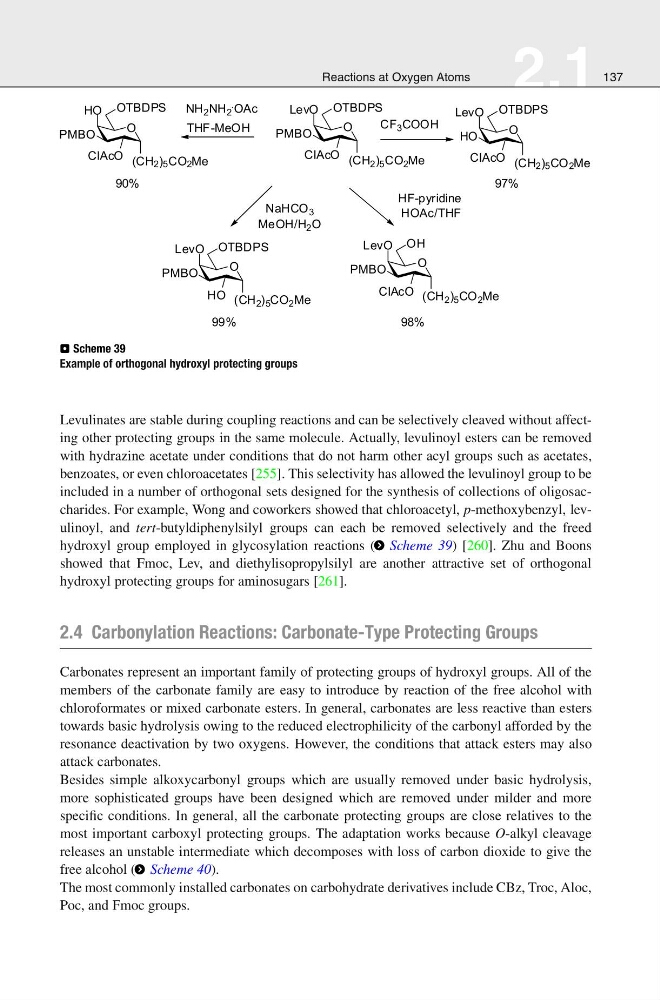
⊡ Scheme 39
Example of orthogonal hydroxyl protecting groups
Levulinates are stable during coupling reactions and can be selectively cleaved without affecting other protecting groups in the same molecule. Actually, levulinoyl esters can be removed
with hydrazine acetate under conditions that do not harm other acyl groups such as acetates,
benzoates, or even chloroacetates [255]. This selectivity has allowed the levulinoyl group to be
included in a number of orthogonal sets designed for the synthesis of collections of oligosaccharides. For example, Wong and coworkers showed that chloroacetyl, p-methoxybenzyl, levulinoyl, and tert-butyldiphenylsilyl groups can each be removed selectively and the freed
hydroxyl group employed in glycosylation reactions ( > Scheme 39) [260]. Zhu and Boons
showed that Fmoc, Lev, and diethylisopropylsilyl are another attractive set of orthogonal
hydroxyl protecting groups for aminosugars [261].
2.4 Carbonylation Reactions: Carbonate-Type Protecting Groups
Carbonates represent an important family of protecting groups of hydroxyl groups. All of the
members of the carbonate family are easy to introduce by reaction of the free alcohol with
chloroformates or mixed carbonate esters. In general, carbonates are less reactive than esters
towards basic hydrolysis owing to the reduced electrophilicity of the carbonyl afforded by the
resonance deactivation by two oxygens. However, the conditions that attack esters may also
attack carbonates.
Besides simple alkoxycarbonyl groups which are usually removed under basic hydrolysis,
more sophisticated groups have been designed which are removed under milder and more
specific conditions. In general, all the carbonate protecting groups are close relatives to the
most important carboxyl protecting groups. The adaptation works because O-alkyl cleavage
releases an unstable intermediate which decomposes with loss of carbon dioxide to give the
free alcohol ( > Scheme 40).
The most commonly installed carbonates on carbohydrate derivatives include CBz, Troc, Aloc,
Poc, and Fmoc groups.
2.1
137
⊡ Scheme 39
Example of orthogonal hydroxyl protecting groups
Levulinates are stable during coupling reactions and can be selectively cleaved without affecting other protecting groups in the same molecule. Actually, levulinoyl esters can be removed
with hydrazine acetate under conditions that do not harm other acyl groups such as acetates,
benzoates, or even chloroacetates [255]. This selectivity has allowed the levulinoyl group to be
included in a number of orthogonal sets designed for the synthesis of collections of oligosaccharides. For example, Wong and coworkers showed that chloroacetyl, p-methoxybenzyl, levulinoyl, and tert-butyldiphenylsilyl groups can each be removed selectively and the freed
hydroxyl group employed in glycosylation reactions ( > Scheme 39) [260]. Zhu and Boons
showed that Fmoc, Lev, and diethylisopropylsilyl are another attractive set of orthogonal
hydroxyl protecting groups for aminosugars [261].
2.4 Carbonylation Reactions: Carbonate-Type Protecting Groups
Carbonates represent an important family of protecting groups of hydroxyl groups. All of the
members of the carbonate family are easy to introduce by reaction of the free alcohol with
chloroformates or mixed carbonate esters. In general, carbonates are less reactive than esters
towards basic hydrolysis owing to the reduced electrophilicity of the carbonyl afforded by the
resonance deactivation by two oxygens. However, the conditions that attack esters may also
attack carbonates.
Besides simple alkoxycarbonyl groups which are usually removed under basic hydrolysis,
more sophisticated groups have been designed which are removed under milder and more
specific conditions. In general, all the carbonate protecting groups are close relatives to the
most important carboxyl protecting groups. The adaptation works because O-alkyl cleavage
releases an unstable intermediate which decomposes with loss of carbon dioxide to give the
free alcohol ( > Scheme 40).
The most commonly installed carbonates on carbohydrate derivatives include CBz, Troc, Aloc,
Poc, and Fmoc groups.