

136
2
General Synthetic Methods
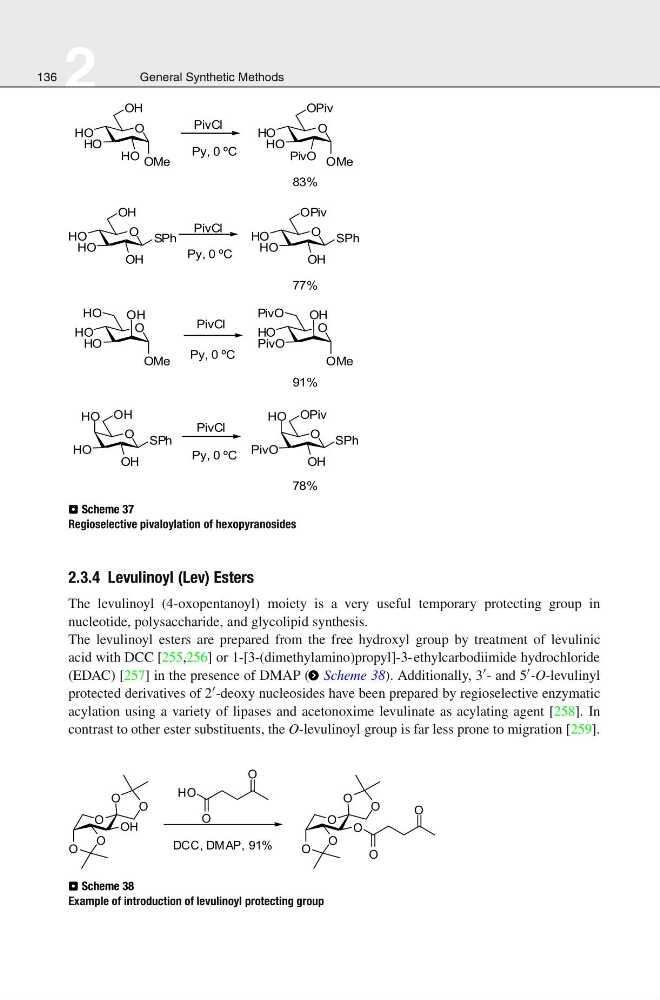
⊡ Scheme 37
Regioselective pivaloylation of hexopyranosides
2.3.4 Levulinoyl (Lev) Esters
The levulinoyl (4-oxopentanoyl) moiety is a very useful temporary protecting group in
nucleotide, polysaccharide, and glycolipid synthesis.
The levulinoyl esters are prepared from the free hydroxyl group by treatment of levulinic
acid with DCC [255,256] or 1-[3-(dimethylamino)propyl]-3-ethylcarbodiimide hydrochloride
(EDAC) [257] in the presence of DMAP ( > Scheme 38). Additionally, 3 - and 5 -O-levulinyl
protected derivatives of 2 -deoxy nucleosides have been prepared by regioselective enzymatic
acylation using a variety of lipases and acetonoxime levulinate as acylating agent [258]. In
contrast to other ester substituents, the O-levulinoyl group is far less prone to migration [259].
⊡ Scheme 38
Example of introduction of levulinoyl protecting group
2
General Synthetic Methods
⊡ Scheme 37
Regioselective pivaloylation of hexopyranosides
2.3.4 Levulinoyl (Lev) Esters
The levulinoyl (4-oxopentanoyl) moiety is a very useful temporary protecting group in
nucleotide, polysaccharide, and glycolipid synthesis.
The levulinoyl esters are prepared from the free hydroxyl group by treatment of levulinic
acid with DCC [255,256] or 1-[3-(dimethylamino)propyl]-3-ethylcarbodiimide hydrochloride
(EDAC) [257] in the presence of DMAP ( > Scheme 38). Additionally, 3 - and 5 -O-levulinyl
protected derivatives of 2 -deoxy nucleosides have been prepared by regioselective enzymatic
acylation using a variety of lipases and acetonoxime levulinate as acylating agent [258]. In
contrast to other ester substituents, the O-levulinoyl group is far less prone to migration [259].
⊡ Scheme 38
Example of introduction of levulinoyl protecting group