

Reactions at Oxygen Atoms
2.1
135
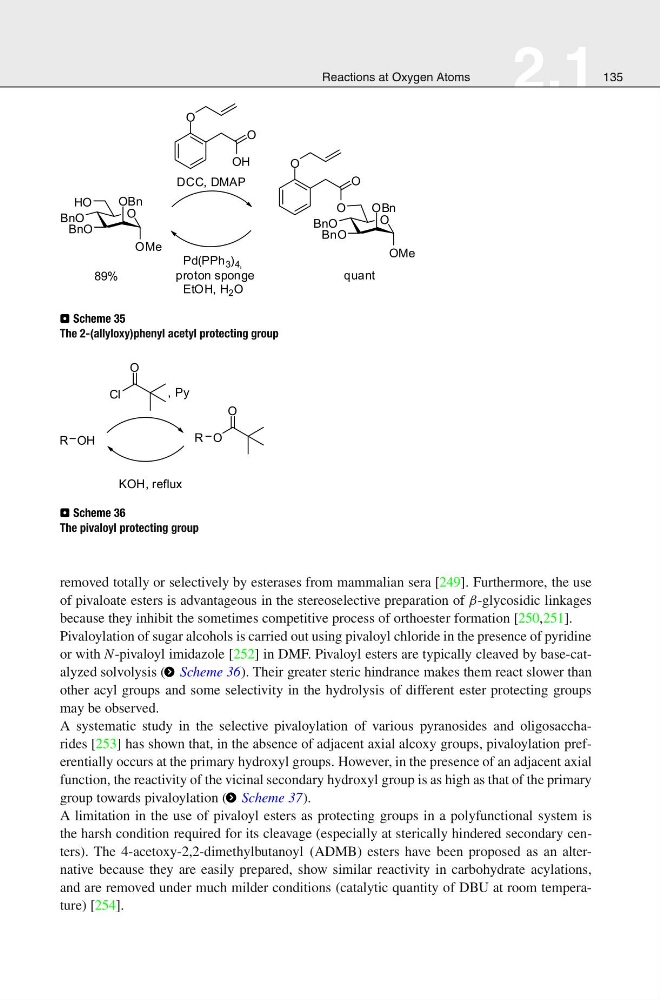
⊡ Scheme 35
The 2-(allyloxy)phenyl acetyl protecting group
⊡ Scheme 36
The pivaloyl protecting group
removed totally or selectively by esterases from mammalian sera [249]. Furthermore, the use
of pivaloate esters is advantageous in the stereoselective preparation of β-glycosidic linkages
because they inhibit the sometimes competitive process of orthoester formation [250,251].
Pivaloylation of sugar alcohols is carried out using pivaloyl chloride in the presence of pyridine
or with N-pivaloyl imidazole [252] in DMF. Pivaloyl esters are typically cleaved by base-catalyzed solvolysis ( > Scheme 36). Their greater steric hindrance makes them react slower than
other acyl groups and some selectivity in the hydrolysis of different ester protecting groups
may be observed.
A systematic study in the selective pivaloylation of various pyranosides and oligosaccharides [253] has shown that, in the absence of adjacent axial alcoxy groups, pivaloylation preferentially occurs at the primary hydroxyl groups. However, in the presence of an adjacent axial
function, the reactivity of the vicinal secondary hydroxyl group is as high as that of the primary
group towards pivaloylation ( > Scheme 37).
A limitation in the use of pivaloyl esters as protecting groups in a polyfunctional system is
the harsh condition required for its cleavage (especially at sterically hindered secondary centers). The 4-acetoxy-2,2-dimethylbutanoyl (ADMB) esters have been proposed as an alternative because they are easily prepared, show similar reactivity in carbohydrate acylations,
and are removed under much milder conditions (catalytic quantity of DBU at room temperature) [254].
2.1
135
⊡ Scheme 35
The 2-(allyloxy)phenyl acetyl protecting group
⊡ Scheme 36
The pivaloyl protecting group
removed totally or selectively by esterases from mammalian sera [249]. Furthermore, the use
of pivaloate esters is advantageous in the stereoselective preparation of β-glycosidic linkages
because they inhibit the sometimes competitive process of orthoester formation [250,251].
Pivaloylation of sugar alcohols is carried out using pivaloyl chloride in the presence of pyridine
or with N-pivaloyl imidazole [252] in DMF. Pivaloyl esters are typically cleaved by base-catalyzed solvolysis ( > Scheme 36). Their greater steric hindrance makes them react slower than
other acyl groups and some selectivity in the hydrolysis of different ester protecting groups
may be observed.
A systematic study in the selective pivaloylation of various pyranosides and oligosaccharides [253] has shown that, in the absence of adjacent axial alcoxy groups, pivaloylation preferentially occurs at the primary hydroxyl groups. However, in the presence of an adjacent axial
function, the reactivity of the vicinal secondary hydroxyl group is as high as that of the primary
group towards pivaloylation ( > Scheme 37).
A limitation in the use of pivaloyl esters as protecting groups in a polyfunctional system is
the harsh condition required for its cleavage (especially at sterically hindered secondary centers). The 4-acetoxy-2,2-dimethylbutanoyl (ADMB) esters have been proposed as an alternative because they are easily prepared, show similar reactivity in carbohydrate acylations,
and are removed under much milder conditions (catalytic quantity of DBU at room temperature) [254].