

134
2
General Synthetic Methods
2.3.2 Substituted Acetyl Esters
The lability of acetates is enhanced by introducing chlorine atoms in the α-position. Thus,
chloroacetates (Cac or ClAc) hydrolyze faster than acetates and trichloroacetates are so reactive that they are rarely used in synthesis. Thus far, thiourea [241], hydrazine dithiocarbonate [242], pyridine [243] and diazabicyclo[2.2.2] octane (DABCO) [244] are representative of
dechloroacetylation reagents. 1-Selenocarbamoylpiperidine also deprotects the O-chloroacetyl
group with high chemoselectivity in the presence of other acyl groups such as acetyl, pivaloyl, and Fmoc without the assistance of a base [245]. Thiourea, hydrazine dithiocarbonate, or
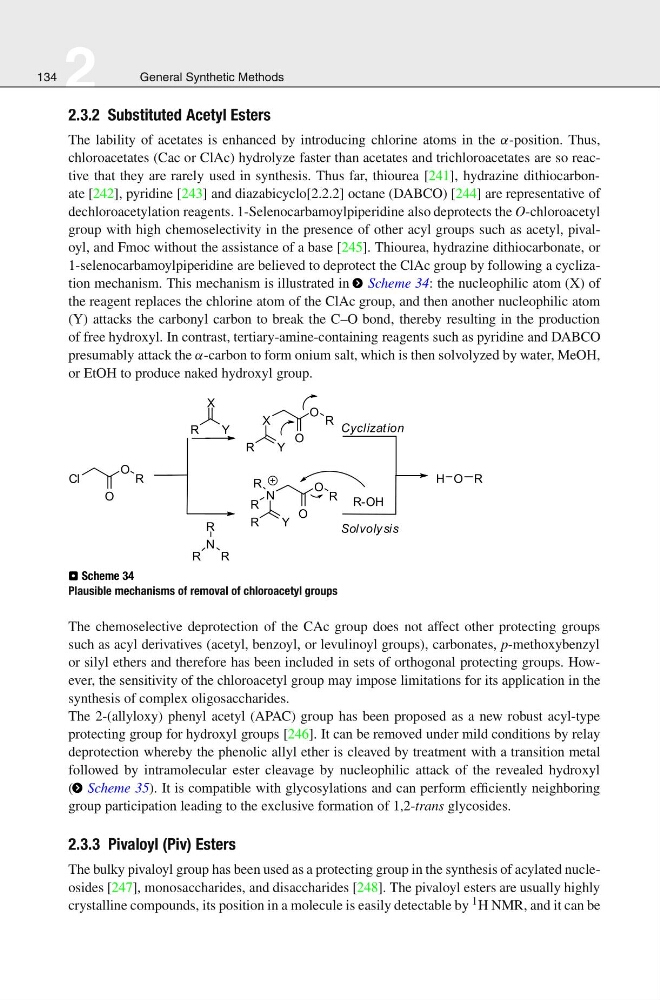
1-selenocarbamoylpiperidine are believed to deprotect the ClAc group by following a cyclization mechanism. This mechanism is illustrated in > Scheme 34: the nucleophilic atom (X) of
the reagent replaces the chlorine atom of the ClAc group, and then another nucleophilic atom
(Y) attacks the carbonyl carbon to break the C–O bond, thereby resulting in the production
of free hydroxyl. In contrast, tertiary-amine-containing reagents such as pyridine and DABCO
presumably attack the α-carbon to form onium salt, which is then solvolyzed by water, MeOH,
or EtOH to produce naked hydroxyl group.
⊡ Scheme 34
Plausible mechanisms of removal of chloroacetyl groups
The chemoselective deprotection of the CAc group does not affect other protecting groups
such as acyl derivatives (acetyl, benzoyl, or levulinoyl groups), carbonates, p-methoxybenzyl
or silyl ethers and therefore has been included in sets of orthogonal protecting groups. However, the sensitivity of the chloroacetyl group may impose limitations for its application in the
synthesis of complex oligosaccharides.
The 2-(allyloxy) phenyl acetyl (APAC) group has been proposed as a new robust acyl-type
protecting group for hydroxyl groups [246]. It can be removed under mild conditions by relay
deprotection whereby the phenolic allyl ether is cleaved by treatment with a transition metal
followed by intramolecular ester cleavage by nucleophilic attack of the revealed hydroxyl
( > Scheme 35). It is compatible with glycosylations and can perform efficiently neighboring
group participation leading to the exclusive formation of 1,2-trans glycosides.
2.3.3 Pivaloyl (Piv) Esters
The bulky pivaloyl group has been used as a protecting group in the synthesis of acylated nucleosides [247], monosaccharides, and disaccharides [248]. The pivaloyl esters are usually highly
crystalline compounds, its position in a molecule is easily detectable by 1 H NMR, and it can be
2
General Synthetic Methods
2.3.2 Substituted Acetyl Esters
The lability of acetates is enhanced by introducing chlorine atoms in the α-position. Thus,
chloroacetates (Cac or ClAc) hydrolyze faster than acetates and trichloroacetates are so reactive that they are rarely used in synthesis. Thus far, thiourea [241], hydrazine dithiocarbonate [242], pyridine [243] and diazabicyclo[2.2.2] octane (DABCO) [244] are representative of
dechloroacetylation reagents. 1-Selenocarbamoylpiperidine also deprotects the O-chloroacetyl
group with high chemoselectivity in the presence of other acyl groups such as acetyl, pivaloyl, and Fmoc without the assistance of a base [245]. Thiourea, hydrazine dithiocarbonate, or
1-selenocarbamoylpiperidine are believed to deprotect the ClAc group by following a cyclization mechanism. This mechanism is illustrated in > Scheme 34: the nucleophilic atom (X) of
the reagent replaces the chlorine atom of the ClAc group, and then another nucleophilic atom
(Y) attacks the carbonyl carbon to break the C–O bond, thereby resulting in the production
of free hydroxyl. In contrast, tertiary-amine-containing reagents such as pyridine and DABCO
presumably attack the α-carbon to form onium salt, which is then solvolyzed by water, MeOH,
or EtOH to produce naked hydroxyl group.
⊡ Scheme 34
Plausible mechanisms of removal of chloroacetyl groups
The chemoselective deprotection of the CAc group does not affect other protecting groups
such as acyl derivatives (acetyl, benzoyl, or levulinoyl groups), carbonates, p-methoxybenzyl
or silyl ethers and therefore has been included in sets of orthogonal protecting groups. However, the sensitivity of the chloroacetyl group may impose limitations for its application in the
synthesis of complex oligosaccharides.
The 2-(allyloxy) phenyl acetyl (APAC) group has been proposed as a new robust acyl-type
protecting group for hydroxyl groups [246]. It can be removed under mild conditions by relay
deprotection whereby the phenolic allyl ether is cleaved by treatment with a transition metal
followed by intramolecular ester cleavage by nucleophilic attack of the revealed hydroxyl
( > Scheme 35). It is compatible with glycosylations and can perform efficiently neighboring
group participation leading to the exclusive formation of 1,2-trans glycosides.
2.3.3 Pivaloyl (Piv) Esters
The bulky pivaloyl group has been used as a protecting group in the synthesis of acylated nucleosides [247], monosaccharides, and disaccharides [248]. The pivaloyl esters are usually highly
crystalline compounds, its position in a molecule is easily detectable by 1 H NMR, and it can be