

Reactions at Oxygen Atoms
2.1
133
Enzymatic regioselective protection techniques are also an interesting and useful method for
the protection of hydroxyl groups [233]. Such techniques are exclusively directed at regioselective acylation and deacylation, mostly by using different lipases [234] or proteases [235],
which can catalyze acyl transfer reactions from activated esters to suitable acceptors. The most
frequently used enzymes are Porcine pancreatic lipase (PPL), Protease N-neutral protease
(PN), Pseudomonas fluorescens lipase (PFL), Chromobacterium viscosum lipase (CVL), and
Candida cylindracea lipase (CCL). The results of the enzymatic acylation of several pyranoses
and furanoses have been reviewed [236]. Almost all combinations of enzymes and substrates
lead to acylation of the primary hydroxy group. The regioselectivities are usually higher than
70%, and the conversions between 40 and 100%. However, if the 6-OH groups are protected
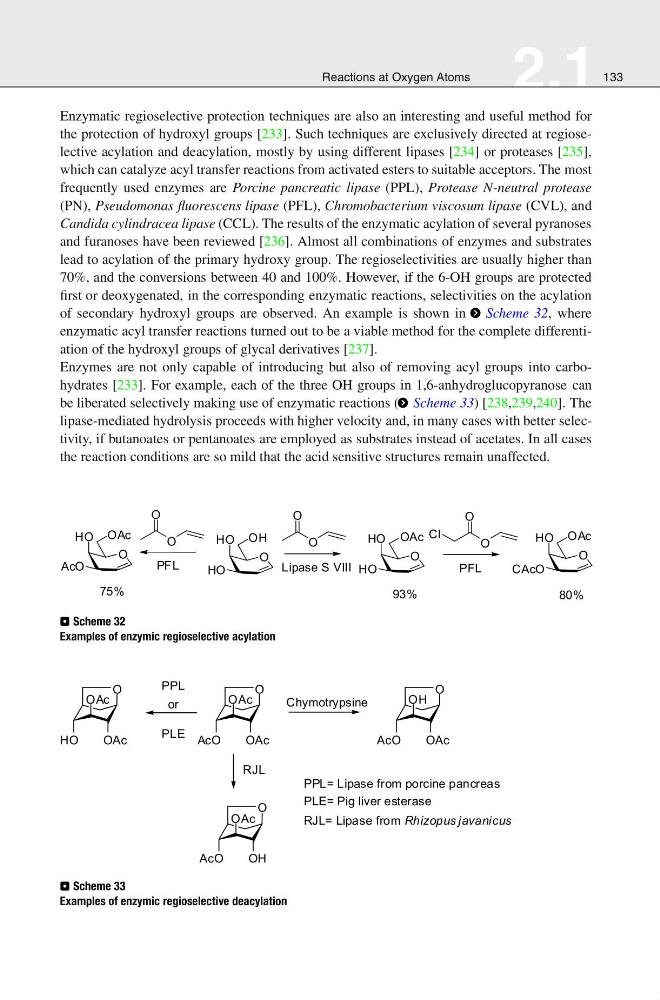
first or deoxygenated, in the corresponding enzymatic reactions, selectivities on the acylation
of secondary hydroxyl groups are observed. An example is shown in > Scheme 32, where
enzymatic acyl transfer reactions turned out to be a viable method for the complete differentiation of the hydroxyl groups of glycal derivatives [237].
Enzymes are not only capable of introducing but also of removing acyl groups into carbohydrates [233]. For example, each of the three OH groups in 1,6-anhydroglucopyranose can
be liberated selectively making use of enzymatic reactions ( > Scheme 33) [238,239,240]. The
lipase-mediated hydrolysis proceeds with higher velocity and, in many cases with better selectivity, if butanoates or pentanoates are employed as substrates instead of acetates. In all cases
the reaction conditions are so mild that the acid sensitive structures remain unaffected.
⊡ Scheme 32
Examples of enzymic regioselective acylation
⊡ Scheme 33
Examples of enzymic regioselective deacylation
2.1
133
Enzymatic regioselective protection techniques are also an interesting and useful method for
the protection of hydroxyl groups [233]. Such techniques are exclusively directed at regioselective acylation and deacylation, mostly by using different lipases [234] or proteases [235],
which can catalyze acyl transfer reactions from activated esters to suitable acceptors. The most
frequently used enzymes are Porcine pancreatic lipase (PPL), Protease N-neutral protease
(PN), Pseudomonas fluorescens lipase (PFL), Chromobacterium viscosum lipase (CVL), and
Candida cylindracea lipase (CCL). The results of the enzymatic acylation of several pyranoses
and furanoses have been reviewed [236]. Almost all combinations of enzymes and substrates
lead to acylation of the primary hydroxy group. The regioselectivities are usually higher than
70%, and the conversions between 40 and 100%. However, if the 6-OH groups are protected
first or deoxygenated, in the corresponding enzymatic reactions, selectivities on the acylation
of secondary hydroxyl groups are observed. An example is shown in > Scheme 32, where
enzymatic acyl transfer reactions turned out to be a viable method for the complete differentiation of the hydroxyl groups of glycal derivatives [237].
Enzymes are not only capable of introducing but also of removing acyl groups into carbohydrates [233]. For example, each of the three OH groups in 1,6-anhydroglucopyranose can
be liberated selectively making use of enzymatic reactions ( > Scheme 33) [238,239,240]. The
lipase-mediated hydrolysis proceeds with higher velocity and, in many cases with better selectivity, if butanoates or pentanoates are employed as substrates instead of acetates. In all cases
the reaction conditions are so mild that the acid sensitive structures remain unaffected.
⊡ Scheme 32
Examples of enzymic regioselective acylation
⊡ Scheme 33
Examples of enzymic regioselective deacylation