

Reactions at Oxygen Atoms
2.1
127
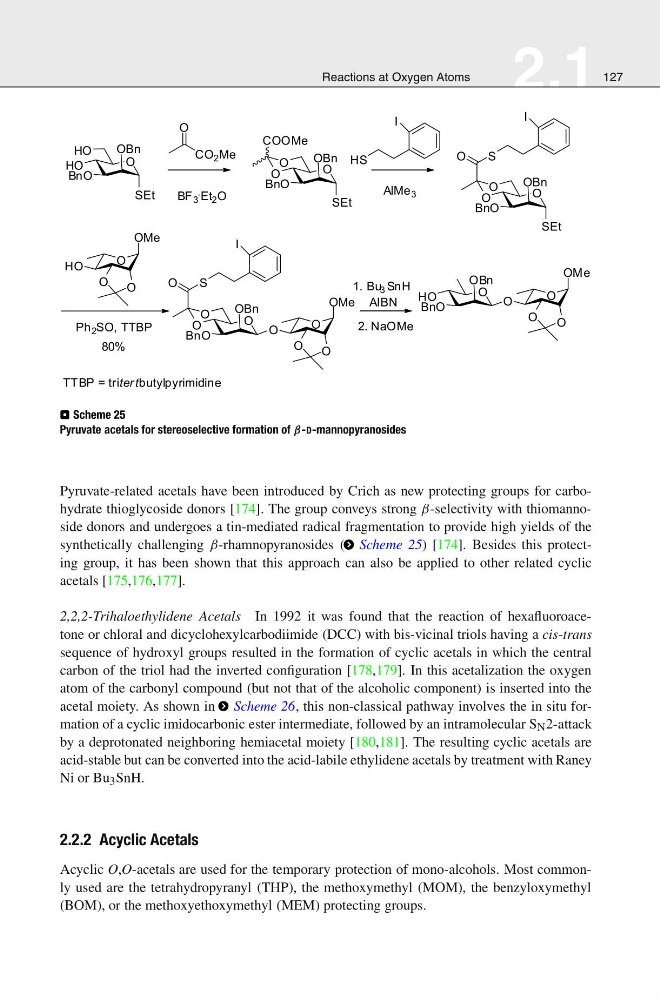
⊡ Scheme 25
Pyruvate acetals for stereoselective formation of β-D-mannopyranosides
Pyruvate-related acetals have been introduced by Crich as new protecting groups for carbohydrate thioglycoside donors [174]. The group conveys strong β-selectivity with thiomannoside donors and undergoes a tin-mediated radical fragmentation to provide high yields of the
synthetically challenging β-rhamnopyranosides ( > Scheme 25) [174]. Besides this protecting group, it has been shown that this approach can also be applied to other related cyclic
acetals [175,176,177].
2,2,2-Trihaloethylidene Acetals In 1992 it was found that the reaction of hexafluoroacetone or chloral and dicyclohexylcarbodiimide (DCC) with bis-vicinal triols having a cis-trans
sequence of hydroxyl groups resulted in the formation of cyclic acetals in which the central
carbon of the triol had the inverted configuration [178,179]. In this acetalization the oxygen
atom of the carbonyl compound (but not that of the alcoholic component) is inserted into the
acetal moiety. As shown in > Scheme 26, this non-classical pathway involves the in situ formation of a cyclic imidocarbonic ester intermediate, followed by an intramolecular S N 2-attack
by a deprotonated neighboring hemiacetal moiety [180,181]. The resulting cyclic acetals are
acid-stable but can be converted into the acid-labile ethylidene acetals by treatment with Raney
Ni or Bu 3 SnH.
2.2.2 Acyclic Acetals
Acyclic O,O-acetals are used for the temporary protection of mono-alcohols. Most commonly used are the tetrahydropyranyl (THP), the methoxymethyl (MOM), the benzyloxymethyl
(BOM), or the methoxyethoxymethyl (MEM) protecting groups.
2.1
127
⊡ Scheme 25
Pyruvate acetals for stereoselective formation of β-D-mannopyranosides
Pyruvate-related acetals have been introduced by Crich as new protecting groups for carbohydrate thioglycoside donors [174]. The group conveys strong β-selectivity with thiomannoside donors and undergoes a tin-mediated radical fragmentation to provide high yields of the
synthetically challenging β-rhamnopyranosides ( > Scheme 25) [174]. Besides this protecting group, it has been shown that this approach can also be applied to other related cyclic
acetals [175,176,177].
2,2,2-Trihaloethylidene Acetals In 1992 it was found that the reaction of hexafluoroacetone or chloral and dicyclohexylcarbodiimide (DCC) with bis-vicinal triols having a cis-trans
sequence of hydroxyl groups resulted in the formation of cyclic acetals in which the central
carbon of the triol had the inverted configuration [178,179]. In this acetalization the oxygen
atom of the carbonyl compound (but not that of the alcoholic component) is inserted into the
acetal moiety. As shown in > Scheme 26, this non-classical pathway involves the in situ formation of a cyclic imidocarbonic ester intermediate, followed by an intramolecular S N 2-attack
by a deprotonated neighboring hemiacetal moiety [180,181]. The resulting cyclic acetals are
acid-stable but can be converted into the acid-labile ethylidene acetals by treatment with Raney
Ni or Bu 3 SnH.
2.2.2 Acyclic Acetals
Acyclic O,O-acetals are used for the temporary protection of mono-alcohols. Most commonly used are the tetrahydropyranyl (THP), the methoxymethyl (MOM), the benzyloxymethyl
(BOM), or the methoxyethoxymethyl (MEM) protecting groups.