

126
2
General Synthetic Methods
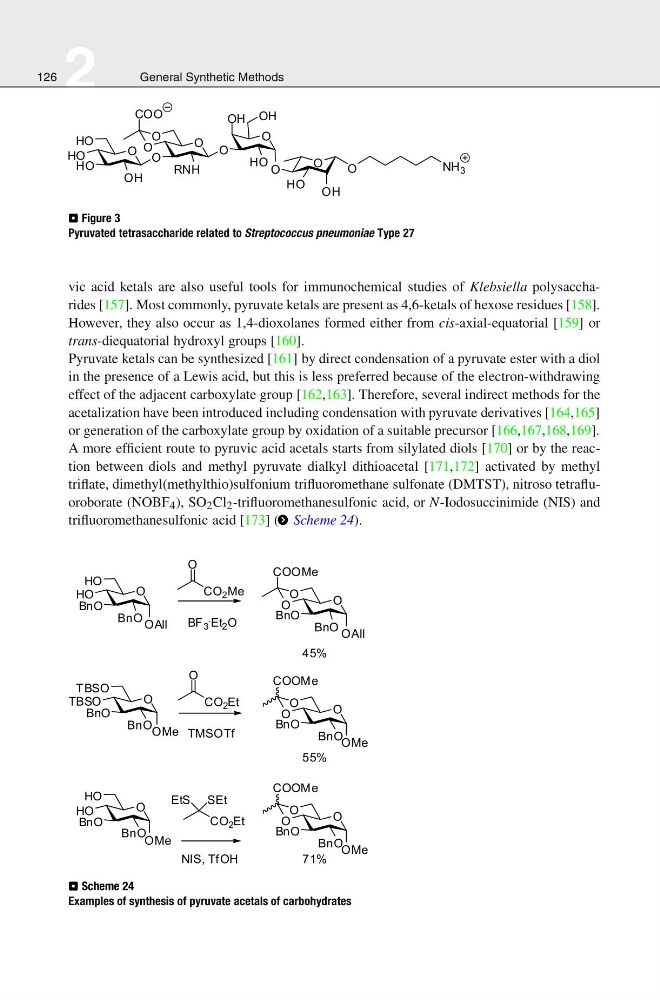
⊡ Figure 3
Pyruvated tetrasaccharide related to Streptococcus pneumoniae Type 27
vic acid ketals are also useful tools for immunochemical studies of Klebsiella polysaccharides [157]. Most commonly, pyruvate ketals are present as 4,6-ketals of hexose residues [158].
However, they also occur as 1,4-dioxolanes formed either from cis-axial-equatorial [159] or
trans-diequatorial hydroxyl groups [160].
Pyruvate ketals can be synthesized [161] by direct condensation of a pyruvate ester with a diol
in the presence of a Lewis acid, but this is less preferred because of the electron-withdrawing
effect of the adjacent carboxylate group [162,163]. Therefore, several indirect methods for the
acetalization have been introduced including condensation with pyruvate derivatives [164,165]
or generation of the carboxylate group by oxidation of a suitable precursor [166,167,168,169].
A more efficient route to pyruvic acid acetals starts from silylated diols [170] or by the reaction between diols and methyl pyruvate dialkyl dithioacetal [171,172] activated by methyl
triflate, dimethyl(methylthio)sulfonium trifluoromethane sulfonate (DMTST), nitroso tetrafluoroborate (NOBF 4 ), SO 2 Cl 2 -trifluoromethanesulfonic acid, or N-Iodosuccinimide (NIS) and
trifluoromethanesulfonic acid [173] ( > Scheme 24).
⊡ Scheme 24
Examples of synthesis of pyruvate acetals of carbohydrates
2
General Synthetic Methods
⊡ Figure 3
Pyruvated tetrasaccharide related to Streptococcus pneumoniae Type 27
vic acid ketals are also useful tools for immunochemical studies of Klebsiella polysaccharides [157]. Most commonly, pyruvate ketals are present as 4,6-ketals of hexose residues [158].
However, they also occur as 1,4-dioxolanes formed either from cis-axial-equatorial [159] or
trans-diequatorial hydroxyl groups [160].
Pyruvate ketals can be synthesized [161] by direct condensation of a pyruvate ester with a diol
in the presence of a Lewis acid, but this is less preferred because of the electron-withdrawing
effect of the adjacent carboxylate group [162,163]. Therefore, several indirect methods for the
acetalization have been introduced including condensation with pyruvate derivatives [164,165]
or generation of the carboxylate group by oxidation of a suitable precursor [166,167,168,169].
A more efficient route to pyruvic acid acetals starts from silylated diols [170] or by the reaction between diols and methyl pyruvate dialkyl dithioacetal [171,172] activated by methyl
triflate, dimethyl(methylthio)sulfonium trifluoromethane sulfonate (DMTST), nitroso tetrafluoroborate (NOBF 4 ), SO 2 Cl 2 -trifluoromethanesulfonic acid, or N-Iodosuccinimide (NIS) and
trifluoromethanesulfonic acid [173] ( > Scheme 24).
⊡ Scheme 24
Examples of synthesis of pyruvate acetals of carbohydrates