

128
2
General Synthetic Methods
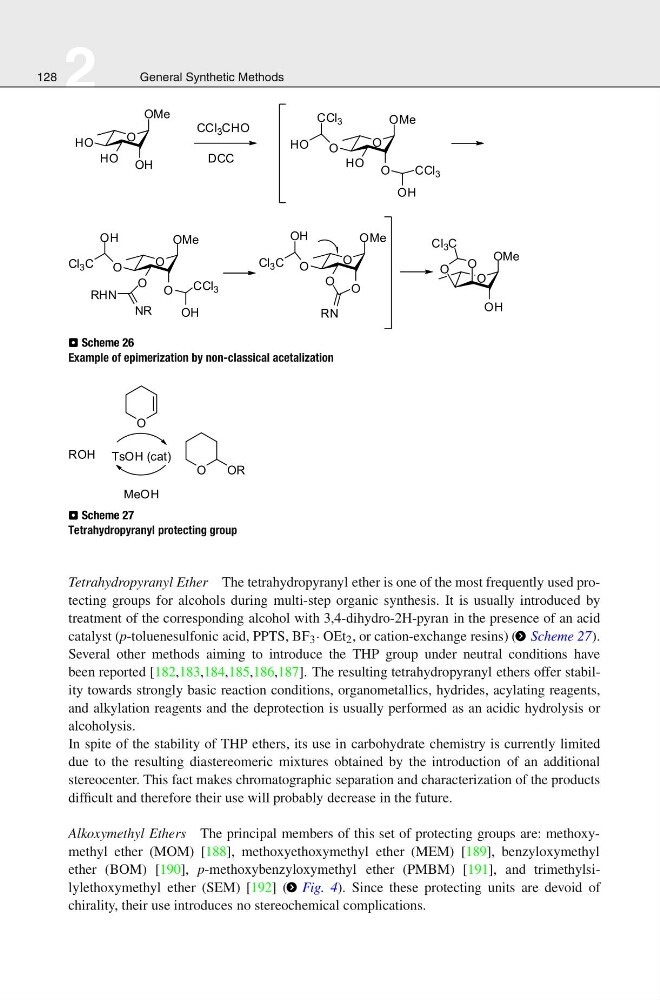
⊡ Scheme 26
Example of epimerization by non-classical acetalization
⊡ Scheme 27
Tetrahydropyranyl protecting group
Tetrahydropyranyl Ether The tetrahydropyranyl ether is one of the most frequently used protecting groups for alcohols during multi-step organic synthesis. It is usually introduced by
treatment of the corresponding alcohol with 3,4-dihydro-2H-pyran in the presence of an acid
catalyst (p-toluenesulfonic acid, PPTS, BF 3 · OEt 2 , or cation-exchange resins) ( > Scheme 27).
Several other methods aiming to introduce the THP group under neutral conditions have
been reported [182,183,184,185,186,187]. The resulting tetrahydropyranyl ethers offer stability towards strongly basic reaction conditions, organometallics, hydrides, acylating reagents,
and alkylation reagents and the deprotection is usually performed as an acidic hydrolysis or
alcoholysis.
In spite of the stability of THP ethers, its use in carbohydrate chemistry is currently limited
due to the resulting diastereomeric mixtures obtained by the introduction of an additional
stereocenter. This fact makes chromatographic separation and characterization of the products
difficult and therefore their use will probably decrease in the future.
Alkoxymethyl Ethers The principal members of this set of protecting groups are: methoxymethyl ether (MOM) [188], methoxyethoxymethyl ether (MEM) [189], benzyloxymethyl
ether (BOM) [190], p-methoxybenzyloxymethyl ether (PMBM) [191], and trimethylsilylethoxymethyl ether (SEM) [192] ( > Fig. 4). Since these protecting units are devoid of
chirality, their use introduces no stereochemical complications.
2
General Synthetic Methods
⊡ Scheme 26
Example of epimerization by non-classical acetalization
⊡ Scheme 27
Tetrahydropyranyl protecting group
Tetrahydropyranyl Ether The tetrahydropyranyl ether is one of the most frequently used protecting groups for alcohols during multi-step organic synthesis. It is usually introduced by
treatment of the corresponding alcohol with 3,4-dihydro-2H-pyran in the presence of an acid
catalyst (p-toluenesulfonic acid, PPTS, BF 3 · OEt 2 , or cation-exchange resins) ( > Scheme 27).
Several other methods aiming to introduce the THP group under neutral conditions have
been reported [182,183,184,185,186,187]. The resulting tetrahydropyranyl ethers offer stability towards strongly basic reaction conditions, organometallics, hydrides, acylating reagents,
and alkylation reagents and the deprotection is usually performed as an acidic hydrolysis or
alcoholysis.
In spite of the stability of THP ethers, its use in carbohydrate chemistry is currently limited
due to the resulting diastereomeric mixtures obtained by the introduction of an additional
stereocenter. This fact makes chromatographic separation and characterization of the products
difficult and therefore their use will probably decrease in the future.
Alkoxymethyl Ethers The principal members of this set of protecting groups are: methoxymethyl ether (MOM) [188], methoxyethoxymethyl ether (MEM) [189], benzyloxymethyl
ether (BOM) [190], p-methoxybenzyloxymethyl ether (PMBM) [191], and trimethylsilylethoxymethyl ether (SEM) [192] ( > Fig. 4). Since these protecting units are devoid of
chirality, their use introduces no stereochemical complications.