

Reactions at Oxygen Atoms
2.1
123
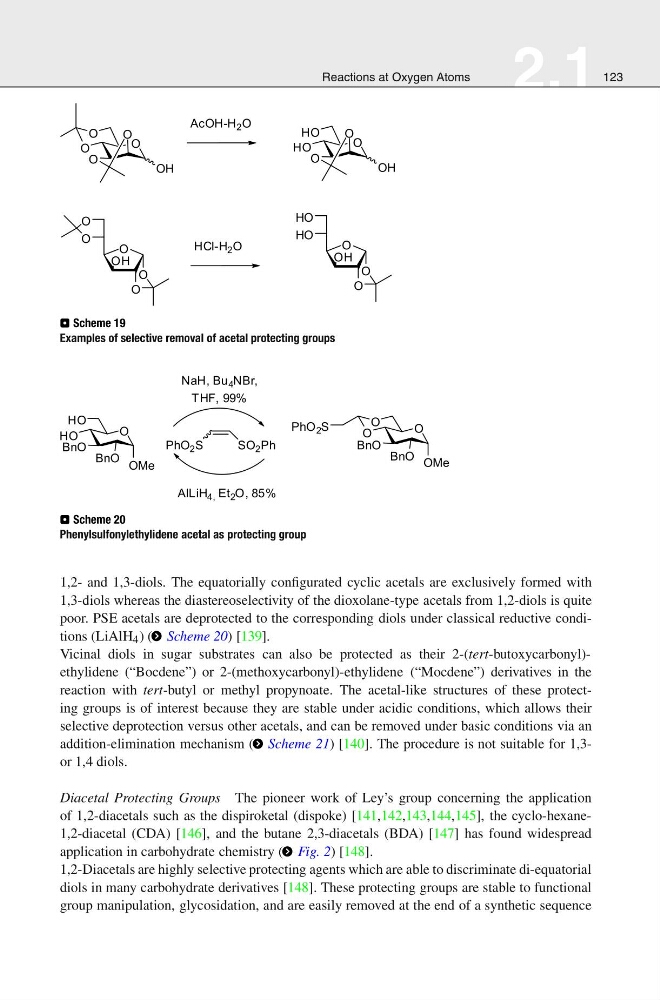
⊡ Scheme 19
Examples of selective removal of acetal protecting groups
⊡ Scheme 20
Phenylsulfonylethylidene acetal as protecting group
1,2- and 1,3-diols. The equatorially configurated cyclic acetals are exclusively formed with
1,3-diols whereas the diastereoselectivity of the dioxolane-type acetals from 1,2-diols is quite
poor. PSE acetals are deprotected to the corresponding diols under classical reductive conditions (LiAlH 4 ) ( > Scheme 20) [139].
Vicinal diols in sugar substrates can also be protected as their 2-(tert-butoxycarbonyl)ethylidene (“Bocdene”) or 2-(methoxycarbonyl)-ethylidene (“Mocdene”) derivatives in the
reaction with tert-butyl or methyl propynoate. The acetal-like structures of these protecting groups is of interest because they are stable under acidic conditions, which allows their
selective deprotection versus other acetals, and can be removed under basic conditions via an
addition-elimination mechanism ( > Scheme 21) [140]. The procedure is not suitable for 1,3or 1,4 diols.
Diacetal Protecting Groups The pioneer work of Ley’s group concerning the application
of 1,2-diacetals such as the dispiroketal (dispoke) [141,142,143,144,145], the cyclo-hexane1,2-diacetal (CDA) [146], and the butane 2,3-diacetals (BDA) [147] has found widespread
application in carbohydrate chemistry ( > Fig. 2) [148].
1,2-Diacetals are highly selective protecting agents which are able to discriminate di-equatorial
diols in many carbohydrate derivatives [148]. These protecting groups are stable to functional
group manipulation, glycosidation, and are easily removed at the end of a synthetic sequence
2.1
123
⊡ Scheme 19
Examples of selective removal of acetal protecting groups
⊡ Scheme 20
Phenylsulfonylethylidene acetal as protecting group
1,2- and 1,3-diols. The equatorially configurated cyclic acetals are exclusively formed with
1,3-diols whereas the diastereoselectivity of the dioxolane-type acetals from 1,2-diols is quite
poor. PSE acetals are deprotected to the corresponding diols under classical reductive conditions (LiAlH 4 ) ( > Scheme 20) [139].
Vicinal diols in sugar substrates can also be protected as their 2-(tert-butoxycarbonyl)ethylidene (“Bocdene”) or 2-(methoxycarbonyl)-ethylidene (“Mocdene”) derivatives in the
reaction with tert-butyl or methyl propynoate. The acetal-like structures of these protecting groups is of interest because they are stable under acidic conditions, which allows their
selective deprotection versus other acetals, and can be removed under basic conditions via an
addition-elimination mechanism ( > Scheme 21) [140]. The procedure is not suitable for 1,3or 1,4 diols.
Diacetal Protecting Groups The pioneer work of Ley’s group concerning the application
of 1,2-diacetals such as the dispiroketal (dispoke) [141,142,143,144,145], the cyclo-hexane1,2-diacetal (CDA) [146], and the butane 2,3-diacetals (BDA) [147] has found widespread
application in carbohydrate chemistry ( > Fig. 2) [148].
1,2-Diacetals are highly selective protecting agents which are able to discriminate di-equatorial
diols in many carbohydrate derivatives [148]. These protecting groups are stable to functional
group manipulation, glycosidation, and are easily removed at the end of a synthetic sequence