

122
2
General Synthetic Methods
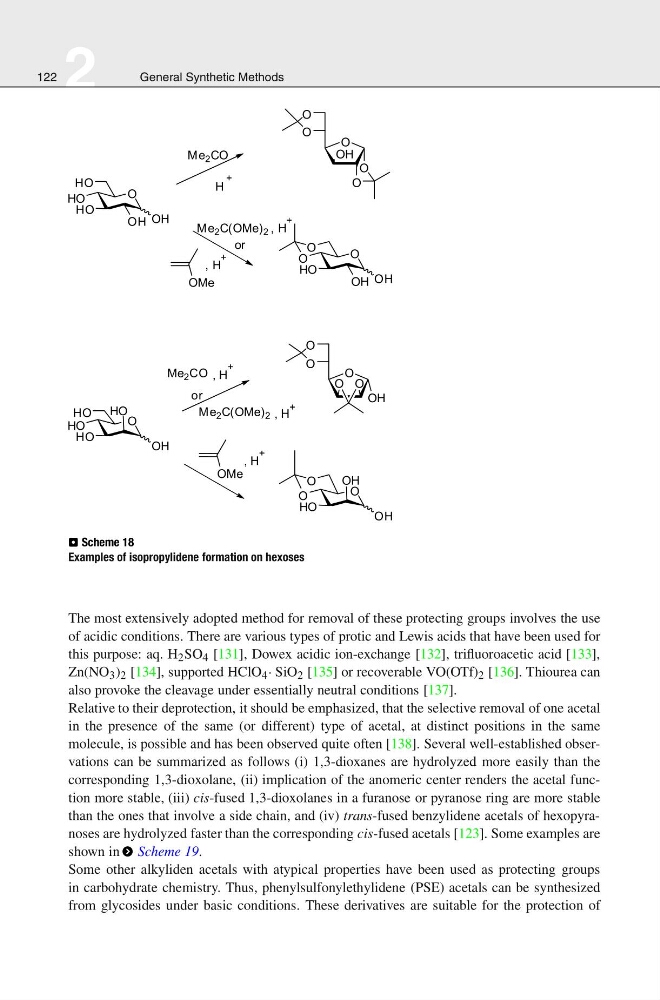
⊡ Scheme 18
Examples of isopropylidene formation on hexoses
The most extensively adopted method for removal of these protecting groups involves the use
of acidic conditions. There are various types of protic and Lewis acids that have been used for
this purpose: aq. H 2 SO 4 [131], Dowex acidic ion-exchange [132], trifluoroacetic acid [133],
Zn(NO 3 ) 2 [134], supported HClO 4 · SiO 2 [135] or recoverable VO(OTf) 2 [136]. Thiourea can
also provoke the cleavage under essentially neutral conditions [137].
Relative to their deprotection, it should be emphasized, that the selective removal of one acetal
in the presence of the same (or different) type of acetal, at distinct positions in the same
molecule, is possible and has been observed quite often [138]. Several well-established observations can be summarized as follows (i) 1,3-dioxanes are hydrolyzed more easily than the
corresponding 1,3-dioxolane, (ii) implication of the anomeric center renders the acetal function more stable, (iii) cis-fused 1,3-dioxolanes in a furanose or pyranose ring are more stable
than the ones that involve a side chain, and (iv) trans-fused benzylidene acetals of hexopyranoses are hydrolyzed faster than the corresponding cis-fused acetals [123]. Some examples are
shown in > Scheme 19.
Some other alkyliden acetals with atypical properties have been used as protecting groups
in carbohydrate chemistry. Thus, phenylsulfonylethylidene (PSE) acetals can be synthesized
from glycosides under basic conditions. These derivatives are suitable for the protection of
2
General Synthetic Methods
⊡ Scheme 18
Examples of isopropylidene formation on hexoses
The most extensively adopted method for removal of these protecting groups involves the use
of acidic conditions. There are various types of protic and Lewis acids that have been used for
this purpose: aq. H 2 SO 4 [131], Dowex acidic ion-exchange [132], trifluoroacetic acid [133],
Zn(NO 3 ) 2 [134], supported HClO 4 · SiO 2 [135] or recoverable VO(OTf) 2 [136]. Thiourea can
also provoke the cleavage under essentially neutral conditions [137].
Relative to their deprotection, it should be emphasized, that the selective removal of one acetal
in the presence of the same (or different) type of acetal, at distinct positions in the same
molecule, is possible and has been observed quite often [138]. Several well-established observations can be summarized as follows (i) 1,3-dioxanes are hydrolyzed more easily than the
corresponding 1,3-dioxolane, (ii) implication of the anomeric center renders the acetal function more stable, (iii) cis-fused 1,3-dioxolanes in a furanose or pyranose ring are more stable
than the ones that involve a side chain, and (iv) trans-fused benzylidene acetals of hexopyranoses are hydrolyzed faster than the corresponding cis-fused acetals [123]. Some examples are
shown in > Scheme 19.
Some other alkyliden acetals with atypical properties have been used as protecting groups
in carbohydrate chemistry. Thus, phenylsulfonylethylidene (PSE) acetals can be synthesized
from glycosides under basic conditions. These derivatives are suitable for the protection of