

124
2
General Synthetic Methods
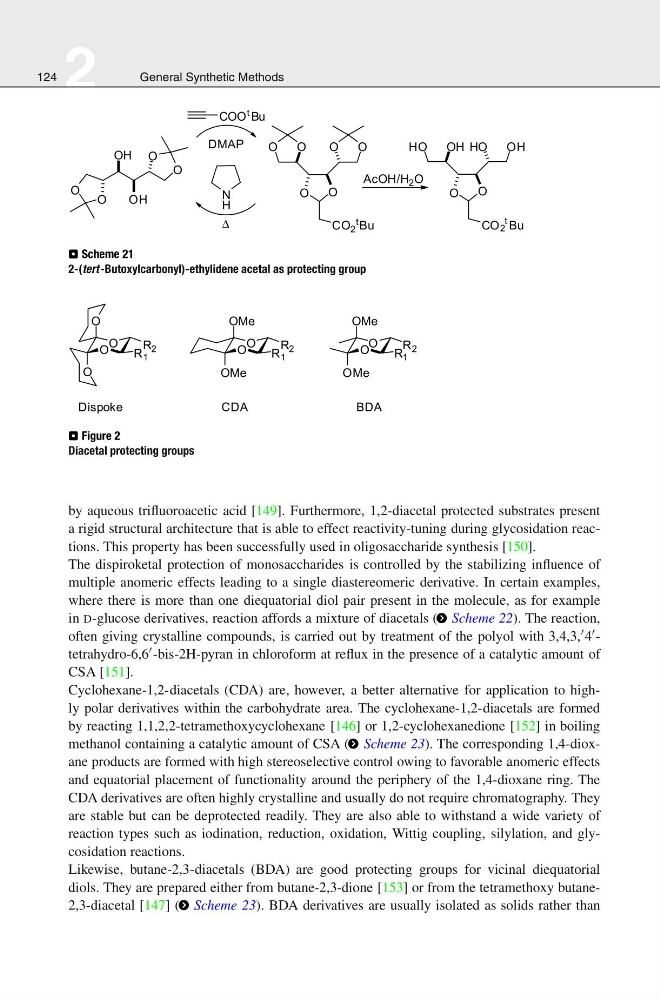
⊡ Scheme 21
2-(tert -Butoxylcarbonyl)-ethylidene acetal as protecting group
⊡ Figure 2
Diacetal protecting groups
by aqueous trifluoroacetic acid [149]. Furthermore, 1,2-diacetal protected substrates present
a rigid structural architecture that is able to effect reactivity-tuning during glycosidation reactions. This property has been successfully used in oligosaccharide synthesis [150].
The dispiroketal protection of monosaccharides is controlled by the stabilizing influence of
multiple anomeric effects leading to a single diastereomeric derivative. In certain examples,
where there is more than one diequatorial diol pair present in the molecule, as for example
in D-glucose derivatives, reaction affords a mixture of diacetals ( > Scheme 22). The reaction,
often giving crystalline compounds, is carried out by treatment of the polyol with 3,4,3, 4 -
tetrahydro-6,6 -bis-2H-pyran in chloroform at reflux in the presence of a catalytic amount of
CSA [151].
Cyclohexane-1,2-diacetals (CDA) are, however, a better alternative for application to highly polar derivatives within the carbohydrate area. The cyclohexane-1,2-diacetals are formed
by reacting 1,1,2,2-tetramethoxycyclohexane [146] or 1,2-cyclohexanedione [152] in boiling
methanol containing a catalytic amount of CSA ( > Scheme 23). The corresponding 1,4-dioxane products are formed with high stereoselective control owing to favorable anomeric effects
and equatorial placement of functionality around the periphery of the 1,4-dioxane ring. The
CDA derivatives are often highly crystalline and usually do not require chromatography. They
are stable but can be deprotected readily. They are also able to withstand a wide variety of
reaction types such as iodination, reduction, oxidation, Wittig coupling, silylation, and glycosidation reactions.
Likewise, butane-2,3-diacetals (BDA) are good protecting groups for vicinal diequatorial
diols. They are prepared either from butane-2,3-dione [153] or from the tetramethoxy butane2,3-diacetal [147] ( > Scheme 23). BDA derivatives are usually isolated as solids rather than
2
General Synthetic Methods
⊡ Scheme 21
2-(tert -Butoxylcarbonyl)-ethylidene acetal as protecting group
⊡ Figure 2
Diacetal protecting groups
by aqueous trifluoroacetic acid [149]. Furthermore, 1,2-diacetal protected substrates present
a rigid structural architecture that is able to effect reactivity-tuning during glycosidation reactions. This property has been successfully used in oligosaccharide synthesis [150].
The dispiroketal protection of monosaccharides is controlled by the stabilizing influence of
multiple anomeric effects leading to a single diastereomeric derivative. In certain examples,
where there is more than one diequatorial diol pair present in the molecule, as for example
in D-glucose derivatives, reaction affords a mixture of diacetals ( > Scheme 22). The reaction,
often giving crystalline compounds, is carried out by treatment of the polyol with 3,4,3, 4 -
tetrahydro-6,6 -bis-2H-pyran in chloroform at reflux in the presence of a catalytic amount of
CSA [151].
Cyclohexane-1,2-diacetals (CDA) are, however, a better alternative for application to highly polar derivatives within the carbohydrate area. The cyclohexane-1,2-diacetals are formed
by reacting 1,1,2,2-tetramethoxycyclohexane [146] or 1,2-cyclohexanedione [152] in boiling
methanol containing a catalytic amount of CSA ( > Scheme 23). The corresponding 1,4-dioxane products are formed with high stereoselective control owing to favorable anomeric effects
and equatorial placement of functionality around the periphery of the 1,4-dioxane ring. The
CDA derivatives are often highly crystalline and usually do not require chromatography. They
are stable but can be deprotected readily. They are also able to withstand a wide variety of
reaction types such as iodination, reduction, oxidation, Wittig coupling, silylation, and glycosidation reactions.
Likewise, butane-2,3-diacetals (BDA) are good protecting groups for vicinal diequatorial
diols. They are prepared either from butane-2,3-dione [153] or from the tetramethoxy butane2,3-diacetal [147] ( > Scheme 23). BDA derivatives are usually isolated as solids rather than