

118
2
General Synthetic Methods
2.1.5 Trityl (Tr) Ethers
The usefulness of triphenylmethyl ethers as protecting groups in organic synthesis, in general, and in carbohydrate and nucleoside chemistry in particular is well documented. Its utility
is attributed to the ease in preparing and removing them as well as to the high selectivity
for primary positions observed in polyols. Tritylation of primary hydroxyl groups using trityl
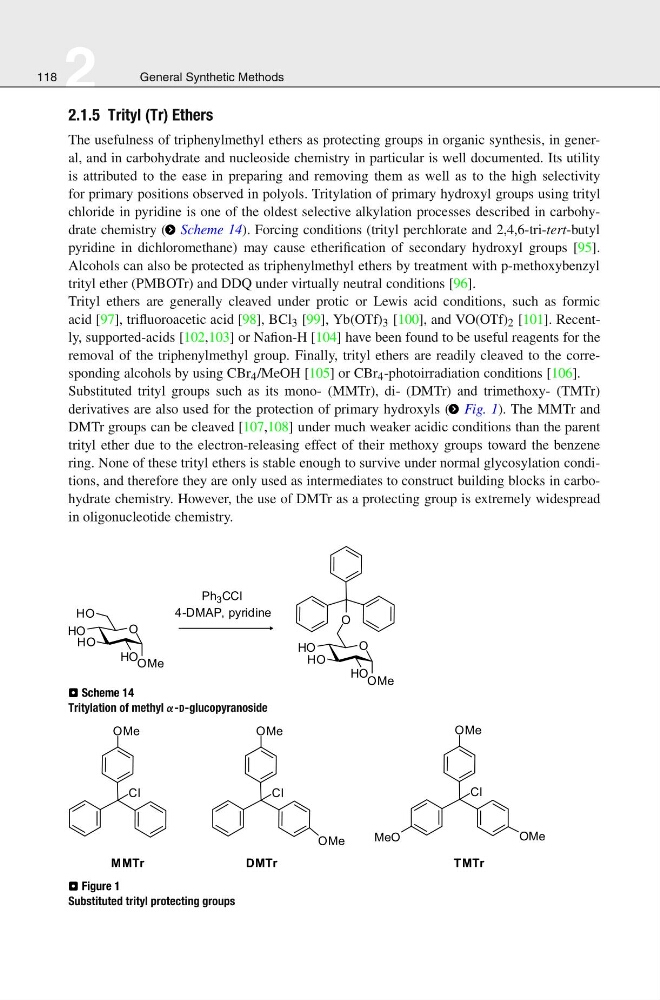
chloride in pyridine is one of the oldest selective alkylation processes described in carbohydrate chemistry ( > Scheme 14). Forcing conditions (trityl perchlorate and 2,4,6-tri-tert-butyl
pyridine in dichloromethane) may cause etherification of secondary hydroxyl groups [95].
Alcohols can also be protected as triphenylmethyl ethers by treatment with p-methoxybenzyl
trityl ether (PMBOTr) and DDQ under virtually neutral conditions [96].
Trityl ethers are generally cleaved under protic or Lewis acid conditions, such as formic
acid [97], trifluoroacetic acid [98], BCl 3 [99], Yb(OTf) 3 [100], and VO(OTf) 2 [101]. Recently, supported-acids [102,103] or Nafion-H [104] have been found to be useful reagents for the
removal of the triphenylmethyl group. Finally, trityl ethers are readily cleaved to the corresponding alcohols by using CBr 4 /MeOH [105] or CBr 4 -photoirradiation conditions [106].
Substituted trityl groups such as its mono- (MMTr), di- (DMTr) and trimethoxy- (TMTr)
derivatives are also used for the protection of primary hydroxyls ( > Fig. 1). The MMTr and
DMTr groups can be cleaved [107,108] under much weaker acidic conditions than the parent
trityl ether due to the electron-releasing effect of their methoxy groups toward the benzene
ring. None of these trityl ethers is stable enough to survive under normal glycosylation conditions, and therefore they are only used as intermediates to construct building blocks in carbohydrate chemistry. However, the use of DMTr as a protecting group is extremely widespread
in oligonucleotide chemistry.
⊡ Scheme 14
Tritylation of methyl α-D-glucopyranoside
⊡ Figure 1
Substituted trityl protecting groups
2
General Synthetic Methods
2.1.5 Trityl (Tr) Ethers
The usefulness of triphenylmethyl ethers as protecting groups in organic synthesis, in general, and in carbohydrate and nucleoside chemistry in particular is well documented. Its utility
is attributed to the ease in preparing and removing them as well as to the high selectivity
for primary positions observed in polyols. Tritylation of primary hydroxyl groups using trityl
chloride in pyridine is one of the oldest selective alkylation processes described in carbohydrate chemistry ( > Scheme 14). Forcing conditions (trityl perchlorate and 2,4,6-tri-tert-butyl
pyridine in dichloromethane) may cause etherification of secondary hydroxyl groups [95].
Alcohols can also be protected as triphenylmethyl ethers by treatment with p-methoxybenzyl
trityl ether (PMBOTr) and DDQ under virtually neutral conditions [96].
Trityl ethers are generally cleaved under protic or Lewis acid conditions, such as formic
acid [97], trifluoroacetic acid [98], BCl 3 [99], Yb(OTf) 3 [100], and VO(OTf) 2 [101]. Recently, supported-acids [102,103] or Nafion-H [104] have been found to be useful reagents for the
removal of the triphenylmethyl group. Finally, trityl ethers are readily cleaved to the corresponding alcohols by using CBr 4 /MeOH [105] or CBr 4 -photoirradiation conditions [106].
Substituted trityl groups such as its mono- (MMTr), di- (DMTr) and trimethoxy- (TMTr)
derivatives are also used for the protection of primary hydroxyls ( > Fig. 1). The MMTr and
DMTr groups can be cleaved [107,108] under much weaker acidic conditions than the parent
trityl ether due to the electron-releasing effect of their methoxy groups toward the benzene
ring. None of these trityl ethers is stable enough to survive under normal glycosylation conditions, and therefore they are only used as intermediates to construct building blocks in carbohydrate chemistry. However, the use of DMTr as a protecting group is extremely widespread
in oligonucleotide chemistry.
⊡ Scheme 14
Tritylation of methyl α-D-glucopyranoside
⊡ Figure 1
Substituted trityl protecting groups