

Reactions at Oxygen Atoms
2.1
119
2.1.6 2-Naphthylmethyl (NAP) Ethers
The 2-naphthylmethyl (NAP) group was introduced by Esko et al. [109] and Spencer et
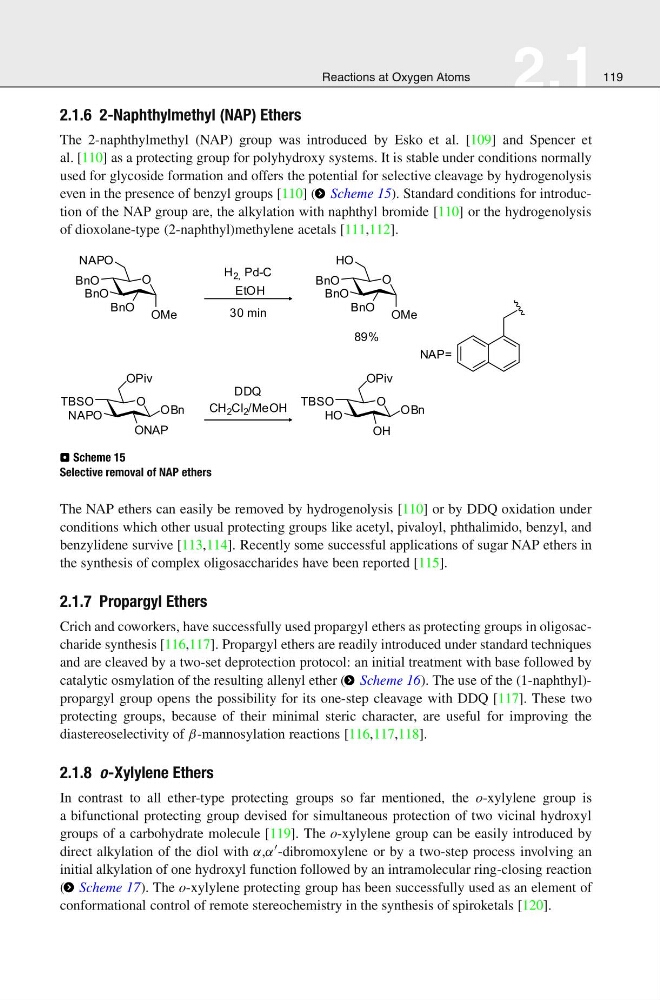
al. [110] as a protecting group for polyhydroxy systems. It is stable under conditions normally
used for glycoside formation and offers the potential for selective cleavage by hydrogenolysis
even in the presence of benzyl groups [110] ( > Scheme 15). Standard conditions for introduction of the NAP group are, the alkylation with naphthyl bromide [110] or the hydrogenolysis
of dioxolane-type (2-naphthyl)methylene acetals [111,112].
⊡ Scheme 15
Selective removal of NAP ethers
The NAP ethers can easily be removed by hydrogenolysis [110] or by DDQ oxidation under
conditions which other usual protecting groups like acetyl, pivaloyl, phthalimido, benzyl, and
benzylidene survive [113,114]. Recently some successful applications of sugar NAP ethers in
the synthesis of complex oligosaccharides have been reported [115].
2.1.7 Propargyl Ethers
Crich and coworkers, have successfully used propargyl ethers as protecting groups in oligosaccharide synthesis [116,117]. Propargyl ethers are readily introduced under standard techniques
and are cleaved by a two-set deprotection protocol: an initial treatment with base followed by
catalytic osmylation of the resulting allenyl ether ( > Scheme 16). The use of the (1-naphthyl)propargyl group opens the possibility for its one-step cleavage with DDQ [117]. These two
protecting groups, because of their minimal steric character, are useful for improving the
diastereoselectivity of β-mannosylation reactions [116,117,118].
2.1.8 o-Xylylene Ethers
In contrast to all ether-type protecting groups so far mentioned, the o-xylylene group is
a bifunctional protecting group devised for simultaneous protection of two vicinal hydroxyl
groups of a carbohydrate molecule [119]. The o-xylylene group can be easily introduced by
direct alkylation of the diol with α,α -dibromoxylene or by a two-step process involving an
initial alkylation of one hydroxyl function followed by an intramolecular ring-closing reaction
( > Scheme 17). The o-xylylene protecting group has been successfully used as an element of
conformational control of remote stereochemistry in the synthesis of spiroketals [120].
2.1
119
2.1.6 2-Naphthylmethyl (NAP) Ethers
The 2-naphthylmethyl (NAP) group was introduced by Esko et al. [109] and Spencer et
al. [110] as a protecting group for polyhydroxy systems. It is stable under conditions normally
used for glycoside formation and offers the potential for selective cleavage by hydrogenolysis
even in the presence of benzyl groups [110] ( > Scheme 15). Standard conditions for introduction of the NAP group are, the alkylation with naphthyl bromide [110] or the hydrogenolysis
of dioxolane-type (2-naphthyl)methylene acetals [111,112].
⊡ Scheme 15
Selective removal of NAP ethers
The NAP ethers can easily be removed by hydrogenolysis [110] or by DDQ oxidation under
conditions which other usual protecting groups like acetyl, pivaloyl, phthalimido, benzyl, and
benzylidene survive [113,114]. Recently some successful applications of sugar NAP ethers in
the synthesis of complex oligosaccharides have been reported [115].
2.1.7 Propargyl Ethers
Crich and coworkers, have successfully used propargyl ethers as protecting groups in oligosaccharide synthesis [116,117]. Propargyl ethers are readily introduced under standard techniques
and are cleaved by a two-set deprotection protocol: an initial treatment with base followed by
catalytic osmylation of the resulting allenyl ether ( > Scheme 16). The use of the (1-naphthyl)propargyl group opens the possibility for its one-step cleavage with DDQ [117]. These two
protecting groups, because of their minimal steric character, are useful for improving the
diastereoselectivity of β-mannosylation reactions [116,117,118].
2.1.8 o-Xylylene Ethers
In contrast to all ether-type protecting groups so far mentioned, the o-xylylene group is
a bifunctional protecting group devised for simultaneous protection of two vicinal hydroxyl
groups of a carbohydrate molecule [119]. The o-xylylene group can be easily introduced by
direct alkylation of the diol with α,α -dibromoxylene or by a two-step process involving an
initial alkylation of one hydroxyl function followed by an intramolecular ring-closing reaction
( > Scheme 17). The o-xylylene protecting group has been successfully used as an element of
conformational control of remote stereochemistry in the synthesis of spiroketals [120].