

Reactions at Oxygen Atoms
2.1
117
cedure [75,76]. Compounds containing base labile groups can also be allylated using allyltrichloroacetimidate [77].
As in the case of benzylation, strategies used for selective allylation include prior conversion to organotin derivatives. When comparisons have been made, there does not seem to be
significant differences in selectivities between benzylation and allylation [33,78]. Diols have
also been selectively alkylated as their copper (II) salts. Under such conditions no disubstitution is observed and regioselectivity towards formation of a preferred monoallylated product
(4,6-diols give mainly 4-substitution and 2,3-diols give mainly 3-substitution) is usually high
( > Scheme 11) [79].
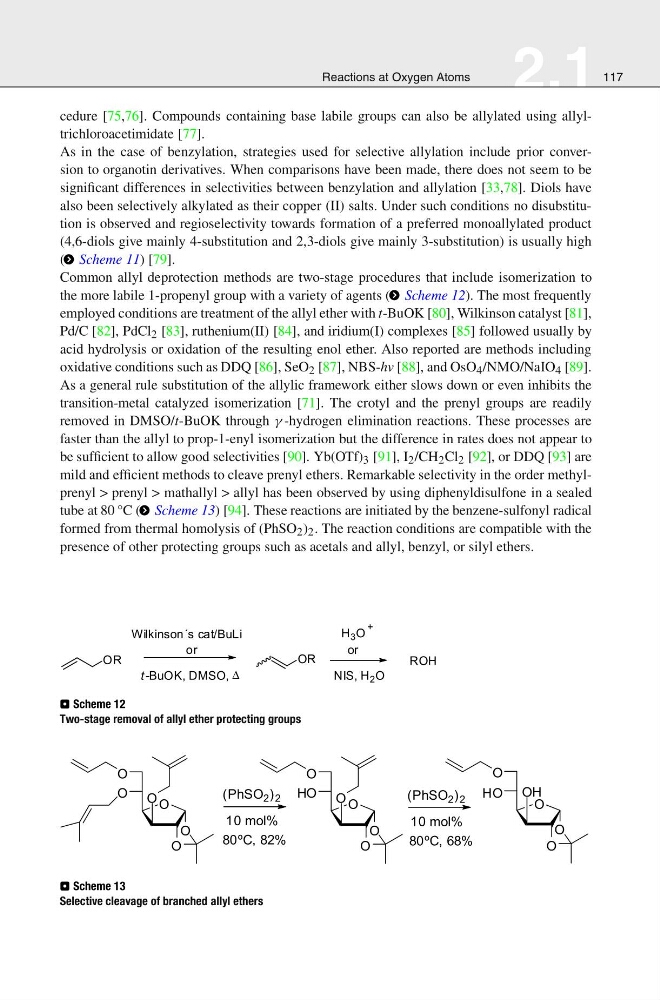
Common allyl deprotection methods are two-stage procedures that include isomerization to
the more labile 1-propenyl group with a variety of agents ( > Scheme 12). The most frequently
employed conditions are treatment of the allyl ether with t-BuOK [80], Wilkinson catalyst [81],
Pd/C [82], PdCl 2 [83], ruthenium(II) [84], and iridium(I) complexes [85] followed usually by
acid hydrolysis or oxidation of the resulting enol ether. Also reported are methods including
oxidative conditions such as DDQ [86], SeO 2 [87], NBS-hv [88], and OsO 4 /NMO/NaIO 4 [89].
As a general rule substitution of the allylic framework either slows down or even inhibits the
transition-metal catalyzed isomerization [71]. The crotyl and the prenyl groups are readily
removed in DMSO/t-BuOK through γ -hydrogen elimination reactions. These processes are
faster than the allyl to prop-1-enyl isomerization but the difference in rates does not appear to
be sufficient to allow good selectivities [90]. Yb(OTf) 3 [91], I 2 /CH 2 Cl 2 [92], or DDQ [93] are
mild and efficient methods to cleave prenyl ethers. Remarkable selectivity in the order methylprenyl > prenyl > mathallyl > allyl has been observed by using diphenyldisulfone in a sealed
tube at 80 °C ( > Scheme 13) [94]. These reactions are initiated by the benzene-sulfonyl radical
formed from thermal homolysis of (PhSO 2 ) 2 . The reaction conditions are compatible with the
presence of other protecting groups such as acetals and allyl, benzyl, or silyl ethers.
⊡ Scheme 12
Two-stage removal of allyl ether protecting groups
⊡ Scheme 13
Selective cleavage of branched allyl ethers
2.1
117
cedure [75,76]. Compounds containing base labile groups can also be allylated using allyltrichloroacetimidate [77].
As in the case of benzylation, strategies used for selective allylation include prior conversion to organotin derivatives. When comparisons have been made, there does not seem to be
significant differences in selectivities between benzylation and allylation [33,78]. Diols have
also been selectively alkylated as their copper (II) salts. Under such conditions no disubstitution is observed and regioselectivity towards formation of a preferred monoallylated product
(4,6-diols give mainly 4-substitution and 2,3-diols give mainly 3-substitution) is usually high
( > Scheme 11) [79].
Common allyl deprotection methods are two-stage procedures that include isomerization to
the more labile 1-propenyl group with a variety of agents ( > Scheme 12). The most frequently
employed conditions are treatment of the allyl ether with t-BuOK [80], Wilkinson catalyst [81],
Pd/C [82], PdCl 2 [83], ruthenium(II) [84], and iridium(I) complexes [85] followed usually by
acid hydrolysis or oxidation of the resulting enol ether. Also reported are methods including
oxidative conditions such as DDQ [86], SeO 2 [87], NBS-hv [88], and OsO 4 /NMO/NaIO 4 [89].
As a general rule substitution of the allylic framework either slows down or even inhibits the
transition-metal catalyzed isomerization [71]. The crotyl and the prenyl groups are readily
removed in DMSO/t-BuOK through γ -hydrogen elimination reactions. These processes are
faster than the allyl to prop-1-enyl isomerization but the difference in rates does not appear to
be sufficient to allow good selectivities [90]. Yb(OTf) 3 [91], I 2 /CH 2 Cl 2 [92], or DDQ [93] are
mild and efficient methods to cleave prenyl ethers. Remarkable selectivity in the order methylprenyl > prenyl > mathallyl > allyl has been observed by using diphenyldisulfone in a sealed
tube at 80 °C ( > Scheme 13) [94]. These reactions are initiated by the benzene-sulfonyl radical
formed from thermal homolysis of (PhSO 2 ) 2 . The reaction conditions are compatible with the
presence of other protecting groups such as acetals and allyl, benzyl, or silyl ethers.
⊡ Scheme 12
Two-stage removal of allyl ether protecting groups
⊡ Scheme 13
Selective cleavage of branched allyl ethers