

116
2
General Synthetic Methods
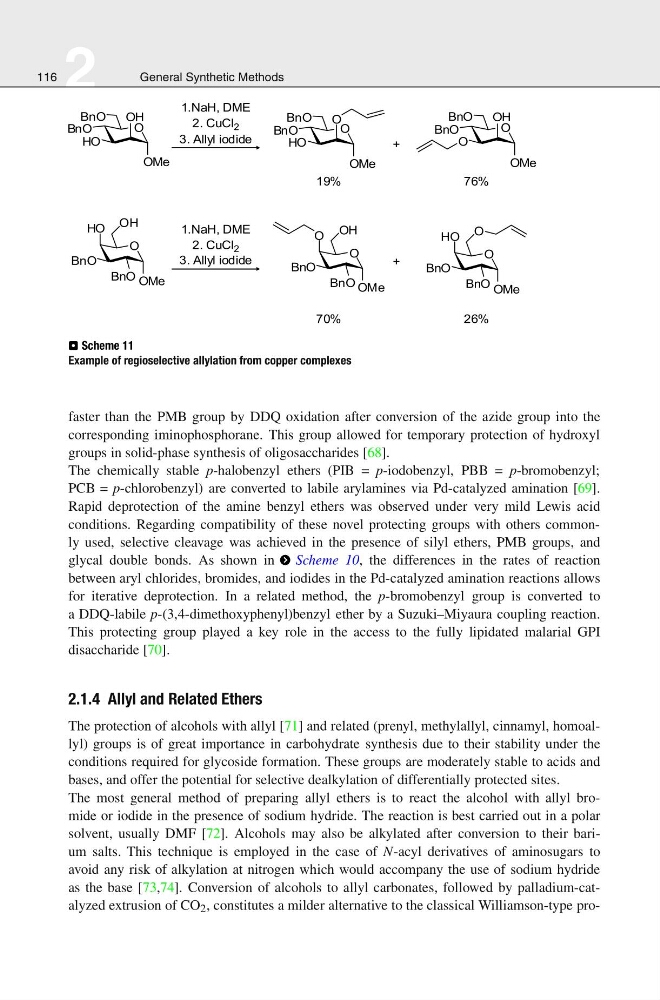
⊡ Scheme 11
Example of regioselective allylation from copper complexes
faster than the PMB group by DDQ oxidation after conversion of the azide group into the
corresponding iminophosphorane. This group allowed for temporary protection of hydroxyl
groups in solid-phase synthesis of oligosaccharides [68].
The chemically stable p-halobenzyl ethers (PIB = p-iodobenzyl, PBB = p-bromobenzyl;
PCB = p-chlorobenzyl) are converted to labile arylamines via Pd-catalyzed amination [69].
Rapid deprotection of the amine benzyl ethers was observed under very mild Lewis acid
conditions. Regarding compatibility of these novel protecting groups with others commonly used, selective cleavage was achieved in the presence of silyl ethers, PMB groups, and
glycal double bonds. As shown in > Scheme 10, the differences in the rates of reaction
between aryl chlorides, bromides, and iodides in the Pd-catalyzed amination reactions allows
for iterative deprotection. In a related method, the p-bromobenzyl group is converted to
a DDQ-labile p-(3,4-dimethoxyphenyl)benzyl ether by a Suzuki–Miyaura coupling reaction.
This protecting group played a key role in the access to the fully lipidated malarial GPI
disaccharide [70].
2.1.4 Allyl and Related Ethers
The protection of alcohols with allyl [71] and related (prenyl, methylallyl, cinnamyl, homoallyl) groups is of great importance in carbohydrate synthesis due to their stability under the
conditions required for glycoside formation. These groups are moderately stable to acids and
bases, and offer the potential for selective dealkylation of differentially protected sites.
The most general method of preparing allyl ethers is to react the alcohol with allyl bromide or iodide in the presence of sodium hydride. The reaction is best carried out in a polar
solvent, usually DMF [72]. Alcohols may also be alkylated after conversion to their barium salts. This technique is employed in the case of N-acyl derivatives of aminosugars to
avoid any risk of alkylation at nitrogen which would accompany the use of sodium hydride
as the base [73,74]. Conversion of alcohols to allyl carbonates, followed by palladium-catalyzed extrusion of CO 2 , constitutes a milder alternative to the classical Williamson-type pro-
2
General Synthetic Methods
⊡ Scheme 11
Example of regioselective allylation from copper complexes
faster than the PMB group by DDQ oxidation after conversion of the azide group into the
corresponding iminophosphorane. This group allowed for temporary protection of hydroxyl
groups in solid-phase synthesis of oligosaccharides [68].
The chemically stable p-halobenzyl ethers (PIB = p-iodobenzyl, PBB = p-bromobenzyl;
PCB = p-chlorobenzyl) are converted to labile arylamines via Pd-catalyzed amination [69].
Rapid deprotection of the amine benzyl ethers was observed under very mild Lewis acid
conditions. Regarding compatibility of these novel protecting groups with others commonly used, selective cleavage was achieved in the presence of silyl ethers, PMB groups, and
glycal double bonds. As shown in > Scheme 10, the differences in the rates of reaction
between aryl chlorides, bromides, and iodides in the Pd-catalyzed amination reactions allows
for iterative deprotection. In a related method, the p-bromobenzyl group is converted to
a DDQ-labile p-(3,4-dimethoxyphenyl)benzyl ether by a Suzuki–Miyaura coupling reaction.
This protecting group played a key role in the access to the fully lipidated malarial GPI
disaccharide [70].
2.1.4 Allyl and Related Ethers
The protection of alcohols with allyl [71] and related (prenyl, methylallyl, cinnamyl, homoallyl) groups is of great importance in carbohydrate synthesis due to their stability under the
conditions required for glycoside formation. These groups are moderately stable to acids and
bases, and offer the potential for selective dealkylation of differentially protected sites.
The most general method of preparing allyl ethers is to react the alcohol with allyl bromide or iodide in the presence of sodium hydride. The reaction is best carried out in a polar
solvent, usually DMF [72]. Alcohols may also be alkylated after conversion to their barium salts. This technique is employed in the case of N-acyl derivatives of aminosugars to
avoid any risk of alkylation at nitrogen which would accompany the use of sodium hydride
as the base [73,74]. Conversion of alcohols to allyl carbonates, followed by palladium-catalyzed extrusion of CO 2 , constitutes a milder alternative to the classical Williamson-type pro-