

Reactions at Oxygen Atoms
2.1
115
Other p-hydroxybenzyl-derived protecting groups include p-acetoxybenzyl ether and 2-(trimethylsilyl)ethoxymethoxybenzyl ether [62]. These groups require a two-stage deprotection
strategy in which treatment with base or fluoride was followed by thermolysis or mild oxidation of the obtained p-phenoxybenzyl intermediate ( > Scheme 8). The conditions are compatible with many of the standard manipulations of oligosaccharide synthesis and with the
presence of benzyl or PMB ethers.
Other p-Substituted Benzyl-Type Ethers Although the PMB protecting group has been
extensively utilized in oligosaccharide synthesis, the acid sensitivity of this group sometimes restricts its synthetical application especially during glycosylations. Therefore, other
p-substituted benzyl groups have been developed ( > Scheme 9). The p-nitrobenzyl (or p-nitrophenylmethyl NPM) group, which is acid-stable, is readily cleaved via a two-stage procedure
involving reduction to an p-amino-benzyl ether followed by mild anodic oxidation [63].
p-Acetamidobenzyl and p-pivaloylaminobenzyl (PAB) derivatives are also used as protecting groups for hydroxyl groups [64,65]. These ethers are much more stable under acidic
conditions than a PMB ether, can be obtained by direct alkylation of the hydroxyl group
or by acylation of the corresponding p-aminobenzylether, and are deprotected by treatment
with DDQ. The oxidation occurs at a rate comparable to PMB ethers, so that no preferential
cleavage could be achieved with DDQ between these two groups. p-Azido benzyl groups are
also useful as protecting groups of hydroxyl moieties [66,67]. They can be removed much
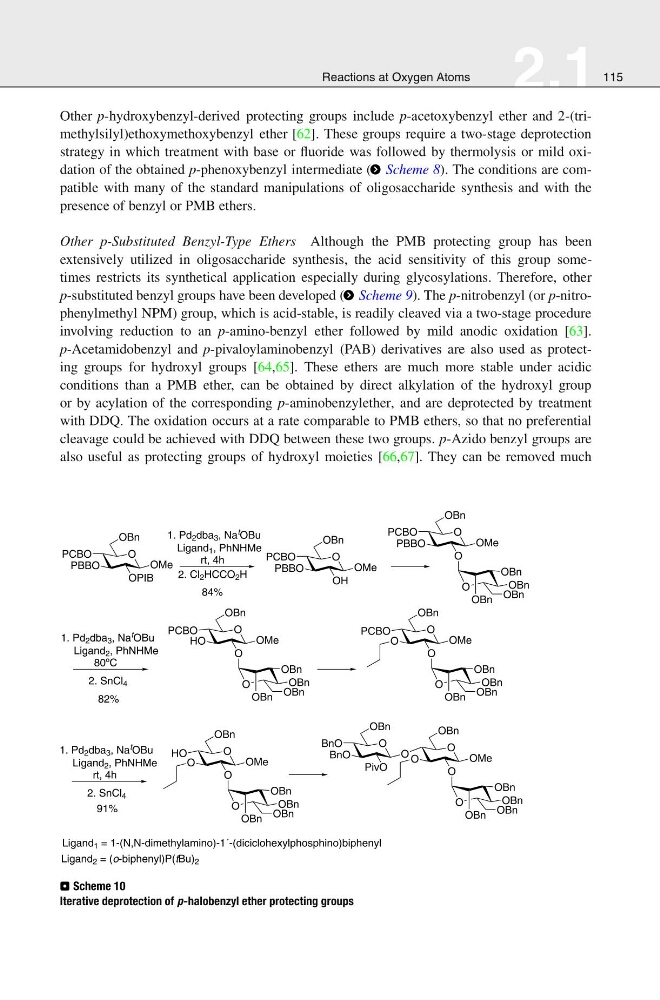
⊡ Scheme 10
Iterative deprotection of p-halobenzyl ether protecting groups
2.1
115
Other p-hydroxybenzyl-derived protecting groups include p-acetoxybenzyl ether and 2-(trimethylsilyl)ethoxymethoxybenzyl ether [62]. These groups require a two-stage deprotection
strategy in which treatment with base or fluoride was followed by thermolysis or mild oxidation of the obtained p-phenoxybenzyl intermediate ( > Scheme 8). The conditions are compatible with many of the standard manipulations of oligosaccharide synthesis and with the
presence of benzyl or PMB ethers.
Other p-Substituted Benzyl-Type Ethers Although the PMB protecting group has been
extensively utilized in oligosaccharide synthesis, the acid sensitivity of this group sometimes restricts its synthetical application especially during glycosylations. Therefore, other
p-substituted benzyl groups have been developed ( > Scheme 9). The p-nitrobenzyl (or p-nitrophenylmethyl NPM) group, which is acid-stable, is readily cleaved via a two-stage procedure
involving reduction to an p-amino-benzyl ether followed by mild anodic oxidation [63].
p-Acetamidobenzyl and p-pivaloylaminobenzyl (PAB) derivatives are also used as protecting groups for hydroxyl groups [64,65]. These ethers are much more stable under acidic
conditions than a PMB ether, can be obtained by direct alkylation of the hydroxyl group
or by acylation of the corresponding p-aminobenzylether, and are deprotected by treatment
with DDQ. The oxidation occurs at a rate comparable to PMB ethers, so that no preferential
cleavage could be achieved with DDQ between these two groups. p-Azido benzyl groups are
also useful as protecting groups of hydroxyl moieties [66,67]. They can be removed much
⊡ Scheme 10
Iterative deprotection of p-halobenzyl ether protecting groups