

374
12. Special Topics
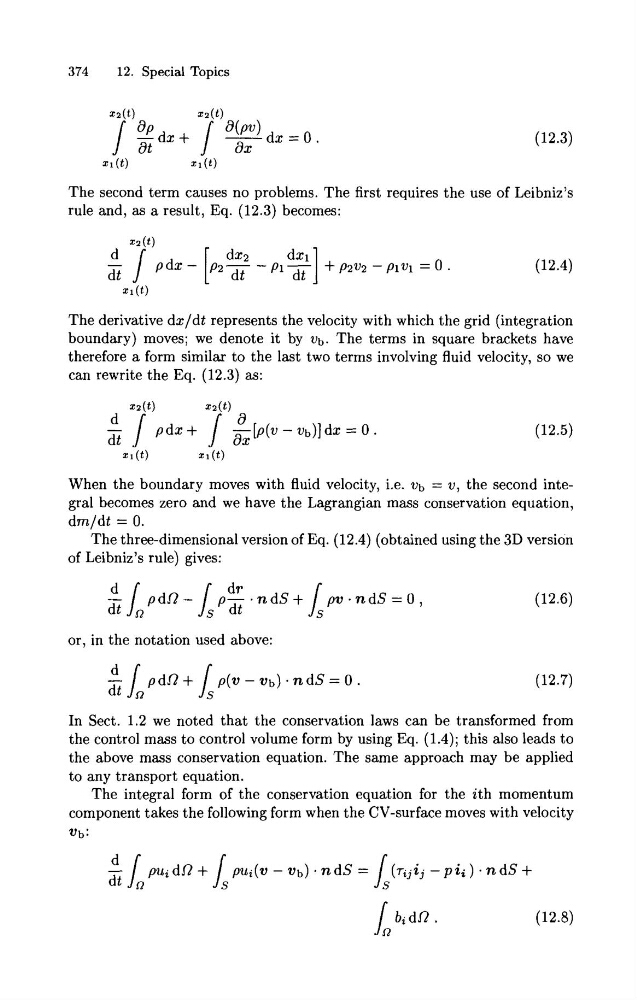
The second term causes no problems. The first requires the use of Leibniz's
rule and, as a result, Eq. (12.3) becomes:
The derivative dxldt represents the velocity with which the grid (integration
boundary) moves; we denote it by vb. The terms in square brackets have
therefore a form similar to the last two terms involving fluid velocity, so we
can rewrite the Eq. (12.3) as:
When the boundary moves with fluid velocity, i.e. vb = v, the second integral becomes zero and we have the Lagrangian mass conservation equation,
dmldt = 0.
The three-dimensional version of Eq. (12.4) (obtained using the 3D version
of Leibniz's rule) gives:
or, in the notation used above:
In Sect. 1.2 we noted that the conservation laws can be transformed from
the control mass to control volume form by using Eq. (1.4); this also leads to
the above mass conservation equation. The same approach may be applied
to any transport equation.
The integral form of the conservation equation for the ith momentum
component takes the following form when the CV-surface moves with velocity
vb:
12. Special Topics
The second term causes no problems. The first requires the use of Leibniz's
rule and, as a result, Eq. (12.3) becomes:
The derivative dxldt represents the velocity with which the grid (integration
boundary) moves; we denote it by vb. The terms in square brackets have
therefore a form similar to the last two terms involving fluid velocity, so we
can rewrite the Eq. (12.3) as:
When the boundary moves with fluid velocity, i.e. vb = v, the second integral becomes zero and we have the Lagrangian mass conservation equation,
dmldt = 0.
The three-dimensional version of Eq. (12.4) (obtained using the 3D version
of Leibniz's rule) gives:
or, in the notation used above:
In Sect. 1.2 we noted that the conservation laws can be transformed from
the control mass to control volume form by using Eq. (1.4); this also leads to
the above mass conservation equation. The same approach may be applied
to any transport equation.
The integral form of the conservation equation for the ith momentum
component takes the following form when the CV-surface moves with velocity
vb: