

352
11. Efficiency and Accuracy Improvement
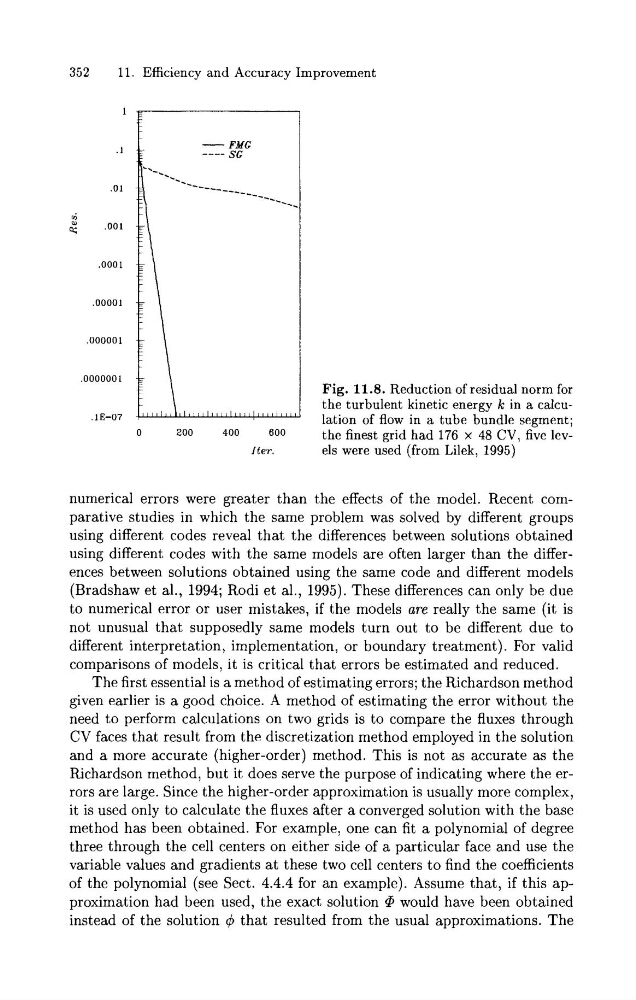
Fig. 11.8. Reduction of residual norm for
the turbulent kinetic energy k in a calculation of flow in a tube bundle segment;
o
200
400
600
the finest grid had 176 x 48 CV, fiie lev:
Iter.
els were used (from Lilek, 1995)
numerical errors were greater than the effects of the model. Recent comparative studies in which the same problem was solved by different groups
using different codes reveal that the differences between solutions obtained
using different codes with the same models are often larger than the differences between solutions obtained using the same code and different models
(Bradshaw et al., 1994; Rodi et al., 1995). These differences can only be due
to numerical error or user mistakes, if the models are really the same (it is
not unusual that supposedly same models turn out to be different due to
different interpretation, implementation, or boundary treatment). For valid
comparisons of models, it is critical that errors be estimated and reduced.
The first essential is a method of estimating errors; the Richardson method
given earlier is a good choice. A method of estimating the error without the
need to perform calculations on two grids is to compare the fluxes through
CV faces that result from the discretization method employed in the solution
and a more accurate (higher-order) method. This is not as accurate as the
Richardson method, but it does serve the purpose of indicating where the errors are large. Since the higher-order approximation is usually more complex,
it is used only to calculate the fluxes after a converged solution with the base
method has been obtained. For example, one can fit a polynomial of degree
three through the cell centers on either side of a particular face and use the
variable values and gradients a t these two cell centers to find the coefficients
of the polynomial (see Sect. 4.4.4 for an example). Assume that, if this approximation had been used, the exact solution Q) would have been obtained
instead of the solution qh that resulted from the usual approximations. The
11. Efficiency and Accuracy Improvement
Fig. 11.8. Reduction of residual norm for
the turbulent kinetic energy k in a calculation of flow in a tube bundle segment;
o
200
400
600
the finest grid had 176 x 48 CV, fiie lev:
Iter.
els were used (from Lilek, 1995)
numerical errors were greater than the effects of the model. Recent comparative studies in which the same problem was solved by different groups
using different codes reveal that the differences between solutions obtained
using different codes with the same models are often larger than the differences between solutions obtained using the same code and different models
(Bradshaw et al., 1994; Rodi et al., 1995). These differences can only be due
to numerical error or user mistakes, if the models are really the same (it is
not unusual that supposedly same models turn out to be different due to
different interpretation, implementation, or boundary treatment). For valid
comparisons of models, it is critical that errors be estimated and reduced.
The first essential is a method of estimating errors; the Richardson method
given earlier is a good choice. A method of estimating the error without the
need to perform calculations on two grids is to compare the fluxes through
CV faces that result from the discretization method employed in the solution
and a more accurate (higher-order) method. This is not as accurate as the
Richardson method, but it does serve the purpose of indicating where the errors are large. Since the higher-order approximation is usually more complex,
it is used only to calculate the fluxes after a converged solution with the base
method has been obtained. For example, one can fit a polynomial of degree
three through the cell centers on either side of a particular face and use the
variable values and gradients a t these two cell centers to find the coefficients
of the polynomial (see Sect. 4.4.4 for an example). Assume that, if this approximation had been used, the exact solution Q) would have been obtained
instead of the solution qh that resulted from the usual approximations. The