

11.4 Adaptive Grid Methods and Local Grid Refinement
351
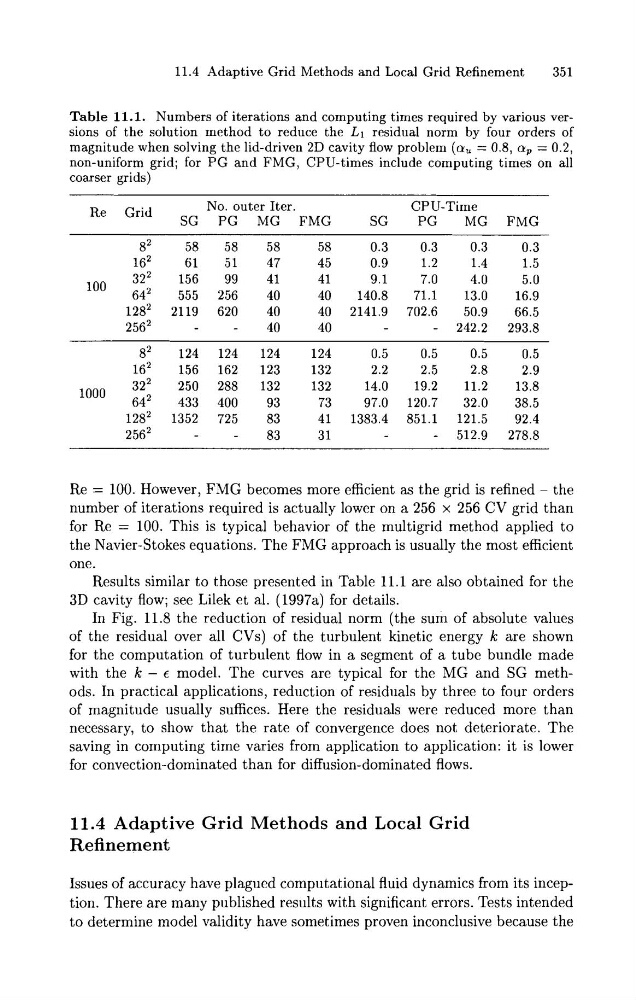
Table 11.1. Numbers of iterations and computing times required by various versions of the solution method t o reduce the L1 residual norm by four orders of
magnitude when solving the lid-driven 2D cavity flow problem ( a , = 0.8, a, = 0.2,
non-uniform grid; for P G and FMG, CPU-times include computing times on all
coarser grids)
No. outer Iter.
CPU-Time
Re Grid
SG P G MG FMG
SG
P G
MG FMG
Re = 100. However, FMG becomes more efficient as the grid is refined - the
number of iterations required is actually lower on a 256 x 256 CV grid than
for Re = 100. This is typical behavior of the multigrid method applied to
the Navier-Stokes equations. The FMG approach is usually the most efficient
one.
Results similar to those presented in Table 11.1 are also obtained for the
3D cavity flow; see Lilek et al. (1997a) for details.
In Fig. 11.8 the reduction of residual norm (the sum of absolute values
of the residual over all CVs) of the turbulent kinetic energy k are shown
for the computation of turbulent flow in a segment of a tube bundle made
with the k - e model. The curves are typical for the MG and SG methods. In practical applications, reduction of residuals by three to four orders
of magnitude usually suffices. Here the residuals were reduced more than
necessary, to show that the rate of convergence does not deteriorate. The
saving in computing time varies from application to application: it is lower
for convection-dominated than for diffusion-dominated flows.
11.4 Adaptive Grid Methods and Local Grid
Refinement
Issues of accuracy have plagued computational fluid dynamics from its inception. There are many published results with significant errors. Tests intended
to determine model validity have sometimes proven inconclusive because the
351
Table 11.1. Numbers of iterations and computing times required by various versions of the solution method t o reduce the L1 residual norm by four orders of
magnitude when solving the lid-driven 2D cavity flow problem ( a , = 0.8, a, = 0.2,
non-uniform grid; for P G and FMG, CPU-times include computing times on all
coarser grids)
No. outer Iter.
CPU-Time
Re Grid
SG P G MG FMG
SG
P G
MG FMG
Re = 100. However, FMG becomes more efficient as the grid is refined - the
number of iterations required is actually lower on a 256 x 256 CV grid than
for Re = 100. This is typical behavior of the multigrid method applied to
the Navier-Stokes equations. The FMG approach is usually the most efficient
one.
Results similar to those presented in Table 11.1 are also obtained for the
3D cavity flow; see Lilek et al. (1997a) for details.
In Fig. 11.8 the reduction of residual norm (the sum of absolute values
of the residual over all CVs) of the turbulent kinetic energy k are shown
for the computation of turbulent flow in a segment of a tube bundle made
with the k - e model. The curves are typical for the MG and SG methods. In practical applications, reduction of residuals by three to four orders
of magnitude usually suffices. Here the residuals were reduced more than
necessary, to show that the rate of convergence does not deteriorate. The
saving in computing time varies from application to application: it is lower
for convection-dominated than for diffusion-dominated flows.
11.4 Adaptive Grid Methods and Local Grid
Refinement
Issues of accuracy have plagued computational fluid dynamics from its inception. There are many published results with significant errors. Tests intended
to determine model validity have sometimes proven inconclusive because the