

344
11. Efficiency and Accuracy Improvement
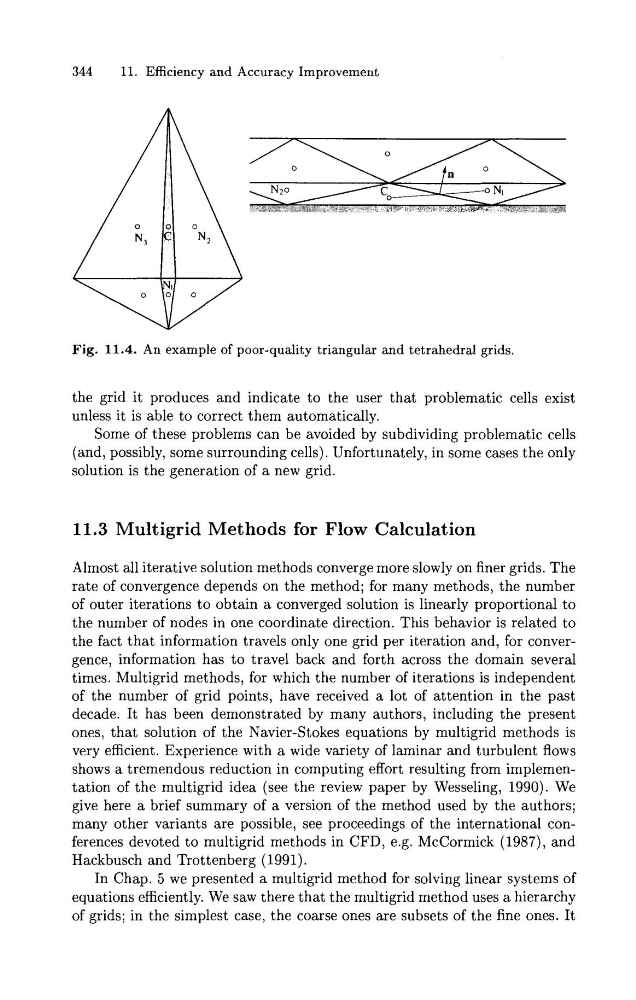
Fig. 11.4. An example of poor-quality triangular and tetrahedral grids.
the grid it produces and indicate to the user that problematic cells exist
unless it is able to correct them automatically.
Some of these problems can be avoided by subdividing problematic cells
(and, possibly, some surrounding cells). Unfortunately, in some cases the only
solution is the generation of a new grid.
11.3 Multigrid Methods for Flow Calculation
Almost all iterative solution methods converge more slowly on finer grids. The
rate of convergence depends on the method; for many methods, the number
of outer iterations t o obtain a converged solution is linearly proportional to
the number of nodes in one coordinate direction. This behavior is related to
the fact that information travels only one grid per iteration and, for convergence, information has to travel back and forth across the domain several
times. Multigrid methods, for which the number of iterations is independent
of the number of grid points, have received a lot of attention in the past
decade. It has been demonstrated by many authors, including the present
ones, that solution of the Navier-Stokes equations by multigrid methods is
very efficient. Experience with a wide variety of laminar and turbulent flows
shows a tremendous reduction in computing effort resulting from implementation of the multigrid idea (see the review paper by Wesseling, 1990). We
give here a brief summary of a version of the method used by the authors;
many other variants are possible, see proceedings of the international conferences devoted to multigrid methods in CFD, e.g. McCormick (1987), and
Hackbusch and Trottenberg (1991).
In Chap. 5 we presented a multigrid method for solving linear systems of
equations efficiently. We saw there that the multigrid method uses a hierarchy
of grids; in the simplest case, the coarse ones are subsets of the fine ones. It
11. Efficiency and Accuracy Improvement
Fig. 11.4. An example of poor-quality triangular and tetrahedral grids.
the grid it produces and indicate to the user that problematic cells exist
unless it is able to correct them automatically.
Some of these problems can be avoided by subdividing problematic cells
(and, possibly, some surrounding cells). Unfortunately, in some cases the only
solution is the generation of a new grid.
11.3 Multigrid Methods for Flow Calculation
Almost all iterative solution methods converge more slowly on finer grids. The
rate of convergence depends on the method; for many methods, the number
of outer iterations t o obtain a converged solution is linearly proportional to
the number of nodes in one coordinate direction. This behavior is related to
the fact that information travels only one grid per iteration and, for convergence, information has to travel back and forth across the domain several
times. Multigrid methods, for which the number of iterations is independent
of the number of grid points, have received a lot of attention in the past
decade. It has been demonstrated by many authors, including the present
ones, that solution of the Navier-Stokes equations by multigrid methods is
very efficient. Experience with a wide variety of laminar and turbulent flows
shows a tremendous reduction in computing effort resulting from implementation of the multigrid idea (see the review paper by Wesseling, 1990). We
give here a brief summary of a version of the method used by the authors;
many other variants are possible, see proceedings of the international conferences devoted to multigrid methods in CFD, e.g. McCormick (1987), and
Hackbusch and Trottenberg (1991).
In Chap. 5 we presented a multigrid method for solving linear systems of
equations efficiently. We saw there that the multigrid method uses a hierarchy
of grids; in the simplest case, the coarse ones are subsets of the fine ones. It