

342
11. Efficiency and Accuracy Improvement
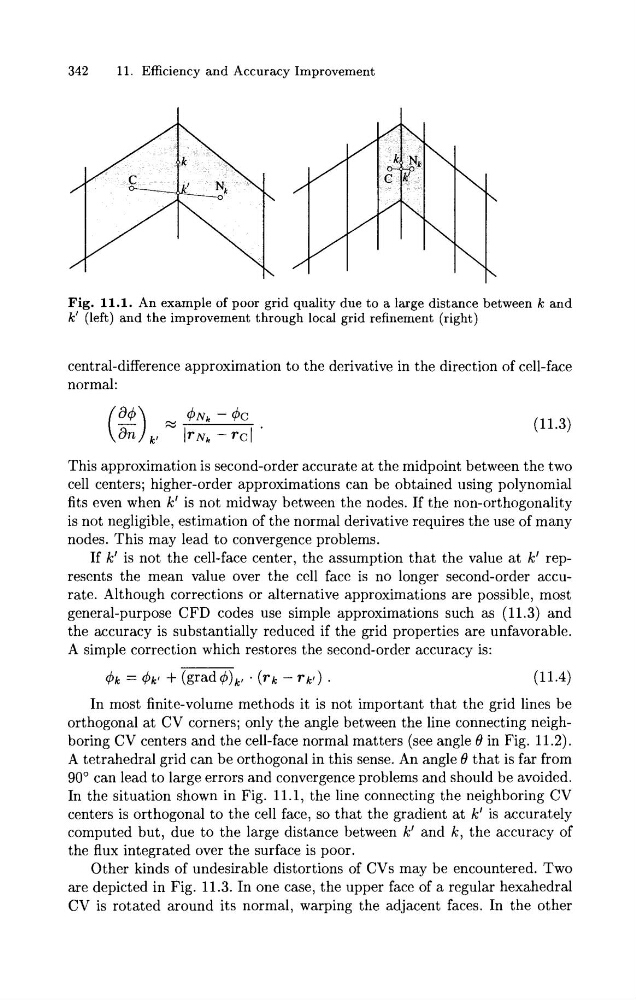
Fig. 11.1. An example of poor grid quality due to a large distance between k and
k' (left) and the improvement through local grid refinement (right)
central-difference approximation to the derivative in the direction of cell-face
normal:
This approximation is second-order accurate at the midpoint between the two
cell centers; higher-order approximations can be obtained using polynomial
fits even when k' is not midway between the nodes. If the non-orthogonality
is not negligible, estimation of the normal derivative requires the use of many
nodes. This may lead t o convergence problems.
If k' is not the cell-face center, the assumption that the value at k' represents the mean value over the cell face is no longer second-order accurate. Although corrections or alternative approximations are possible, most
general-purpose CFD codes use simple approximations such as (11.3) and
the accuracy is substantially reduced if the grid properties are unfavorable.
A simple correction which restores the second-order accuracy is:
$k = $kt + ( g r a d d k ' . (rk - rkt) .
(1 1.4)
In most finite-volume methods it is not important that the grid lines be
orthogonal at CV corners; only the angle between the line connecting neighboring CV centers and the cell-face normal matters (see angle 0 in Fig. 11.2).
A tetrahedral grid can be orthogonal in this sense. An angle 0 that is far from
90" can lead to large errors and convergence problems and should be avoided.
In the situation shown in Fig. 11.1, the line connecting the neighboring CV
centers is orthogonal to the cell face, so that the gradient a t k' is accurately
computed but, due to the large distance between k' and k, the accuracy of
the flux integrated over the surface is poor.
Other kinds of undesirable distortions of CVs may be encountered. Two
are depicted in Fig. 11.3. In one case, the upper face of a regular hexahedral
CV is rotated around its normal, warping the adjacent faces. In the other
11. Efficiency and Accuracy Improvement
Fig. 11.1. An example of poor grid quality due to a large distance between k and
k' (left) and the improvement through local grid refinement (right)
central-difference approximation to the derivative in the direction of cell-face
normal:
This approximation is second-order accurate at the midpoint between the two
cell centers; higher-order approximations can be obtained using polynomial
fits even when k' is not midway between the nodes. If the non-orthogonality
is not negligible, estimation of the normal derivative requires the use of many
nodes. This may lead t o convergence problems.
If k' is not the cell-face center, the assumption that the value at k' represents the mean value over the cell face is no longer second-order accurate. Although corrections or alternative approximations are possible, most
general-purpose CFD codes use simple approximations such as (11.3) and
the accuracy is substantially reduced if the grid properties are unfavorable.
A simple correction which restores the second-order accuracy is:
$k = $kt + ( g r a d d k ' . (rk - rkt) .
(1 1.4)
In most finite-volume methods it is not important that the grid lines be
orthogonal at CV corners; only the angle between the line connecting neighboring CV centers and the cell-face normal matters (see angle 0 in Fig. 11.2).
A tetrahedral grid can be orthogonal in this sense. An angle 0 that is far from
90" can lead to large errors and convergence problems and should be avoided.
In the situation shown in Fig. 11.1, the line connecting the neighboring CV
centers is orthogonal to the cell face, so that the gradient a t k' is accurately
computed but, due to the large distance between k' and k, the accuracy of
the flux integrated over the surface is poor.
Other kinds of undesirable distortions of CVs may be encountered. Two
are depicted in Fig. 11.3. In one case, the upper face of a regular hexahedral
CV is rotated around its normal, warping the adjacent faces. In the other