

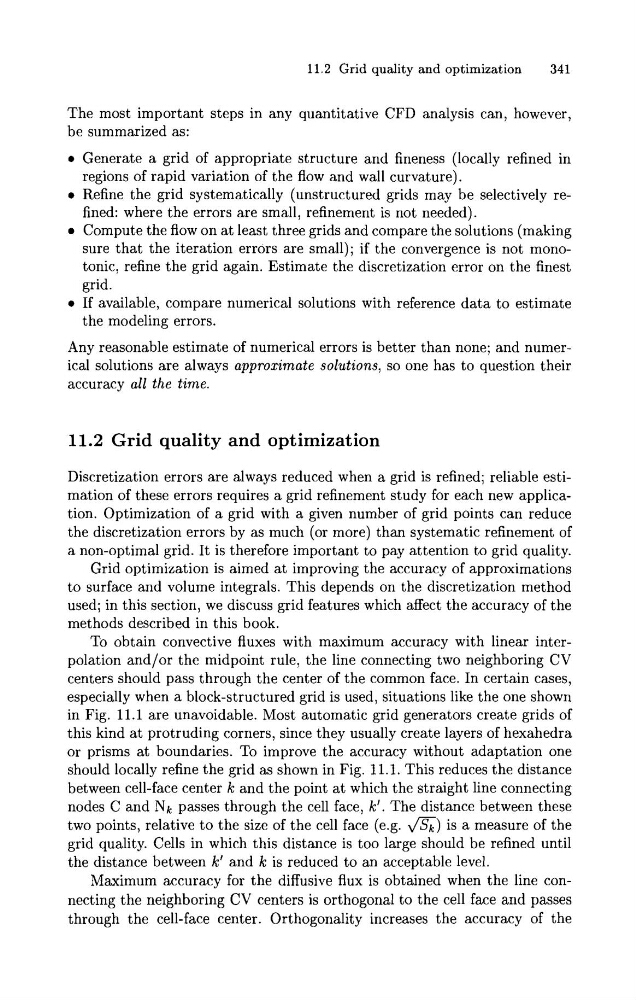
11.2 Grid quality and optimization
341
The most important steps in any quantitative CFD analysis can, however,
be summarized as:
0 Generate a grid of appropriate structure and fineness (locally refined in
regions of rapid variation of the flow and wall curvature).
0 Refine the grid systematically (unstructured grids may be selectively refined: where the errors are small, refinement is not needed).
Compute the flow on at least three grids and compare the solutions (making
sure that the iteration errors are small); if the convergence is not monotonic, refine the grid again. Estimate the discretization error on the finest
grid.
0 If available, compare numerical solutions with reference data to estimate
the modeling errors.
Any reasonable estimate of numerical errors is better than none; and numerical solutions are always approximate solutions, so one has to question their
accuracy all the time.
11.2 Grid quality and optimization
Discretization errors are always reduced when a grid is refined; reliable estimation of these errors requires a grid refinement study for each new application. Optimization of a grid with a given number of grid points can reduce
the discretization errors by as much (or more) than systematic refinement of
a non-optimal grid. It is therefore important to pay attention to grid quality.
Grid optimization is aimed at improving the accuracy of approximations
to surface and volume integrals. This depends on the discretization method
used; in this section, we discuss grid features which affect the accuracy of the
methods described in this book.
To obtain convective fluxes with maximum accuracy with linear interpolation and/or the midpoint rule, the line connecting two neighboring CV
centers should pass through the center of the common face. In certain cases,
especially when a block-structured grid is used, situations like the one shown
in Fig. 11.1 are unavoidable. Most automatic grid generators create grids of
this kind at protruding corners, since they usually create layers of hexahedra
or prisms at boundaries. To improve the accuracy without adaptation one
should locally refine the grid as shown in Fig. 11.1. This reduces the distance
between cell-face center k and the point at which the straight line connecting
nodes C and Nk passes through the cell face, k'. The distance between these
two points, relative to the size of the cell face (e.g. a) is a measure of the
grid quality. Cells in which this distance is too large should be refined until
the distance between k' and k is reduced to an acceptable level.
Maximum accuracy for the diffusive flux is obtained when the line connecting the neighboring CV centers is orthogonal to the cell face and passes
through the cell-face center. Orthogonality increases the accuracy of the
341
The most important steps in any quantitative CFD analysis can, however,
be summarized as:
0 Generate a grid of appropriate structure and fineness (locally refined in
regions of rapid variation of the flow and wall curvature).
0 Refine the grid systematically (unstructured grids may be selectively refined: where the errors are small, refinement is not needed).
Compute the flow on at least three grids and compare the solutions (making
sure that the iteration errors are small); if the convergence is not monotonic, refine the grid again. Estimate the discretization error on the finest
grid.
0 If available, compare numerical solutions with reference data to estimate
the modeling errors.
Any reasonable estimate of numerical errors is better than none; and numerical solutions are always approximate solutions, so one has to question their
accuracy all the time.
11.2 Grid quality and optimization
Discretization errors are always reduced when a grid is refined; reliable estimation of these errors requires a grid refinement study for each new application. Optimization of a grid with a given number of grid points can reduce
the discretization errors by as much (or more) than systematic refinement of
a non-optimal grid. It is therefore important to pay attention to grid quality.
Grid optimization is aimed at improving the accuracy of approximations
to surface and volume integrals. This depends on the discretization method
used; in this section, we discuss grid features which affect the accuracy of the
methods described in this book.
To obtain convective fluxes with maximum accuracy with linear interpolation and/or the midpoint rule, the line connecting two neighboring CV
centers should pass through the center of the common face. In certain cases,
especially when a block-structured grid is used, situations like the one shown
in Fig. 11.1 are unavoidable. Most automatic grid generators create grids of
this kind at protruding corners, since they usually create layers of hexahedra
or prisms at boundaries. To improve the accuracy without adaptation one
should locally refine the grid as shown in Fig. 11.1. This reduces the distance
between cell-face center k and the point at which the straight line connecting
nodes C and Nk passes through the cell face, k'. The distance between these
two points, relative to the size of the cell face (e.g. a) is a measure of the
grid quality. Cells in which this distance is too large should be refined until
the distance between k' and k is reduced to an acceptable level.
Maximum accuracy for the diffusive flux is obtained when the line connecting the neighboring CV centers is orthogonal to the cell face and passes
through the cell-face center. Orthogonality increases the accuracy of the