

9.4 RANS Models
301
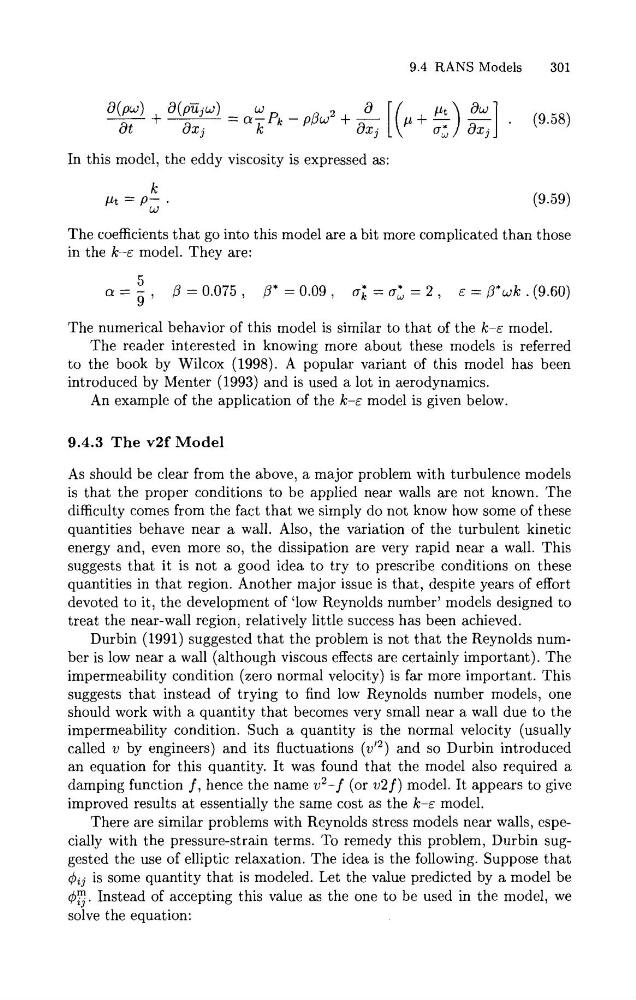
In this model, the eddy viscosity is expressed as:
The coefficients that go into this model are a bit more complicated than those
in the k-E model. They are:
The numerical behavior of this model is similar to that of the k-E model.
The reader interested in knowing more about these models is referred
to the book by Wilcox (1998). A popular variant of this model has been
introduced by Menter (1993) and is used a lot in aerodynamics.
An example of the application of the k-E model is given below.
9.4.3 The v2f Model
As should be clear from the above, a major problem with turbulence models
is that the proper conditions to be applied near walls are not known. The
difficulty comes from the fact that we simply do not know how some of these
quantities behave near a wall. Also, the variation of the turbulent kinetic
energy and, even more so, the dissipation are very rapid near a wall. This
suggests that it is not a good idea to try to prescribe conditions on these
quantities in that region. Another major issue is that, despite years of effort
devoted to it, the development of 'low Reynolds number' models designed to
treat the near-wall region, relatively little success has been achieved.
Durbin (1991) suggested that the problem is not that the Reynolds number is low near a wall (although viscous effects are certainly important). The
impermeability condition (zero normal velocity) is far more important. This
suggests that instead of trying to find low Reynolds number models, one
should work with a quantity that becomes very small near a wall due to the
impermeability condition. Such a quantity is the normal velocity (usually
called v by engineers) and its fluctuations (vf2) and so Durbin introduced
an equation for this quantity. It was found that the model also required a
damping function f , hence the name v2- f (or 82 f ) model. It appears to give
improved results at essentially the same cost as the k-E model.
There are similar problems with Reynolds stress models near walls, especially with the pressure-strain terms. To remedy this problem, Durbin suggested the use of elliptic relaxation. The idea is the following. Suppose that
dij is some quantity that is modeled. Let the value predicted by a model be
4;. Instead of accepting this value as the one to be used in the model, we
solve the equation:
301
In this model, the eddy viscosity is expressed as:
The coefficients that go into this model are a bit more complicated than those
in the k-E model. They are:
The numerical behavior of this model is similar to that of the k-E model.
The reader interested in knowing more about these models is referred
to the book by Wilcox (1998). A popular variant of this model has been
introduced by Menter (1993) and is used a lot in aerodynamics.
An example of the application of the k-E model is given below.
9.4.3 The v2f Model
As should be clear from the above, a major problem with turbulence models
is that the proper conditions to be applied near walls are not known. The
difficulty comes from the fact that we simply do not know how some of these
quantities behave near a wall. Also, the variation of the turbulent kinetic
energy and, even more so, the dissipation are very rapid near a wall. This
suggests that it is not a good idea to try to prescribe conditions on these
quantities in that region. Another major issue is that, despite years of effort
devoted to it, the development of 'low Reynolds number' models designed to
treat the near-wall region, relatively little success has been achieved.
Durbin (1991) suggested that the problem is not that the Reynolds number is low near a wall (although viscous effects are certainly important). The
impermeability condition (zero normal velocity) is far more important. This
suggests that instead of trying to find low Reynolds number models, one
should work with a quantity that becomes very small near a wall due to the
impermeability condition. Such a quantity is the normal velocity (usually
called v by engineers) and its fluctuations (vf2) and so Durbin introduced
an equation for this quantity. It was found that the model also required a
damping function f , hence the name v2- f (or 82 f ) model. It appears to give
improved results at essentially the same cost as the k-E model.
There are similar problems with Reynolds stress models near walls, especially with the pressure-strain terms. To remedy this problem, Durbin suggested the use of elliptic relaxation. The idea is the following. Suppose that
dij is some quantity that is modeled. Let the value predicted by a model be
4;. Instead of accepting this value as the one to be used in the model, we
solve the equation: