

9.3 Large Eddy Simulation (LES)
287
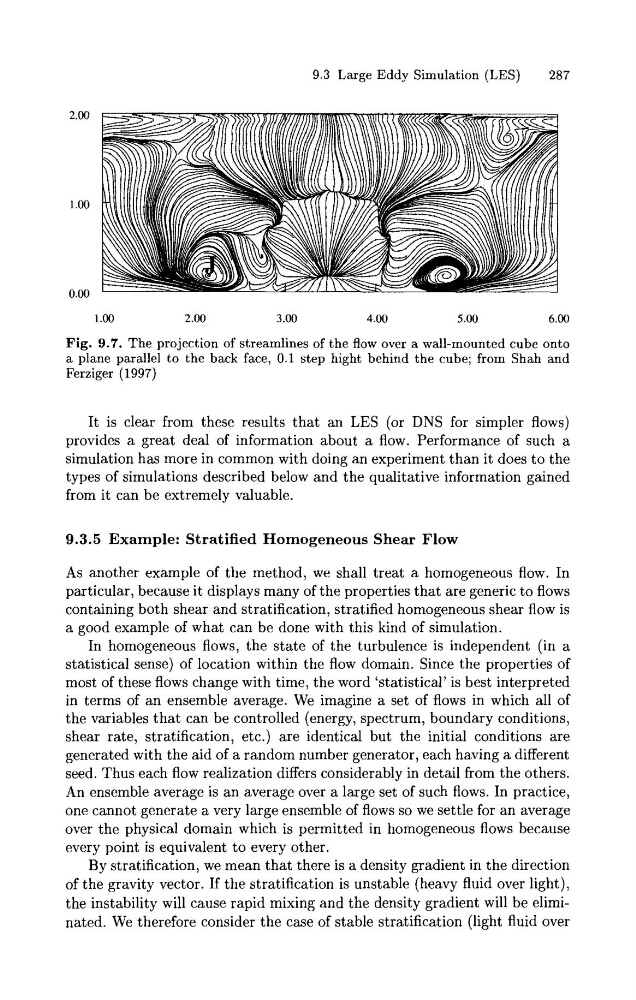
Fig. 9.7. The projection of streamlines of the flow over a wall-mounted cube onto
a plane parallel to the back face, 0.1 step hight behind the cube; from Shah and
Ferziger (1997)
It is clear from these results that an LES (or DNS for simpler flows)
provides a great deal of information about a flow. Performance of such a
simulation has more in common with doing an experiment than it does to the
types of simulations described below and the qualitative information gained
from it can be extremely valuable.
9.3.5 Example: Stratified Homogeneous Shear Flow
As another example of the method, we shall treat a homogeneous flow. In
particular, because it displays many of the properties that are generic to flows
containing both shear and stratification, stratified homogeneous shear flow is
a good example of what can be done with this kind of simulation.
In homogeneous flows, the state of the turbulence is independent (in a
statistical sense) of location within the flow domain. Since the properties of
most of these flows change with time, the word 'statistical' is best interpreted
in terms of an ensemble average. We imagine a set of flows in which all of
the variables that can be controlled (energy, spectrum, boundary conditions,
shear rate, stratification, etc.) are identical but the initial conditions are
generated with the aid of a random number generator, each having a different
seed. Thus each flow realization differs considerably in detail from the others.
An ensemble average is an average over a large set of such flows. In practice,
one cannot generate a very large ensemble of flows so we settle for an average
over the physical domain which is permitted in homogeneous flows because
every point is equivalent to every other.
By stratification, we mean that there is a density gradient in the direction
of the gravity vector. If the stratification is unstable (heavy fluid over light),
the instability will cause rapid mixing and the density gradient will be eliminated. We therefore consider the case of stable stratification (light fluid over
287
Fig. 9.7. The projection of streamlines of the flow over a wall-mounted cube onto
a plane parallel to the back face, 0.1 step hight behind the cube; from Shah and
Ferziger (1997)
It is clear from these results that an LES (or DNS for simpler flows)
provides a great deal of information about a flow. Performance of such a
simulation has more in common with doing an experiment than it does to the
types of simulations described below and the qualitative information gained
from it can be extremely valuable.
9.3.5 Example: Stratified Homogeneous Shear Flow
As another example of the method, we shall treat a homogeneous flow. In
particular, because it displays many of the properties that are generic to flows
containing both shear and stratification, stratified homogeneous shear flow is
a good example of what can be done with this kind of simulation.
In homogeneous flows, the state of the turbulence is independent (in a
statistical sense) of location within the flow domain. Since the properties of
most of these flows change with time, the word 'statistical' is best interpreted
in terms of an ensemble average. We imagine a set of flows in which all of
the variables that can be controlled (energy, spectrum, boundary conditions,
shear rate, stratification, etc.) are identical but the initial conditions are
generated with the aid of a random number generator, each having a different
seed. Thus each flow realization differs considerably in detail from the others.
An ensemble average is an average over a large set of such flows. In practice,
one cannot generate a very large ensemble of flows so we settle for an average
over the physical domain which is permitted in homogeneous flows because
every point is equivalent to every other.
By stratification, we mean that there is a density gradient in the direction
of the gravity vector. If the stratification is unstable (heavy fluid over light),
the instability will cause rapid mixing and the density gradient will be eliminated. We therefore consider the case of stable stratification (light fluid over