

288
9. Turbulent Flows
heavy). The effects of stratification are felt through a body force term in the
equation for the vertical component of momentum. In many flows, density
differences are small and the density may be assumed to be constant except
in the body force term. This is called the Boussinesq approximation.
For a flow to be homogeneous, every point in the flow must 'feel' the same
imposed strain or, more generally, the same mean velocity derivative. This
means that the mean velocity must be linear in all of the coordinates. Even
with this restriction, there are many possibilities. Among these are plane
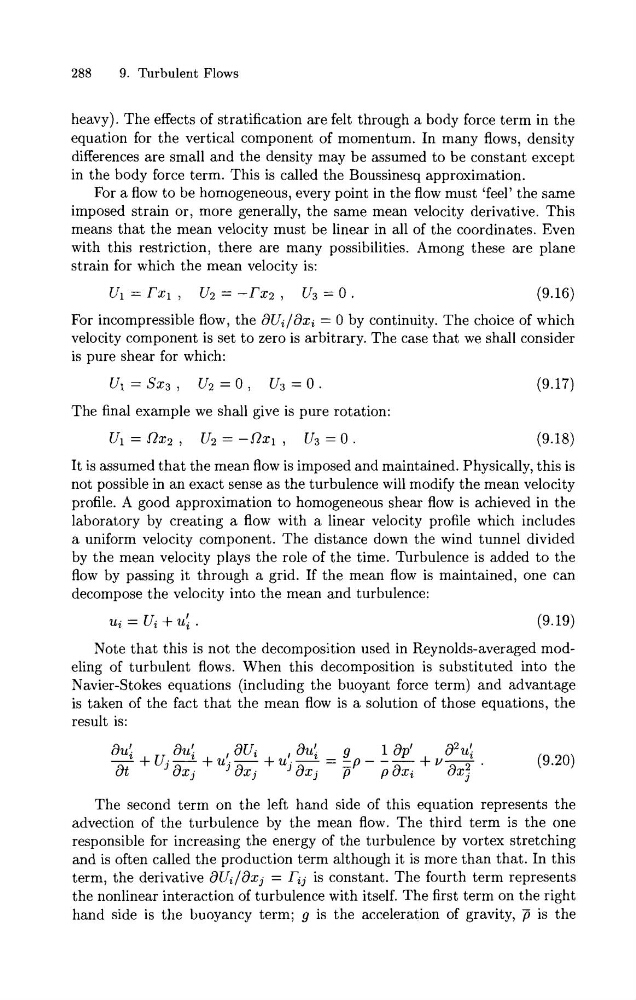
strain for which the mean velocity is:
For incompressible flow, the dUi/dxi = 0 by continuity. The choice of which
velocity component is set to zero is arbitrary. The case that we shall consider
is pure shear for which:
The final example we shall give is pure rotation:
It is assumed that the mean flow is imposed and maintained. Physically, this is
not possible in an exact sense as the turbulence will modify the mean velocity
profile. A good approximation to homogeneous shear flow is achieved in the
laboratory by creating a flow with a linear velocity profile which includes
a uniform velocity component. The distance down the wind tunnel divided
by the mean velocity plays the role of the time. Turbulence is added to the
flow by passing it through a grid. If the mean flow is maintained, one can
decompose the velocity into the mean and turbulence:
Note that this is not the decomposition used in Reynolds-averaged modeling of turbulent flows. When this decomposition is substituted into the
Navier-Stokes equations (including the buoyant force term) and advantage
is taken of the fact that the mean flow is a solution of those equations, the
result is:
The second term on the left hand side of this equation represents the
advection of the turbulence by the mean flow. The third term is the one
responsible for increasing the energy of the turbulence by vortex stretching
and is often called the production term although it is more than that. In this
term, the derivative d ~ J i / d x j = rij is constant. The fourth term represents
the nonlinear interaction of turbulence with itself. The first term on the right
hand side is the buoyancy term; g is the acceleration of gravity, jS is the
9. Turbulent Flows
heavy). The effects of stratification are felt through a body force term in the
equation for the vertical component of momentum. In many flows, density
differences are small and the density may be assumed to be constant except
in the body force term. This is called the Boussinesq approximation.
For a flow to be homogeneous, every point in the flow must 'feel' the same
imposed strain or, more generally, the same mean velocity derivative. This
means that the mean velocity must be linear in all of the coordinates. Even
with this restriction, there are many possibilities. Among these are plane
strain for which the mean velocity is:
For incompressible flow, the dUi/dxi = 0 by continuity. The choice of which
velocity component is set to zero is arbitrary. The case that we shall consider
is pure shear for which:
The final example we shall give is pure rotation:
It is assumed that the mean flow is imposed and maintained. Physically, this is
not possible in an exact sense as the turbulence will modify the mean velocity
profile. A good approximation to homogeneous shear flow is achieved in the
laboratory by creating a flow with a linear velocity profile which includes
a uniform velocity component. The distance down the wind tunnel divided
by the mean velocity plays the role of the time. Turbulence is added to the
flow by passing it through a grid. If the mean flow is maintained, one can
decompose the velocity into the mean and turbulence:
Note that this is not the decomposition used in Reynolds-averaged modeling of turbulent flows. When this decomposition is substituted into the
Navier-Stokes equations (including the buoyant force term) and advantage
is taken of the fact that the mean flow is a solution of those equations, the
result is:
The second term on the left hand side of this equation represents the
advection of the turbulence by the mean flow. The third term is the one
responsible for increasing the energy of the turbulence by vortex stretching
and is often called the production term although it is more than that. In this
term, the derivative d ~ J i / d x j = rij is constant. The fourth term represents
the nonlinear interaction of turbulence with itself. The first term on the right
hand side is the buoyancy term; g is the acceleration of gravity, jS is the